- FDA-cleared
- Rotating OLED display readable from any angle
- Lifetime warranty
- Readings in less than 4 seconds
- App with unlimited storage
- Some users report sync issues
- More expensive than a basic oximeter
During the COVID-19 pandemic, pulse oximeters had their moment in the spotlight. But the trend didn’t die out completely, and people still use them. Whether you are trying to keep an eye on your chronic respiratory condition or just looking for a device to have around just in case, Oxiline Pulse XS Pro positions itself as a step above the generic options flooding the market: FDA-cleared, Bluetooth-compatible, and can be used with an app for tracking purposes.
I tested it over several weeks to find out how reliable the readings are, whether the overall experience justifies the price, and whether it offers enough value to stand out from less expensive alternatives.
| Product name | Oxiline Pulse XS Pro |
| Price | $89 |
| Display type | 1.5-inch Crystal OLED |
| SpO₂ range | 35–100% |
| Pulse rate range | 25–250bpm |
| Battery type | Two AAA batteries |
| FDA clearance status | FDA-cleared |
| Connectivity | Bluetooth |
| Warranty | Lifetime warranty |
| Included accessories | Wrist lanyard |
What exactly is the Oxiline Pulse XS Pro?
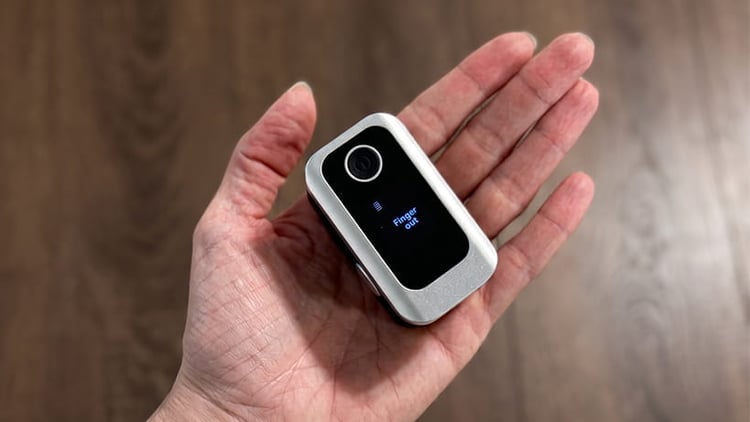
Pulse XS Pro is a fingertip pulse oximeter—a small clip-style device that sits on your fingertip and uses light passing through it to estimate blood oxygen saturation (SpO₂) and heart rate.
It also tracks perfusion index, a measure of pulse strength at the sensor site—with a stronger signal suggesting more accurate readings of SpO₂ levels.
The reason why Oxiline Pulse XS Pro is not just a basic oximeter is its ability to send your data to the complimentary app via Bluetooth. In other words, you will not just see your readings on the screen but will have them in the app for tracking purposes.
The app also generates charts and can export data as PDF or CSV to share with a healthcare provider. It also integrates with Apple Health and Android Health Connect for anyone who wants their health data in one place.
Design, comfort and first impressions
Out of the box, Pulse XS Pro feels compact and well-made. It's a standard fingertip clip form factor—you slide your finger in, press the button, and within a few seconds, you have a reading.
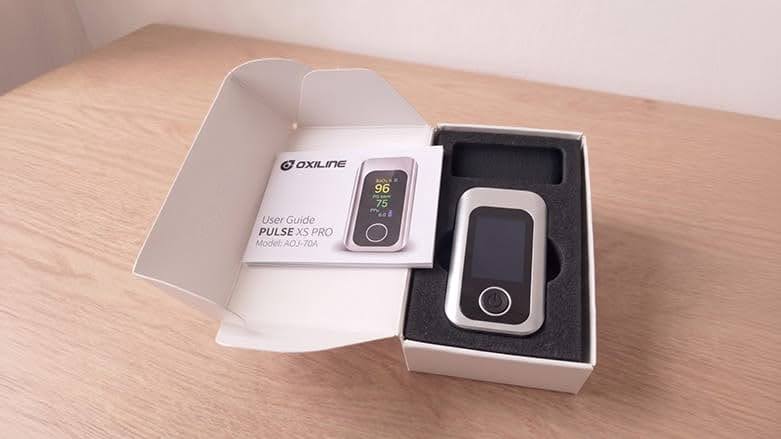
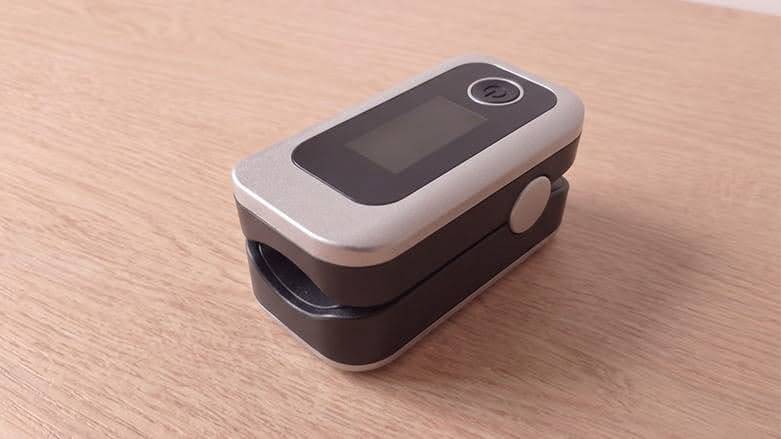
The standout feature on the hardware side is the display, which rotates 360 degrees. This sounds like a minor detail until you've used a cheaper oximeter and had to contort your wrist to read it—the rotating screen genuinely makes a difference in everyday use.
Moreover, the display is bright and high-contrast (1.5-inch Crystal OLED) and quite readable in low or bright light. You can also check your readings on the app—it offers a live view feature.
The device is compact, ideal for those who want to have an oximeter on hand while away from home. The box also includes a wrist lanyard for ease while carrying it around.
Getting started and everyday use
Setup is not complicated at all. All you need to do is download the app and pair the device via Bluetooth. Our team found the pairing process seamless. The readings appear in real time on both the device and app—and yes, you can absolutely use the device without even downloading the app.
The clip mechanism feels sturdy, and the device is light enough that holding your hand still during a reading doesn't feel uncomfortable. It uses two AAA batteries, and on continuous operation, it should last around 24 hours. As it is not intended for continuous tracking (during sleep, for example), those 24 hours translate to weeks of usage before you run out of battery.
The app is clean and intuitive. It organizes the history by date and time, presents trend charts, and lets you export the data if you want to share it with your healthcare provider. No subscription is needed—and these days, when almost every app offers premium features, it is a refreshing change.
One thing I didn't love about Pulse XS Pro may not bother everyone, but if you already own another Oxiline device, it's worth knowing upfront: not everything lives in the same app for every user. Pulse XS Pro pairs with the Oxiline Health app; no issues there. But for the Oxiline smart scale, I ran into a regional split: the official app is built for US users and isn't set up for the EU or EEA. Buyers there get pushed toward a third-party app called Fitdays instead.
For me, this meant Pulse XS Pro data sat in Oxiline Health while scale data sat in Fitdays—two apps, no single dashboard. US buyers without other Oxiline devices won't notice this at all, but if you're building out an Oxiline ecosystem, check which app each device actually uses before you buy.
How accurate is it really?
This is the section that needs the most honest treatment, and it is hardest to evaluate without going into the details on what you can expect from an at-home pulse oximeter.
Oxiline positions it as a clinical-grade device for home use, backed by FDA 510(k) clearance. This is a meaningful credential—though FDA clearance for a consumer oximeter means the device has met defined accuracy standards for home use, not that it performs at the same level as hospital-grade equipment.
This does not mean that it is 100% accurate: the officially stated SpO₂ accuracy is ±2% in the 70–100% range, which is in line with most FDA-cleared consumer oximeters. Again, it is broadly acceptable for home monitoring purposes.
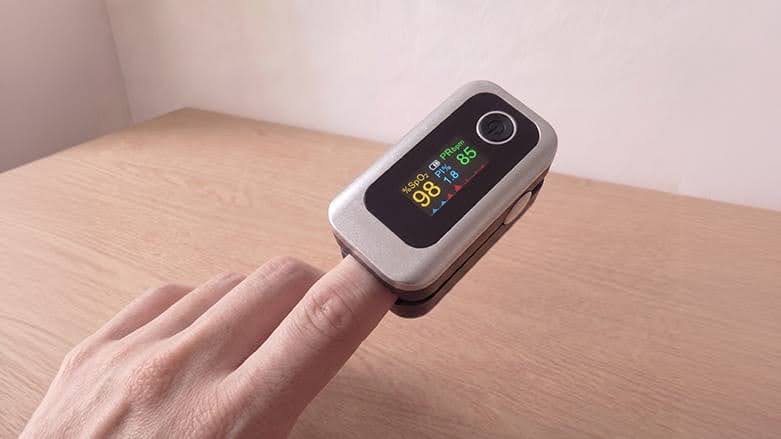
When I was testing Pulse XS Pro, I was looking to see if the readings were consistent. If the pulse oximeter gives seemingly random numbers that go up or down unexpectedly, this might indicate that it is not accurate, but I didn’t notice any abnormalities during my testing.
For the heart rate, Oxiline claims ±2bpm accuracy. During my testing, I compared the readings with what I saw on my Apple Watch. I selected Apple Watch as a benchmark because research has shown it to be highly accurate at tracking heart rate, especially at rest. Compared to Oxiline, the readings were quite similar, and I didn’t witness differences higher than 5bpm.
Now, one thing needs to be addressed: while at-home pulse oximeters may be accurate, even medical-grade devices sometimes cannot provide precise measurements. This is because they share the same underlying technology—oximeters measure how much light is absorbed by the blood to estimate blood oxygen saturation.
So, if you have nail polish on (especially black or blue), the reading might be off. The research also indicates that darker skin color may lead to overestimated results.
So, is Pulse XS Pro accurate enough? For tracking trends at home or identifying changes that may be worth looking into further, Pulse XS Pro is a helpful tool. If you need precise, clinically validated SpO₂ data for a medical condition, a conversation with your healthcare provider about the right equipment is a better starting point.
Price, warranty, and value
Pulse XS Pro retails at $119 but is frequently available at $89, with sales a regular occurrence on Oxiline's official website.
At that price, the combination of FDA clearance, a free full-featured app, Bluetooth connectivity, and a lifetime warranty is competitive. Most comparable FDA-cleared oximeters with app connectivity sit in a similar price range, and few offer a lifetime warranty at this price point.
The one area where the experience could be improved is the return window. At 30 days, it's functional but tighter than the 45–100-day windows offered by some competitors—worth factoring in if you want more time to evaluate the device before committing.
Other health monitoring device reviews:
Best screenless fitness trackers: Tested picks for distraction-free health tracking
Best smart scales: Tested picks for weight and body composition tracking
Best wrist pulse oximeters: For sleep, recovery, and health tracking
Best pulse oximeters overall: Tested and compared
Should you buy the Oxiline Pulse XS Pro?
Whether Pulse XS Pro is the right buy depends on what you're looking for from a pulse oximeter.
If you want a reliable, connected device for everyday home monitoring (tracking SpO₂ and heart rate trends, sharing data with a healthcare provider, and doing so without a subscription), it's a strong option. The app is well-designed, and the lifetime warranty removes one of the more common concerns around budget health devices.
If you're managing a serious respiratory or cardiac condition and need clinical-grade accuracy, a conversation with your doctor about the appropriate device is the more appropriate first step. Consumer pulse oximeters, including this one, are wellness tools rather than diagnostic instruments, and your doctor would be able to tell if Oxiline may be the right fit for you.
Another thing—some people use pulse oximeters during sleep or workouts. This is not that type of device. It is not clearly highlighted on the official website, but this device is not suitable for passive wear and is meant for quick spot checks only.
-
StatPearls.
-
Annals of the American Thoracic Society.
-
Nature.