- Adaptive algorithm modes
- Rechargeable battery that lasts up to 1 year
- Over 40 health biomarkers
- Segmental readings across 5 body zones
- Expensive
- Complex data makes it difficult to interpret metrics
- Withings App is buggy
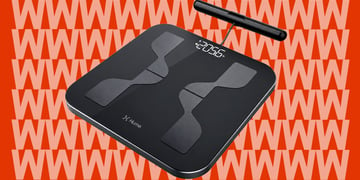
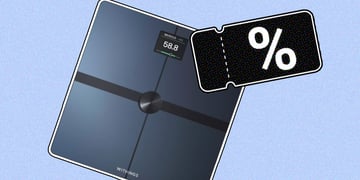
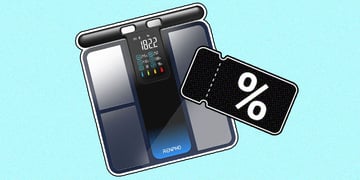
Wellness tech keeps evolving and you can buy smart scales almost everywhere these days. You’ve probably encountered options like Hume Body Pod, Oxiline MD Pro, or Renpho Smart Scale, maybe even considered other Withings models like the Body Comp.
But Withings Body Scan? In my experience, it’s in an entirely different tier. Eight embedded electrodes perform an in-depth bioelectrical impedance analysis (BIA, going beyond total body measurements—you get segmental breakdowns for arms, legs and torso.
In this Withings Body Scan review, I cover my month-long testing: what the scale measures, if it’s actually difficult to understand the data, and whether the price tag makes sense for your specific goals.
| Product | Withings Body Scan |
| Price | $499.95 |
| Companion app | Withings App |
| Connectivity | WiFi and Bluetooth |
| Compatible third-party platforms | Apple Health, Strava, Health Connect, WHOOP, Samsung Health, and more |
| Battery life | Up to 1 year (rechargeable) |
| Max users | 8 |
| Metrics tracked | 40+ (body fat %, bone mass, visceral fat, hydration, muscle mass, and more) |
| Verdict | Best for fitness enthusiasts who want segmental body composition |
My first impression: Simple design and setup
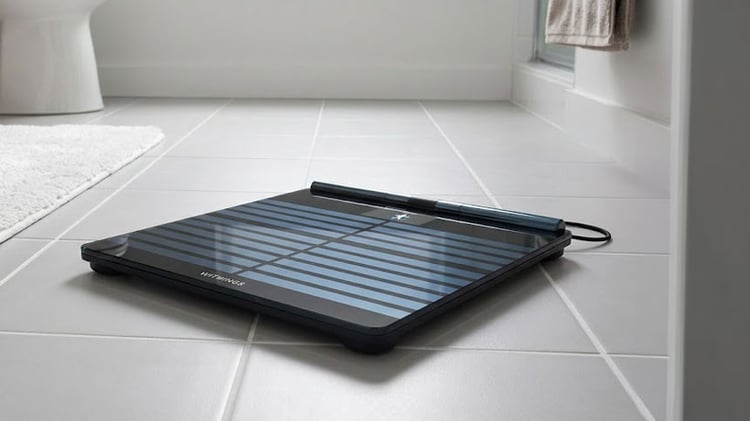
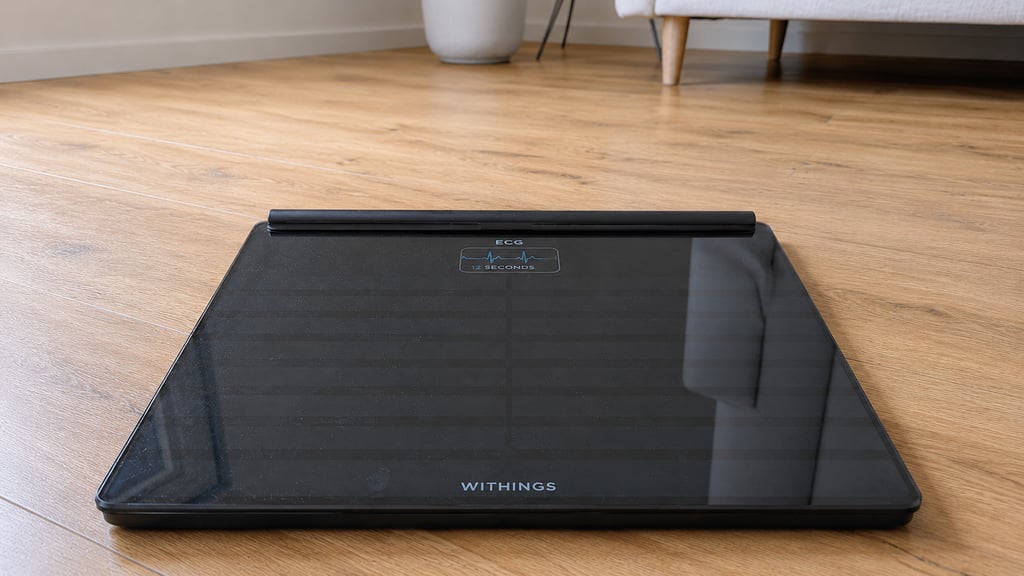
Withings Body Scan looks clean and minimal—nothing fancy, but modern and polished. It comes in black or white, features a high-strength tempered glass platform, and a high resolution LCD color screen. At 12.8 x 12.8 x 1.1 inches, it’s compact and easy to store away.
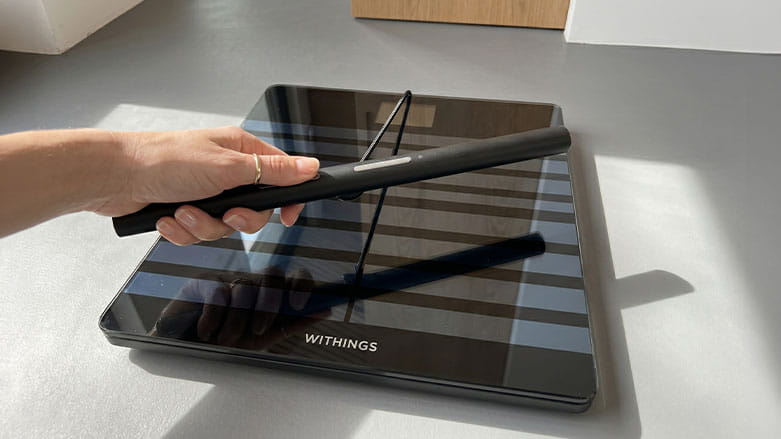
An interesting detail is the handle. You get four electrodes on the platform for your feet, and four more embedded in the handle you grip during the 90-second session. Holding it feels silly at first, but since you’re doing this at home—nobody judges.
One thing I didn’t expect, though, was that the scale needs slightly moist palms and feet to take measurements. I ran into this early on and struggled until I found the suggestion to wet my skin before each session.
Steps to the syncing process
Overall speaking, setup is straightforward. Here’s what you do:
- Download the Withings App (App Store or Google Play)
- Create or log into your account
- Tap ‘Add’ in the upper right corner and select ‘Scales’
- Choose your Body Scan, then enable WiFi or Bluetooth and location
- Press start installation and follow prompts to complete syncing
After the initial setup, data is supposed to sync automatically. However, I’ve had quite a few issues, as the app occasionally disconnects and needs troubleshooting.
On another note, if you want to link your Body Scan to Apple Health, Strava, or other platforms, just open the ‘Share’ tab in the Withings app. Partner integrations are already listed, so syncing is quick. By the way, you can choose which metrics you want to sync.
How accurate is the Body Scan?
To tell the truth, I actually enjoyed testing the Body Scan even though I’m not a fitness fanatic. Still, I’m keeping my opinion that this scale won’t truly justify the price unless you’re serious about long-term body composition tracking.
Also, I can’t truly comment on the device's accuracy, since I don’t have access to medical tools like DEXA. I compared received measurements with other smart scales we have tested at Wareable.
What worked for me
Diving into the positives, the Body Scan nails basic measurements. You get consistent readings and solid precision, making it reliable for daily tracking and spotting trends.
I liked the segmental body composition breakdowns the most. Instead of whole body measurements, the five-zone trends felt more comprehensive and meaningful. During my testing, I saw consistent data patterns, so I believe the Body Scan muscle and fat distribution trends may actually be useful for real-life habit changes.
The 6-lead ECG and advanced metrics, as well as smart features, add value beyond your typical scales. Though I couldn’t verify their accuracy without medical tools.
Where are its limits?
The Body Scan is consistent but absolute accuracy against medical-grade DEXA is debatable. BIA technology works by sending a small electrical current through your body to estimate body composition, relying on statistical models to assume normal patterns.
Where’s the problem in this? It’s less personalized—hydration status heavily skews fat percentage readings and if you’re outside average body proportions, there are some inconsistencies.
Of course, unless you’re a professional athlete, such precise numbers aren’t needed for reliable everyday fitness trends tracking.
Also, getting accurate measurements calls for proper contact with eight electrodes. You need moist skin, correct hand placement on the handle, and consistent stance. This is definitely frustrating, but gets solved once you understand it.
The last drawback I want to mention is complexity vs. usefulness. You get over 40 metrics, but most people don’t need them all. The data quickly becomes overwhelming and interpreting everything takes time and effort. I’d say with this scale, Withings overdelivers on information and underdelivers on clarity.
Living with the Body Scan
Data interpretation
Adding Withings Body Scan to your routine isn’t something complicated. Depending on your goals, schedule, and mood, you can weigh yourself as often as you want.
I don’t think daily checks are particularly useful on their own, but they do build trend data so you might spot patterns and minor changes over time.
That said, the real issue is the actionability. You get dozens of metrics, but the app doesn’t actually tell you what to do with them. You’ll need your own fitness knowledge to make sense of the numbers. Weight trends are straightforward for anyone, yet segmental body composition requires research or a conversation with a trainer to truly understand.
Smart features
The Body Scan includes athlete mode, pregnancy mode, baby mode, and eyes-closed motivation screens. Each slightly adjusts how the scale measures you, treating your body composition as something other than the assumed average. Here’s what each mode does:
- Athlete mode. It adjusts algorithms to account for high muscle mass, which prevents the scale from misinterpreting muscle tissue as fat. Though, this only works if you actually have above-average muscle mass—otherwise your readings become unreliable.
- Pregnancy mode. You input your due date and the scale provides pregnancy-specific tips while tracking changes in the context of your trimester.
- Baby mode. A convenient feature for new parents—it subtracts your weight to show only the baby's weight when you step on the scale while holding them. Keep in mind it works for babies around 7-33 lbs.
- Eye-closed mode. This is truly the standout feature, as it hides all numbers from the display and replaces them with motivational messages. If you struggle with weight-related anxiety, it removes the immediate stress of seeing the number, while the data still uploads to the app.
These modes aren’t absolute game-changers. I found them a nice touch that makes the scale feel designed for more than just the average person. But honestly, weight tracking and segmental body composition readings are what actually matter on the Body Scan.
Withings App experience
Withings App is available on iOS and Android, and overall it’s a well-built software. The free version shows your weight, body composition, and over 40 other biomarkers. The interface is clean and I found it intuitive to navigate through.
Also, you can subscribe to Withings+ for additional features like Health Improvement Score, Readiness Indicator, Cardio Check-up, plus recipes and exercise recommendations. Though, I’d say the subscription isn’t necessary. There’s not enough new content to justify the annual $99.50 cost.
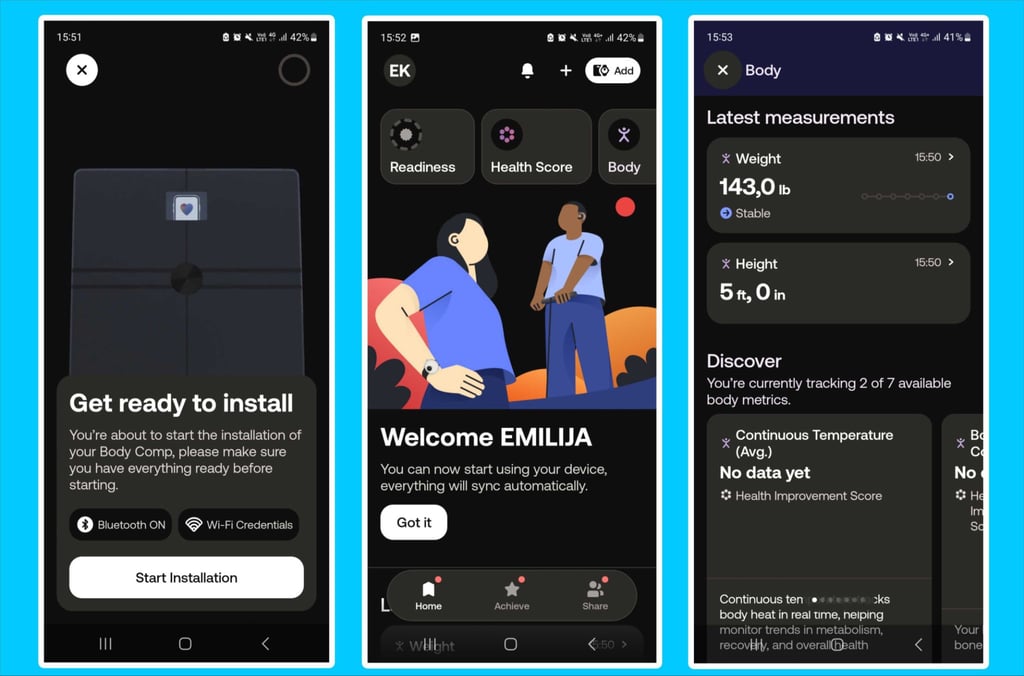
The real problem with an app is repeated intermittent sync failures. The app disconnects from the scale and requires troubleshooting. Sometimes it also crashes during setup, taking even more time out of your day.
Withings has been working on this for quite a while with updates, but as of now—the issue persists.
Is it worth the money?
Withings Body Scan is definitely a premium-priced product at $499.95, and whether it may justify the cost depends entirely on you. If you already understand body composition metrics (or are ready to actively learn) and actually commit to using the scale consistently—the cost makes sense. Otherwise, there are more budget-friendly alternatives you might want to explore.
Withings backs the purchase with free shipping, a 30-day money-back guarantee, and the usual 2-year warranty for manufacturing issues. It’s solid coverage, though nothing extraordinary for a device at this price point. I’d have appreciated more here, but these protections are standard throughout the market.
A smart scale unlike most others?
Here’s how the Body Scan compares with other popular body composition scales:
| Product | Withings Body Scan | Withings Body Comp | Garmin Index™ S2 Smart Scale | Renpho MorphoScan Smart Body Scale | Hume Body Pod |
| Price | $499.95 | $299.95 | From $199.99 | $179.99 | $199 |
| Subscription | $9.95/month or $99.50/year (optional) | $9.95/month or $99.50/year (optional) | $6.99/month or $69.99/year (optional) | None | $9.99/month (optional) |
| Biometrics tracked | 40+ | 10+ | 6+ | 50+ | 45+ |
| Battery life | Up to 1 year (rechargeable) | Up to 15 months (AAA batteries) | Up to 9 months (AAA batteries) | Up to 4.5 months (rechargeable) | Up to 1 year (rechargeable) |
| Best for | Fitness enthusiasts with prior body composition knowledge | Beginners who don’t want complex data | Garmin ecosystem users | Budget-conscious people wanting extensive metrics | Longevity focused people |
Other smart scale reviews
- Our picks of the best smart scales in 2026
- Read our review of Hume Body Pod
- Check out Withings Body Comp review
- Compare Hume Body Pod vs. Renpho MorphoScan Smart Body Scale
Verdict: Should you buy the Withings Body Scan?
After a month of testing, I have to say that Withings Body Scan impressed me. The design is clean and modern, the measurements are detailed, and the app interface is intuitive. It really feels like an overall great product.
That app reliability issue I mentioned bothered me, but it’s fixable. Withings has been pushing updates for months, and software problems aren’t deal-breakers. Just give it time to be fixed.
Still, my position remains the same—you should buy this only if you’re committed. That means two things: you actually use the scale consistently and you either understand body composition metrics or are willing to learn them. The Body Scan isn’t for beginners. It gives you data and you decide what to do with it.
If you’re serious about tracking muscle gain, fat loss, and targeted body changes, the segmental breakdown and ECG feature may just justify the $499.95 investment. Overall, whatever you choose, committing to the experience and understanding your body is the real win here.
Resources:
-
Diagnostics (Basel, Switzerland).