- Excellent heart rate accuracy
- Polished, deeply iPhone-integrated experience
- Entry price remains the same—even as rivals increase
- Battery life barely improves
- Audio Intelligence raises consent questions
- Wider bezels, smaller display area
Every September, the latest Apple Watch Series—the world's default smartwatch—arrives with a familiar handful of refinements. A few weeks later, we tend to give the same advice to anyone who bought one of the last few generations: stay put and don't upgrade yet.
The Series 12 comes with a louder pitch. Apple has built its launch around a rebuilt heart sensor it says delivers "the most accurate heart rate sensing in a wearable," a new daily Readiness score, and on-device Audio Intelligence features that listen to the world around you. On paper, it's the most ambitious story Apple has given the standard Series in years.
Big ambitions come with great responsibility, though. And with Apple's key rivals making strides in 2026—plus the wearable tech industry continuing to tilt toward screenless trackers and AI-powered pins and rings—the pressure is mounting on the Series line to deliver something that keeps the Cupertino brand ahead of the pack.
So, is the Series 12 the leap Apple's marketing suggests? Below is our extensive review.
Price and competition
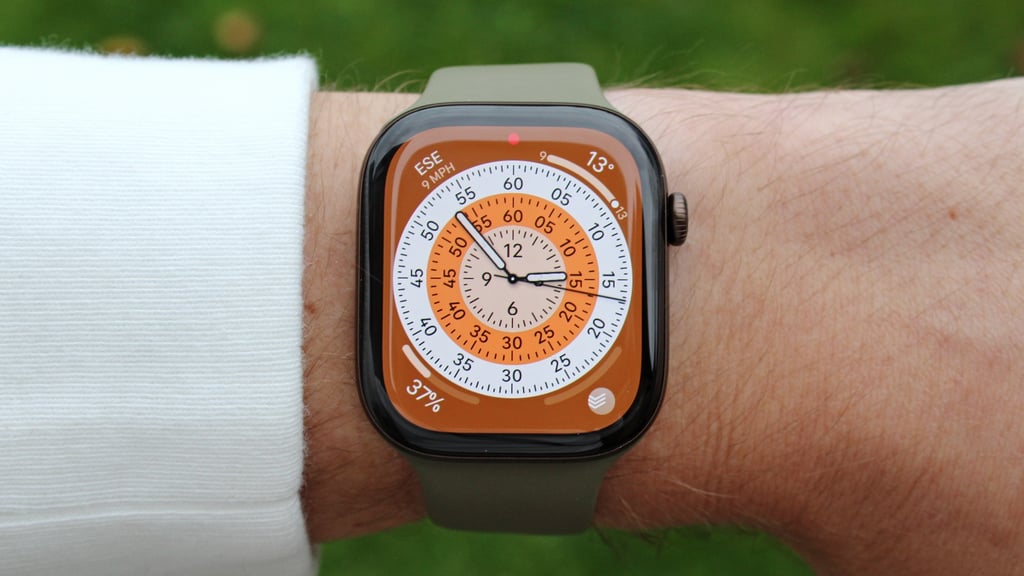
The Apple Watch Series 12 went on sale in September at the same starting price as its predecessor: $399/£369 for the 42mm aluminum GPS model. Even as rivals have adjusted prices over the last few years—and Apple itself tinkers with the entry points of the rest of its wide product lineup—the Series remains the same. That can only be a positive.
The catch is the larger case. The 46mm aluminum model now starts at $449/£419, widening the gap between sizes to $50/£50 from $30/£30 last year. Cellular adds $100/£100 on the aluminum models. Titanium, cellular-only, starts at $699/£649, while ceramic, also cellular-only and back in the lineup, starts at $899/£849.
Within Apple's range, the decision is pretty standard. The Apple Watch SE 3 ($249/£219) remains the budget pick, while the $799/£749 Apple Watch Ultra 4 offers dual-frequency GPS, satellite connectivity, and a battery that lasts over two days.
The more interesting pressure comes from outside—even if, as always, people rarely base their phone-buying decisions on supported smartwatches.
No longer out on its own
The Google Pixel Watch 5, which launched in August at $399/£369 for the 41mm (its first-ever base-price increase), has closed most of the gaps that used to separate Android's best smartwatch from Apple's. Its 45mm model offers up to 40 hours with the always-on display and up to 72 hours in Battery Saver. The domed Actua 360 display reaches 3,000 nits, Gemini is woven deeply into the experience, and Google keeps shipping safety features its rivals don't have. The latest is a breathing-emergency alert that watches for severe, persistent drops in blood oxygen.
Google has also done something with GPS that nobody else is really matching, even if it only happens after the workout. The Pixel Watch 5 reprocesses your route using 3D environmental models and AI-driven corrections, which Google says doubles route accuracy in tough environments like cities and forests. (Google also claims, based on its own testing, that this beats the Apple Watch Ultra 3 and Garmin Fenix 8 Pro.)
The Pixel Watch is Android-only, so it isn't a cross-shopping option for iPhone owners. Still, it clarifies the Series 12's position. This is the best smartwatch for most iPhone users, largely because the Apple Watch has always been really good, thanks to its iPhone integration, polish, and ecosystem, not because it has pulled further ahead.
For the first time in a while, the closest rival feels like it's playing the same game.
Design and display
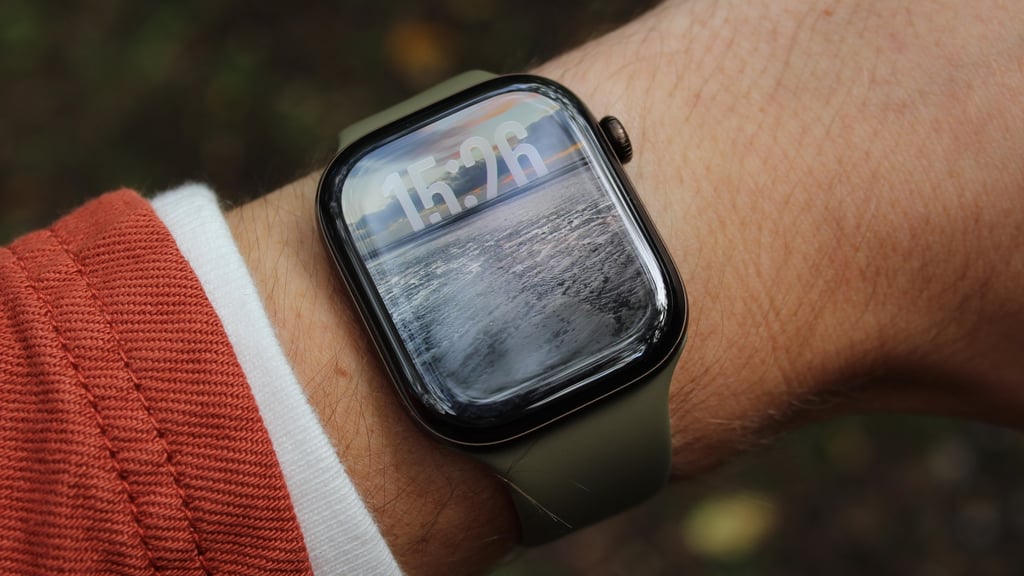
On the surface, very little has changed. The 42mm and 46mm sizes carry over, and, from a distance, the Series 12 looks identical to the Apple Watch Series 11.
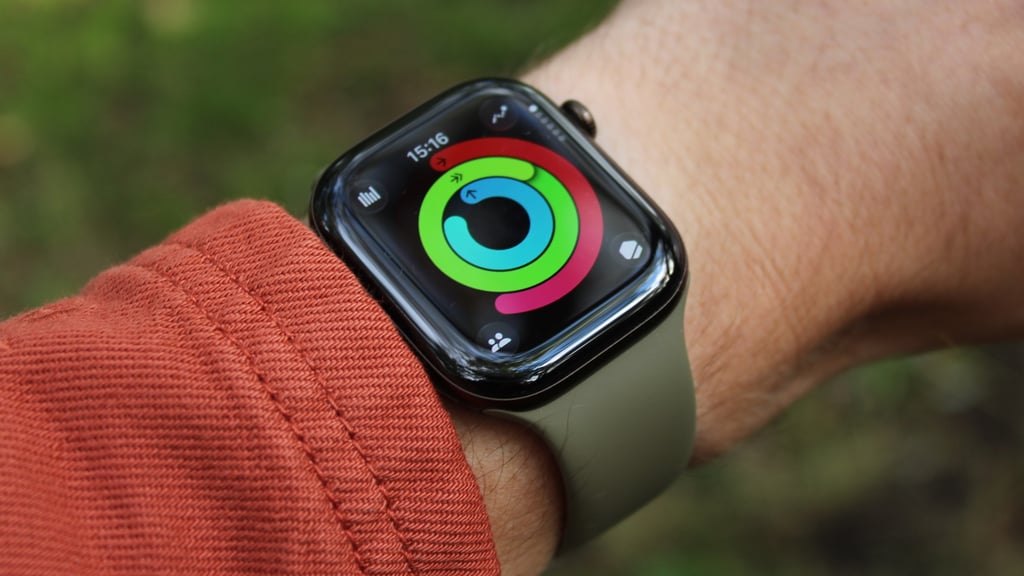
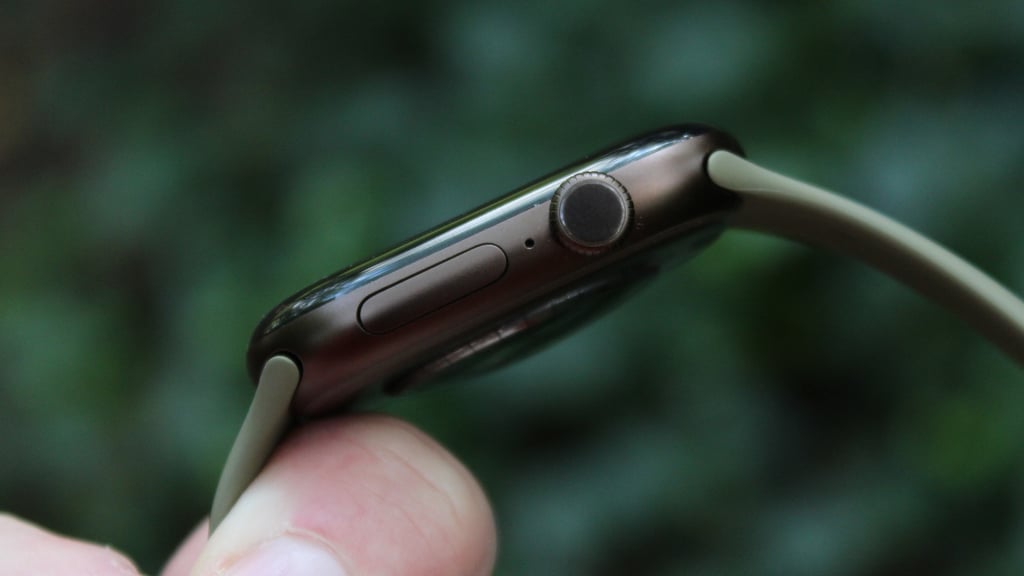
Up close, though, Apple has taken a step backward on the display. The resolution is unchanged, but the case is a millimeter wider (Apple lists the 46mm at 46 x 40 x 9.7mm, against the Series 11's 46 x 39 x 9.7mm) and the borders around the screen are noticeably thicker, which means more of the front of the watch is dead space. By Apple's figures, the 46mm display area dips about 2%, from 1,220 to 1,196 sq mm, and the 42mm goes from 989 to 970 sq mm.
After the Series 7-9 era brought more edge-to-edge screens, Apple whittled them back in Series 10-11. Now, with the Series 12, it's receded further. How much it matters depends on how locked in you are to the Series design's finer points. However you slice it, it's a worse viewing experience.
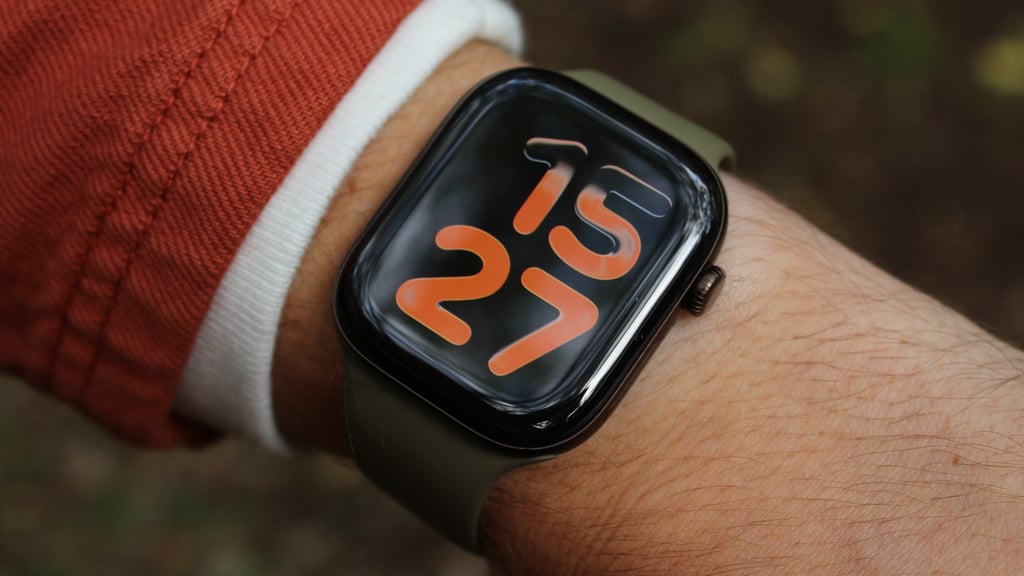
Dark watch faces hide it well, and light or colorful ones don't (as you'll see throughout this review). I suspect it's all a prelude to Apple adding more screen in next year's iteration before an expected remodel for the Series 14—so, in that sense, I find it hard to get too worked up about. At the same time, I noticed it instantly when jumping from Ultra 2 to Ultra 3, so I get why it's a deal-breaker for some.
New finishes—and a new display material
The rest of the hardware story is gentler.
Aluminum models now get Ceramic Shield 2, which Apple says is 60% tougher than last year's Ion-X glass. For what it's worth, I haven't suffered any nicks, scratches, or cracks on the Series 12 during the last month of wear—but I didn't on the previous generation, either, or any before that.
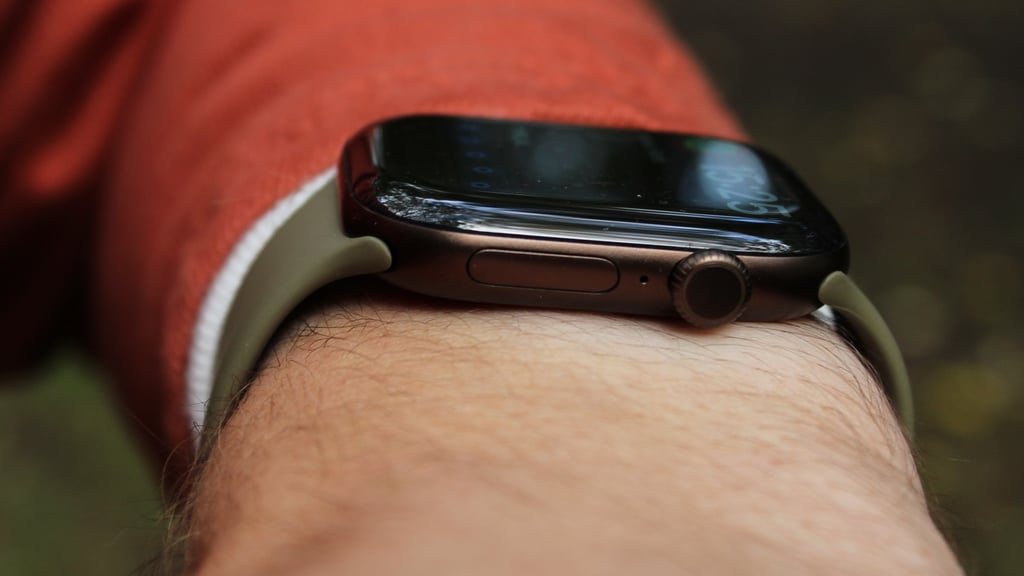
Meanwhile, the titanium and ceramic models keep sapphire glass. There are also boatloads of new bands, including new Nike options and more Hermès choices, plus fresh aluminum finishes in Dark Bronze and Light Gold alongside Black and Space Gray.
I thought the Dark Bronze looked pretty weak when it was announced on screen. However, it's really grown on me during wear for this review, and it suits autumn and winter well... if that's your sort of thing. I would have liked to get hands-on with the ceramic version, too, since it's a joy to see ceramic return to the range, but this is the one I'd steer most people to if they want something with personality.
Software, watchOS 27, and everyday health
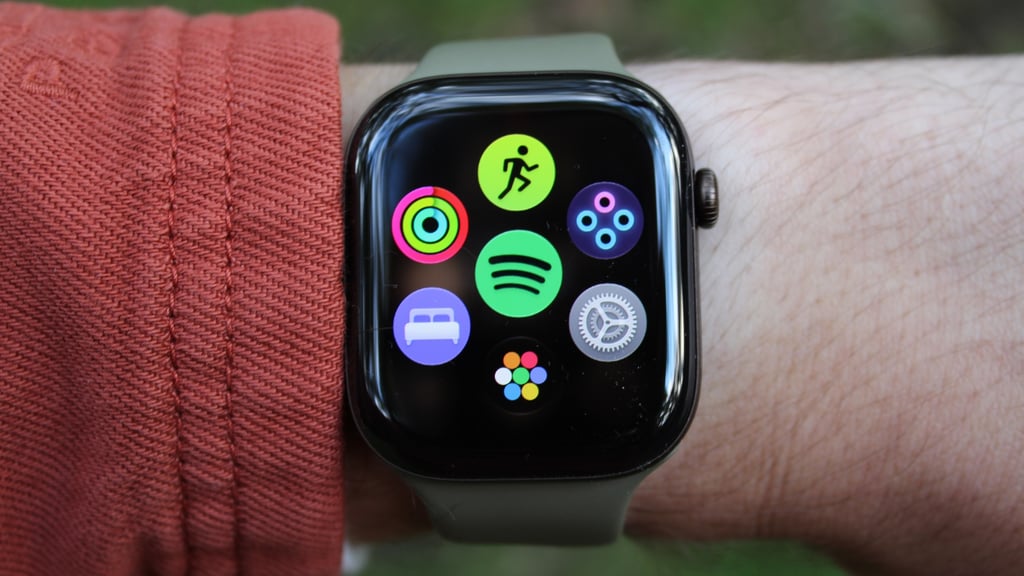
Little of what makes the Apple Watch the Apple Watch has changed, and that's still its biggest strength.
As I said in our Series 11, SE 3, and Ultra 3 reviews last year, rivals still struggle to match the deep, frictionless integration with the iPhone, from notifications and music streaming to apps like Strava and Runna that work flawlessly.
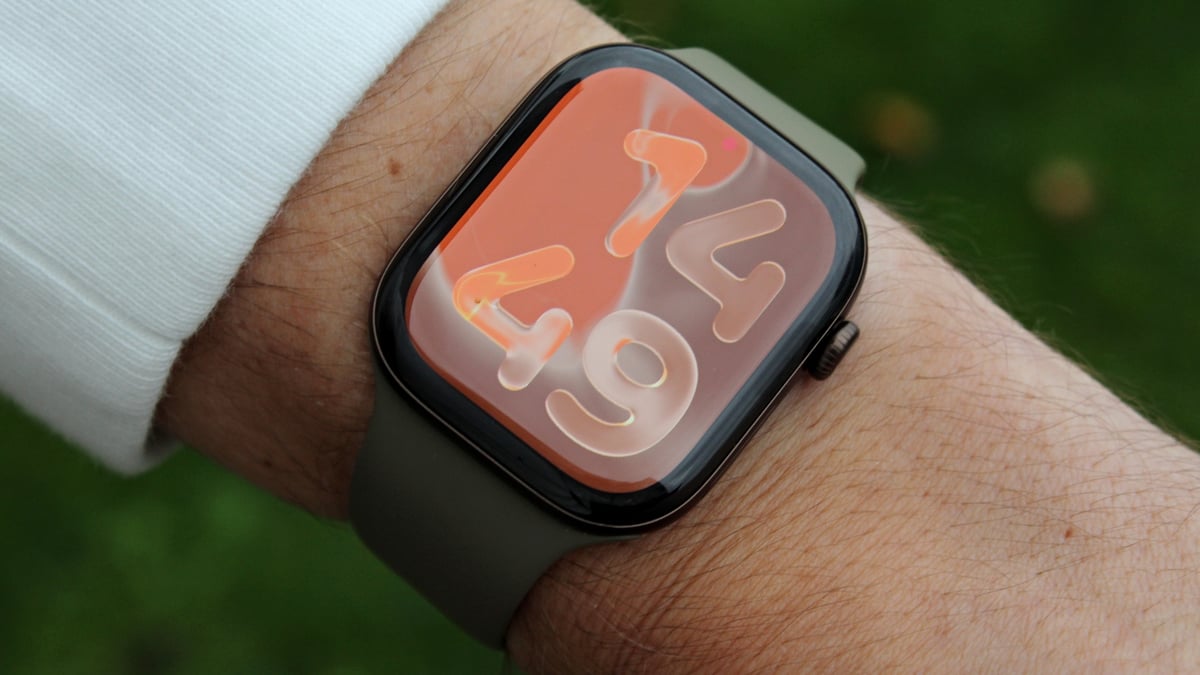
The most obvious visual change is the new dynamic app grid, shown above. It's a neat change that, once you get used to it, you wonder how you ever did without it. You won't miss the old double-press of the crown to bring up your recent apps, and the whole experience just feels a little more alive.
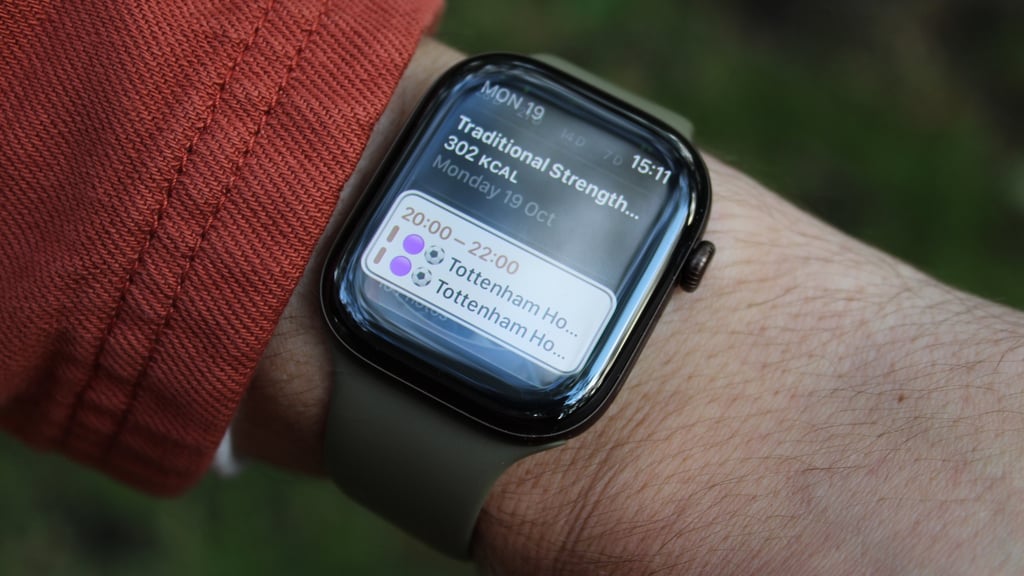
That's also true of the ever-improving Smart Stack, which is now a bit easier to tap through to cards via a single tap (while Double Tap still allows you to sift through the list).
A formidable suite
Underneath sits the same formidable health suite: ECG, hypertension notifications, sleep apnea alerts, Sleep Score, Fall and Crash Detection, and cycle tracking, much of which also runs on older models.
The watchOS 27 update is free for Series 9 and later, which means much of the software story isn't a reason to buy new hardware. It also brings Siri AI to the wrist in English, Workout Buddy that works without your iPhone nearby (as it should have done at launch), a Steps complication, and updated step-counting and distance algorithms.
The bigger Health app redesign on iPhone arrives later this year in beta. It adds AI summaries and recommendations, Apple Intelligence guidance (including suggested intervals), support for pulling in lab work, a Longevity tab, and a Health Age score based on sleep, VO2 max, HRV, heart rate, exercise minutes, steps, and, optionally, labs.
There's also a new six-minute VO2 max test you can do in your living room, plus tests for flexibility, movement mechanics and strength that can be trended over time. None of it was live for testing, so we'll revisit it.
Health Sensing System
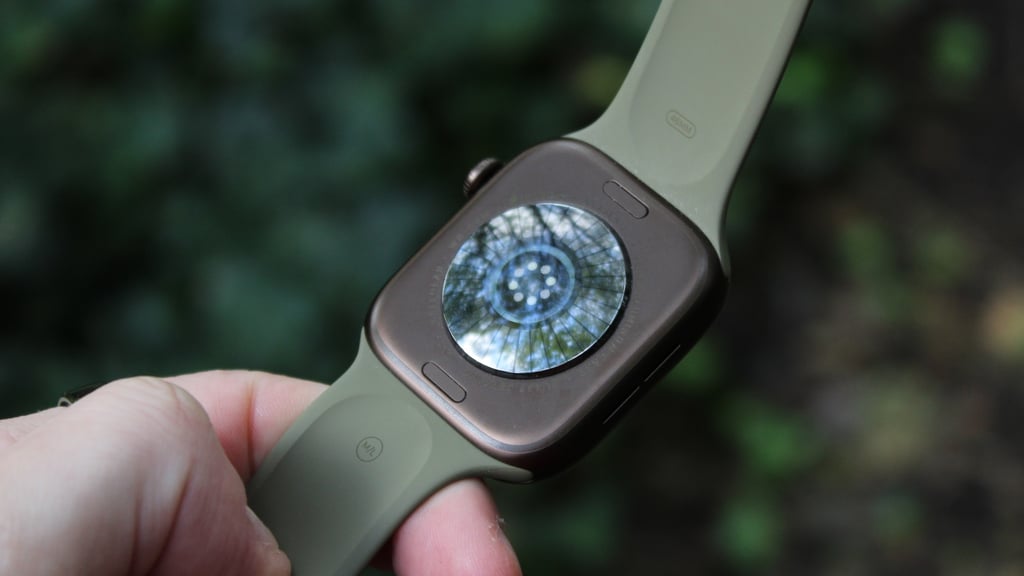
The real change is under the watch. Apple's new Health Sensing System pairs a redesigned electrical heart sensor with a larger electrode surface (for better ECGs) with a new optical setup: new photodiodes for better workout capture, a new LED array for 24/7 readings, and a thinner overall bump than before.
It's driven by the new S11 chip, which borrows features from the iPhone 18 Pro's A20 Pro and includes a secure, isolated audio-processing exclave for Audio Intelligence (more on that below).
The headline number is how often it samples. The Series 12 now captures background heart rate every five seconds, 60 times more often than the Series 11, and HRV every five minutes, 24 times more often.
Apple pairs this with a bold claim that the Series 12 and Ultra 4 deliver "the most accurate heart rate sensing in a wearable," backed by its own white paper.
It's a large, carefully designed study: 1,460 participants across five sites, six rivals including the Garmin Forerunner 970, Pixel Watch 4, Whoop 5.0, and Oura Ring 5, and a Polar H10 chest strap as the reference. Apple reports statistically better accuracy in 139 of 159 comparisons.
The fine print on "most accurate"
The study measures the heart rate a user actually sees, and the results are impressive by that measure.
However, it omits how often the watch shows nothing at all. Apple's paper mentions neither dropout nor missing-data rates. While the reference Polar H10 chest strap was held to strict coverage thresholds, the tested wearables only needed to output a clean stream free of extreme anomalies, with each generated reading matched to the nearest reference timestamp. In practice, if the watch skips a reading entirely, it never penalizes that missing data point.
That's crucial because of how the Series 12 and Ultra 4 track workouts. Instead of logging a value every second like every other wearable, it dynamically surfaces one every few seconds—sometimes longer—in the Workout app and skips any reading it isn't confident in. That's a defensible design choice, in some respects. It's arguably better to show nothing than to show something wrong.
It's the same philosophy we see with its GPS—detailed in our Ultra 3 review—which prefers leaving a gap to guessing.
Yet, by comparing competitors—who often force-plot data every second or so—against a filtered Apple dataset that discards its unconfident moments, the study inherently tilts the playing field in Apple's favor. By Apple’s study protocol, no data effectively equals flawless data. And it goes without saying, possibly, that claiming victory in an accuracy study where your device can drop its hardest assignments while forcing competitors to show their work is pretty disingenuous.
Either way, these dropouts are visible in our testing below. The heart rate tracking performance is still, as it always has been when we've tested Apple Watch heart rate over the last decade, outstanding—but its self-crown comes with major caveats.
What our testing showed
I've put the Series 12 through plenty of tests over the last month or so, but I've picked three very different sessions to capture the broader picture of these latest claims, each against the same reference device.
For all our core reviews, I test against the Garmin HRM 600 chest strap (on this occasion, paired to a Fenix 9 Pro), rather than the Polar H10 Apple used. A Whoop MG on my bicep acted as a second opinion.
Test 1: Sustained effort
- Full session viewable here
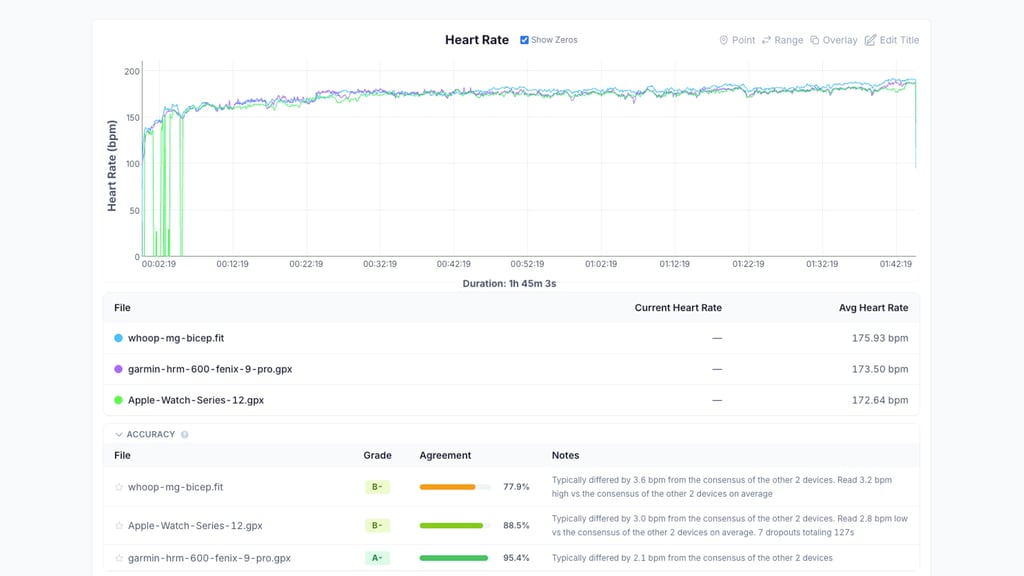
A sustained effort over 1 hour 45 minutes at the Manchester Half Marathon is our 'easy', steady heart rate test. The goal is to see how the sensor handles minimal changes in intensity—and, in this case, there wasn't much environmental change or elevation to deal with.
As expected, the Series 12 passed comfortably. The HRM 600 averaged 173.5 bpm, and the Series 12 averaged 172.6 bpm, within a beat of each other. The Whoop MG averaged 175.9 bpm, a couple of beats higher, likely because its second-half performance was elevated.
Interestingly, the data analysis tool reports that Series 12 had seven dropouts totaling 127 seconds (roughly 2% of the run). As shown, all of that seems to have occurred during the first 5-6 minutes of the race, when it seems to find its feet.
Test 2: Changeable effort
- Full session viewable here
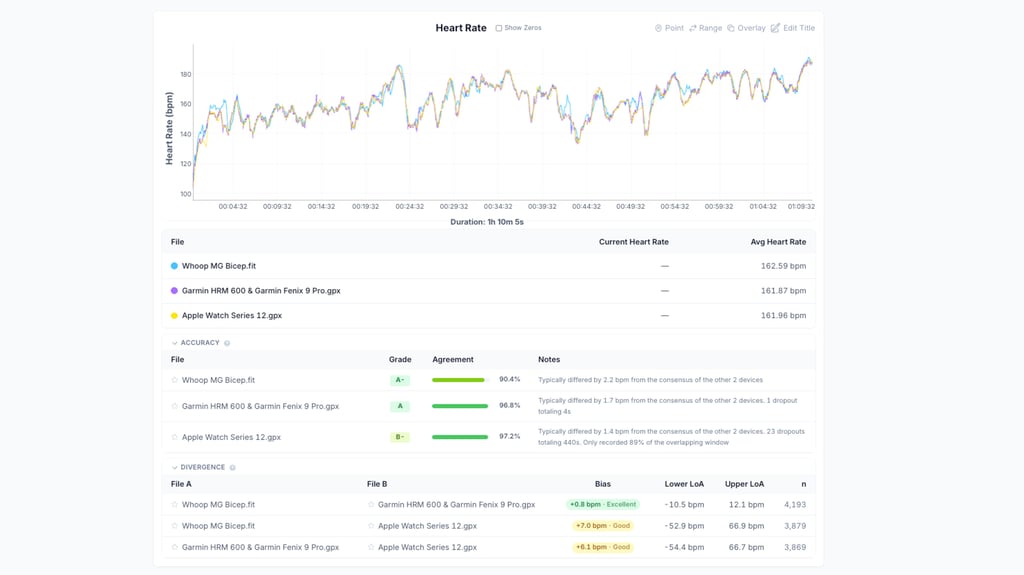
A steady effort doesn't really stress latency, so the next test was an incline-heavy run in Mallorca with constant intensity changes.
Over 1 hour 10 minutes, session averages were—again—almost identical: 161.96 bpm for the Series 12, 161.87 bpm for the HRM 600, and 162.59 bpm for the Whoop MG. That's less than a 0.1 bpm difference from the strap.
That puts the Series 12 agreement at 97.2%, a touch ahead of the HRM 600 (96.8%) and the Whoop (90.4%). However, as the graph shows, it also logged 23 dropouts totaling 440 seconds, recording only 89% of the window. These dropouts were also more evenly distributed throughout the workout than what I saw in the effort above.
Again, that gap between accuracy and completeness is the key point. Dropouts don't drag the session averages down, and the watch leaves a gap instead of inserting a questionable number. What it does record lines up with the strap, as long as the gaps aren't concentrated in one part of the effort. The cost is completeness, not accuracy.
Test 3: Strength training session
- Full session viewable here
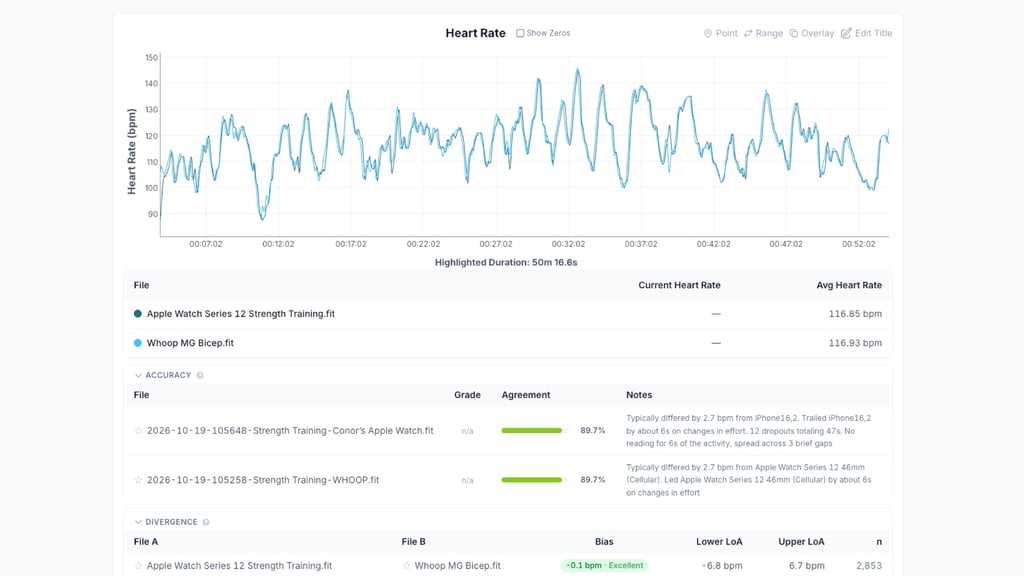
Strength training is hard on optical sensors because of wrist flexion and a tight grip, so I also compared the Series 12 with the Whoop MG during a typical gym session.
Over a 50-minute stretch, the averages were 116.85 bpm for the Series 12 and 116.93 bpm for the Whoop, a difference of less than 0.1 bpm. The Series 12 logged 12 dropouts totaling 47 seconds. The one consistent difference was timing: on average, it trailed the Whoop by about six seconds during effort changes, and this held across sets.
The takeaway is that this is an outstanding optical sensor, as Apple's have been for many years.
For intervals, I still trust it, and it's right up there with Garmin's best chest strap for grading session averages.
I wouldn't choose it over a chest strap because latency and potential dropouts can skew the picture—especially in a race or session where you want to account for every second.
However, as I've also noted since the Apple AirPods Pro 3 launched last year, pairing an Apple Watch with those heart-rate-sensing headphones is a genuinely formidable alternative to a chest strap and a sports watch. That's even more true with the Health Sensing System.
Readiness and Vitals
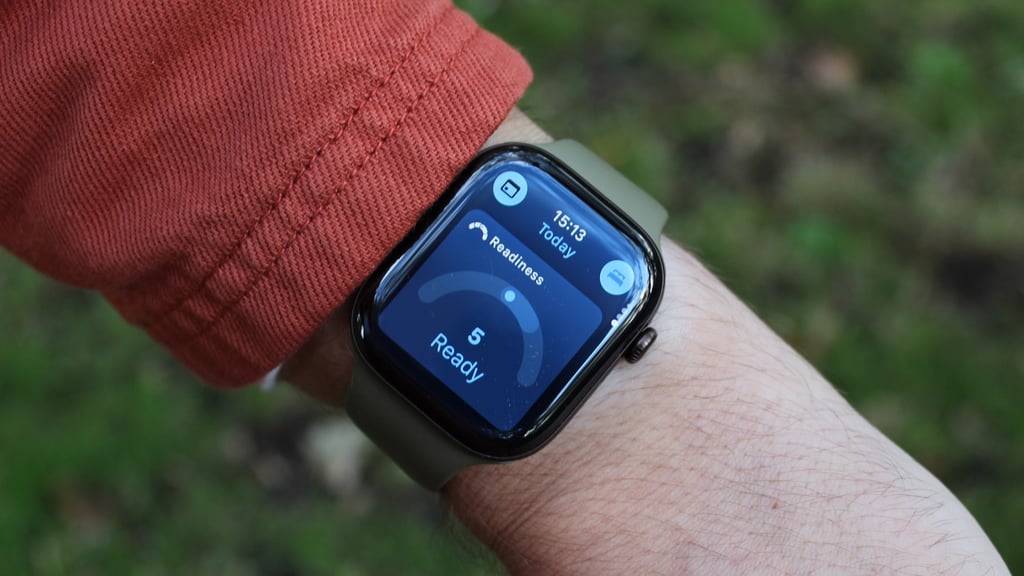
Readiness is Apple's answer to a category that Whoop, Oura, and Garmin have spent the last half-decade building: a single number that tells you how ready you are to train.
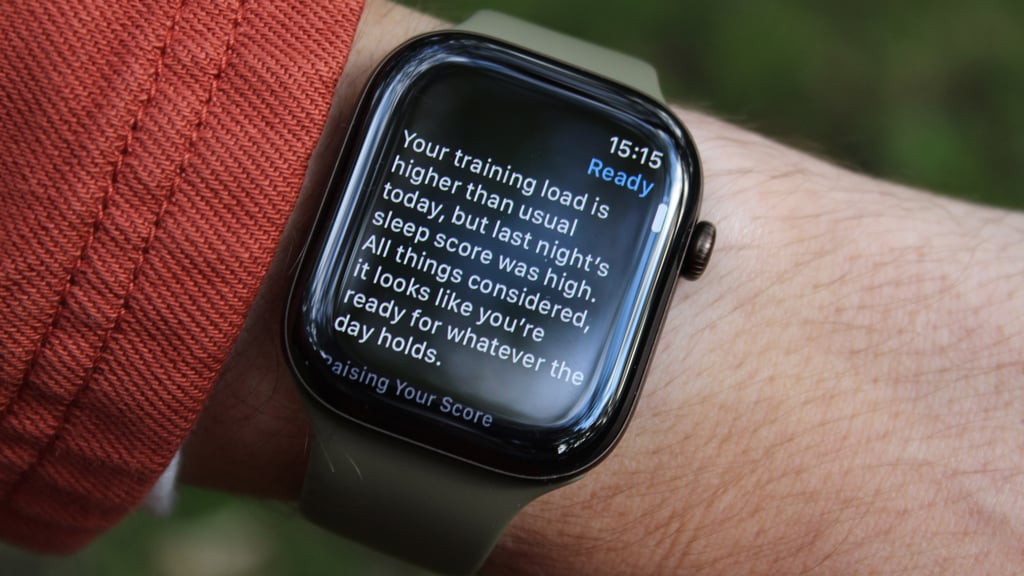
Apple's version is a score from 0 to 10 paired with one of four labels (Recover, Pace Yourself, Ready, or Go For It), viewable on the watch and in the Fitness app. It draws on your sleep, overnight and daytime vitals, training load, and recent activity, and needs seven nights of data on a given watch before it will show anything.
Like Garmin's version, and unlike the once-a-morning scores from Whoop and Oura, Apple's is dynamic, updating throughout the day as you train. You can also see what's dragging it down, whether that's sleep, vitals, or fitness, and it highlights outliers against your own baseline.
Like Apple's Sleep Score last year, the observations mostly align with my own perception. Like Sleep Score, it also errs more on the positive side than Whoop, Oura, and Garmin. Compared to those rivals, Readiness has less depth in the wider picture—those other wearables will dynamically adjust workouts, surface AI suggestions and detailed breakdowns, and notify you (on-device or via the companion app) when your morning analysis is ready.
By contrast, Apple mostly leaves you to check in on Readiness at your leisure. It comes down to personal preference—I don't feel it has the depth to keep me engaged or checking in as part of my routine, but some people prefer a lighter touch from their wearables... especially, it seems, when it comes to daily readiness.
What I would say about Readiness is that the presentation is neat; having a glanceable way to see what's raising and reducing your readiness at least leaves you with an action point to move forward with.
Diving deep into daytime HRV—but with little effect
The updated Vitals app now shows overnight HRV and a new daytime view. Apple has also moved overnight HRV readings to RMSSD (rather than SDNN), finally making the number comparable to other brands.
The daytime view is messier: Apple compares each hour with your own history for that same hour and excludes any time you're moving or working out. If you're very active, it can take longer than seven days to build a baseline, with gaps across the chart.
That's the least of the problems, though—and when you dive into the Apple Health app to scan these readings, you quickly remember why most brands don't show these raw figures.
Because daytime HRV figures are often noisy (due to wrist movement throughout the day), brands have typically bundled them into a stress score. I've written ad nauseam about how weak stress tracking has been within wearables over the last decade, but two brands—Whoop and Oura—have done the best job of contextualizing this data and helping you understand the trends.
Apple gives you a lot to look at here, but I'm not sure any of it really tells you anything unless you know what to look for—and even then, I'm not convinced. The side point, of course, is that these new insights are also exclusive to Series 12 and Ultra 4. Even though Series 11, Series 10, Series 9, Ultra 3, and Ultra 2 all run watchOS 27, none get it.
To fill in the gaps in stress insights on the Apple Watch, I've been using the third-party app StressWatch for the past year or so. It offers more context than the Vitals app and Apple Health, and you can even choose a cat theme to view the stats. Catch up, Apple, I say.
Audio Intelligence
Audio Intelligence is the part of the Series 12 I'm least comfortable with, and it's hard to evaluate properly because most of it isn't live yet.
Two features are available now. Sound Recognition shows text alerts for sirens, doorbells, crying babies, and more, and Instant Shazam names songs when you raise your wrist. Both are fine, but neither justifies an upgrade.
The headline features arrive later this year as a beta, starting in English. Live Rewind lets you double-tap the Digital Crown for a text-only transcript of the last 15 seconds of speech, while Siri Recap listens in the background and sends a summary, including a title and key points, to your iPhone. Both need an Apple Intelligence-enabled iPhone 16 or later.
Regional availability is patchy. Apple says Audio Intelligence won't be available in the EU initially, which aligns with the delayed arrival of Siri AI, and reports indicate Live Rewind and Siri Recap won't launch in mainland China either.
Opening up a can of worms?
Apple's privacy case is carefully made. It says audio is processed on-device in the isolated 'Secure Exclave' on the S11 and deleted immediately. No recordings are created or stored, speakers aren't identified, and synced summaries are end-to-end encrypted. Everything is opt-in; each feature can be toggled independently; Siri Recap can be scheduled; and Live Rewind sounds a chime and shows an on-screen cue. The S11 requirement also explains why none of this rolls back to older watches.
My issue isn't the engineering, which deserves respect; it's the grey areas of consent. Even if you've opted in, the person sitting next to you in a cafe or across the table in a meeting hasn't. Rules on recording and transcribing conversations vary by country (and, in the US, by state), and there's little precedent for a wearable that can turn nearby speech into text.
We've been here before in the home, when Alexa and Google Home created legal grey areas that are still being tested. This takes that outside the home. And while this case isn't necessarily the same as Meta's smart glasses, I fear it could provoke the same kind of backlash over the next year or so.
The visual and audible signals feel thin in practice, since few people nearby will notice a small wrist animation.
The whole thing just feels slightly un-Apple. Ultimately, this brand usually waits until the market is crying out for a feature, then does it better—but I don't think anyone is clamoring for this, and I don't think it's more considered than what other companies are doing.
Why isn't it on the iPhone or AirPods—is this a dry run to gauge reaction? The late rollout—after the industry's reviews have come and gone—also lets Apple avoid immediate backlash when the watch goes on sale.
One potential side effect of all this? I suspect older Apple Watches, which won't get the headline Audio Intelligence feature, may come back into vogue with people who'd rather not have it.
GPS tracking accuracy
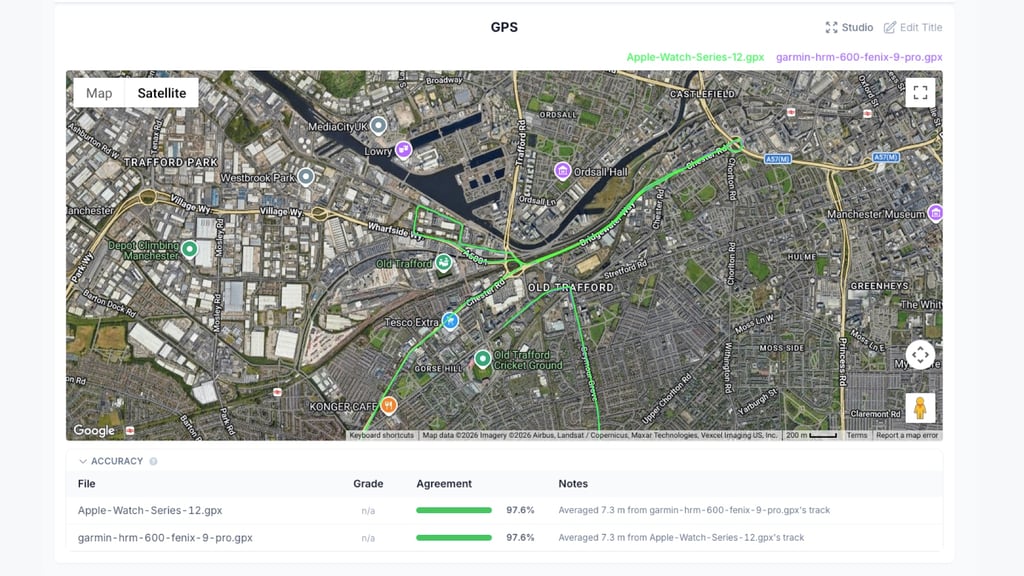
The Series 12 sticks with single-frequency GPS, which Apple now brands "Precision L1," while dual-frequency remains exclusive to the Ultra line.
As with the Series 11, that's likely partly about protecting the Ultra—and, in our testing, it rarely matters. On that half marathon through Manchester, the Series 12's track averaged 7.3m from the Fenix 9 Pro (set to Garmin's best-accuracy Multi-Band mode), with the data analysis scoring agreement at 97.6%.
On the Mallorca run through built-up streets and tree cover, it averaged 3.5m from the Garmin's track, with 99.0% agreement.
The philosophy is the same one we flagged with the Ultra 3 in Paris last October: Apple's watches would rather leave a gap than guess. The catch, as in Paris, is distance: where a watch doesn't guess, it can underreport. I didn't experience any of that with the Series 12, but, as ever, testing will continue over the next 12 months.
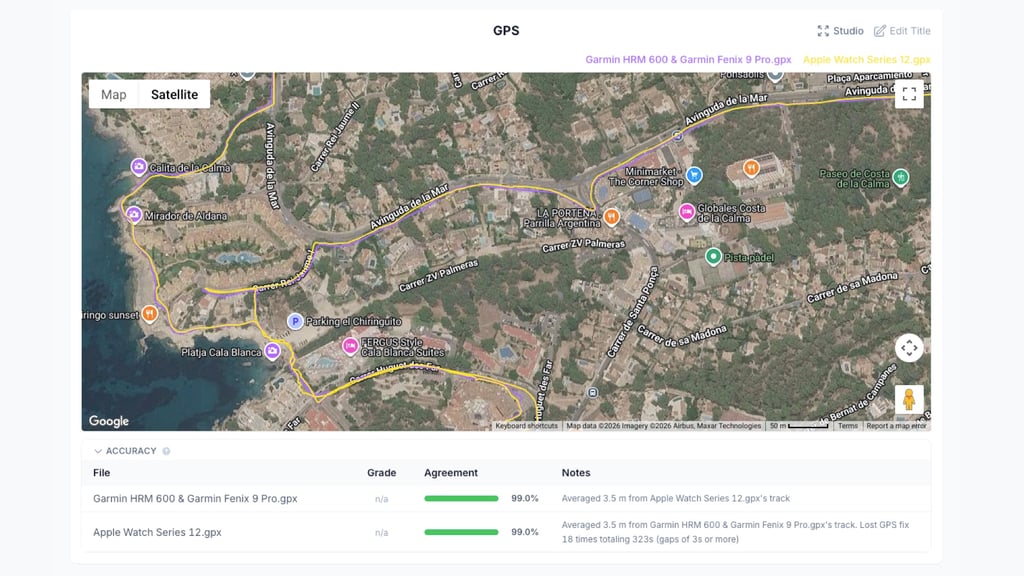
Apple says watchOS 27 improves distance accuracy with updated algorithms, which should also apply to older watches. Google's post-workout GPS processing remains the more intriguing idea in the category, but for pure track fidelity, the Series 12 is excellent.
Battery life and charging
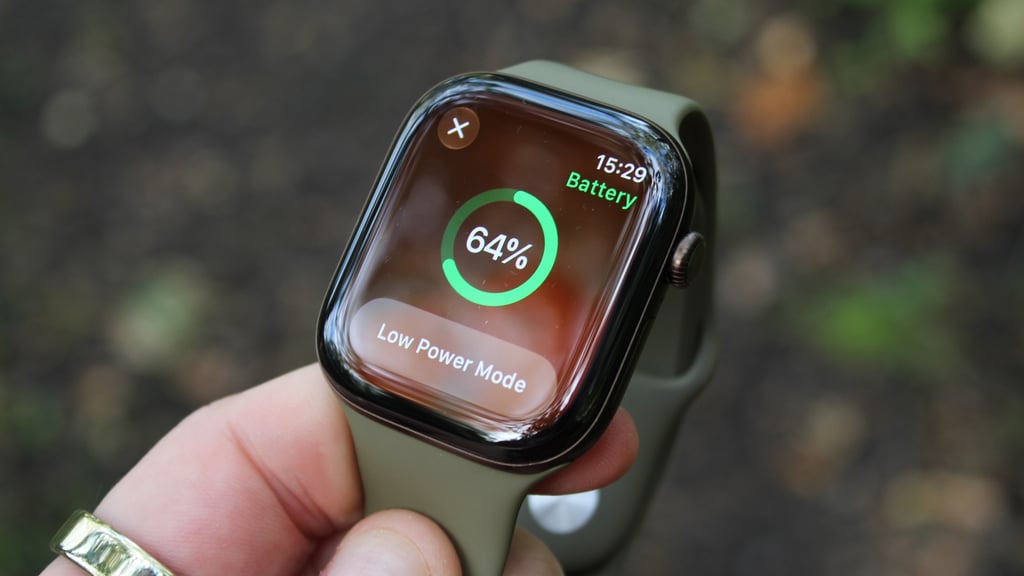
Apple rates the Series 12 at up to 24 hours, with up to 38 hours in Low Power Mode and up to 10 hours of outdoor workout tracking (the Series 11 was rated for eight).
The real improvement is charging: 15 minutes now provides up to 12 hours of use, up from 8 hours on the Series 11. The Ultra 4, meanwhile, stretches to over two days, and Apple has added revamped Extended Battery and new Max Extended modes for longer GPS workouts, without making any battery claims for the Series 12. I asked Apple whether the new sensor and S11 chip make the Series 12 more efficient than the 11, but I didn't get a firm answer.
As we've said in virtually every Apple Watch Series review in the last half-decade, the brand has long been conservative with its battery estimates—so 24 hours is closer to a floor than a typical day.
Push it hard, with a marathon and music, or a 12-hour hike with sleep tracking, and you'll get close. In most typical use, I'm getting around 30 to 35 hours. But I've never managed back-to-back nights of sleep tracking without charging it. An eight-hour sleep tends to take 10 to 15%, and the half marathon without music cost me 35%.
24/7 features require more power
It's still the watch's weakest area, and I charge more for it than any other. That gets annoying when you're traveling, as I have been during this review period, or when you get into bed and realize you're on 8%.
This matters more than usual: Readiness relies on all-day and all-night data, heart rate is sampled every five seconds, and Audio Intelligence needs a microphone ready all day. Apple has shown with the Ultra 4 that it can stretch battery life when it wants to.
Google has made big strides here too, with the Pixel Watch 5's 45mm model rated at up to 40 hours. It's wild that we're still dealing with a roughly 30-hour watch this deep into the game, and it's the area that most needs a big upgrade if the Series keeps adding 24/7 features.
Final thoughts: Should you buy the Series 12?
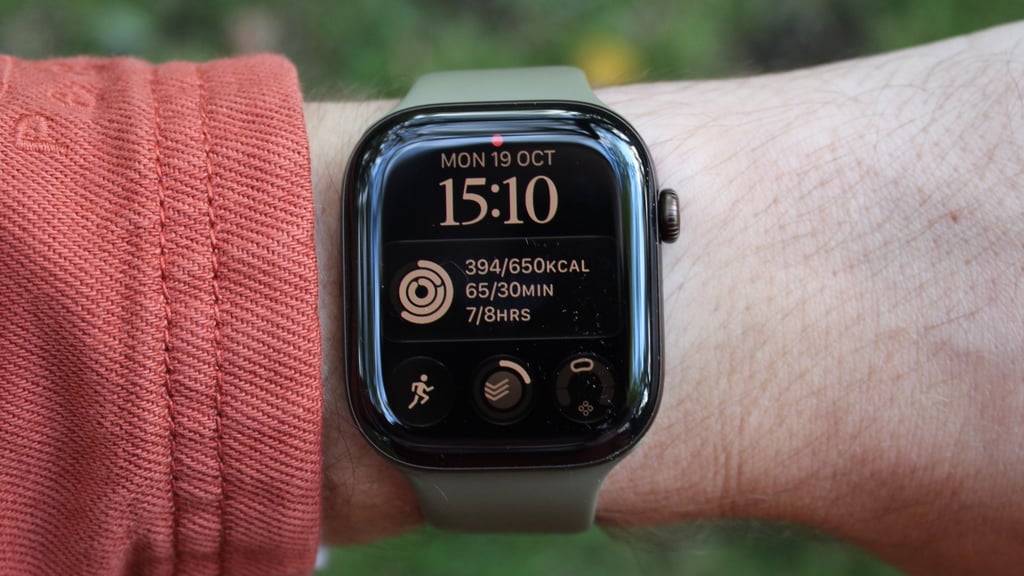
The Series 12 is an outstanding smartwatch, and still the best choice for most iPhone owners. The sensor is excellent in the real world; the polish, app ecosystem, and iPhone integration remain the benchmark; fast charging is a nice quality-of-life improvement; and the Health Sensing System lays the foundation for a much richer picture of your recovery.
Not everything is fully formed. Readiness is competent but late to a crowded category; daytime HRV is more confusing than useful; Audio Intelligence isn't live and will need to earn trust; the display quietly lost ground; and battery life remains the Series' Achilles' heel.
It's a fantastic watch for the right person. It's for the iPhone owner who wants one device for notifications, music, apps, and health without fiddling, and for the runner or gym-goer who wants reliable heart rate and GPS without strapping on a chest strap every session. For those who want multi-day battery, the Ultra 4 is the answer—and, if you're on Android, the Pixel Watch 5 or Galaxy Watch Ultra 2 are the ones to look at.
Regarding upgrading, the answer is different this year.
I'd normally recommend the Series to people whose watch is nearing the end of its software lifecycle, and never to someone who bought one of the last two or three generations. That still holds for older watches, which watchOS 27 is leaving behind. But because so many of the Series 12's features, from Readiness and Recovery HRV to high-frequency heart rate, Audio Intelligence, and faster charging, don't roll back even to the Series 11, there's a genuine case for trading in last year's watch for the first time I can remember. Whether it's worth it depends on how much you want those things.