We analyzed 6,372 used smartwatch sales on eBay US and found that—depending on the brand and model—devices lose 24% to 60% of their original value after just six months.
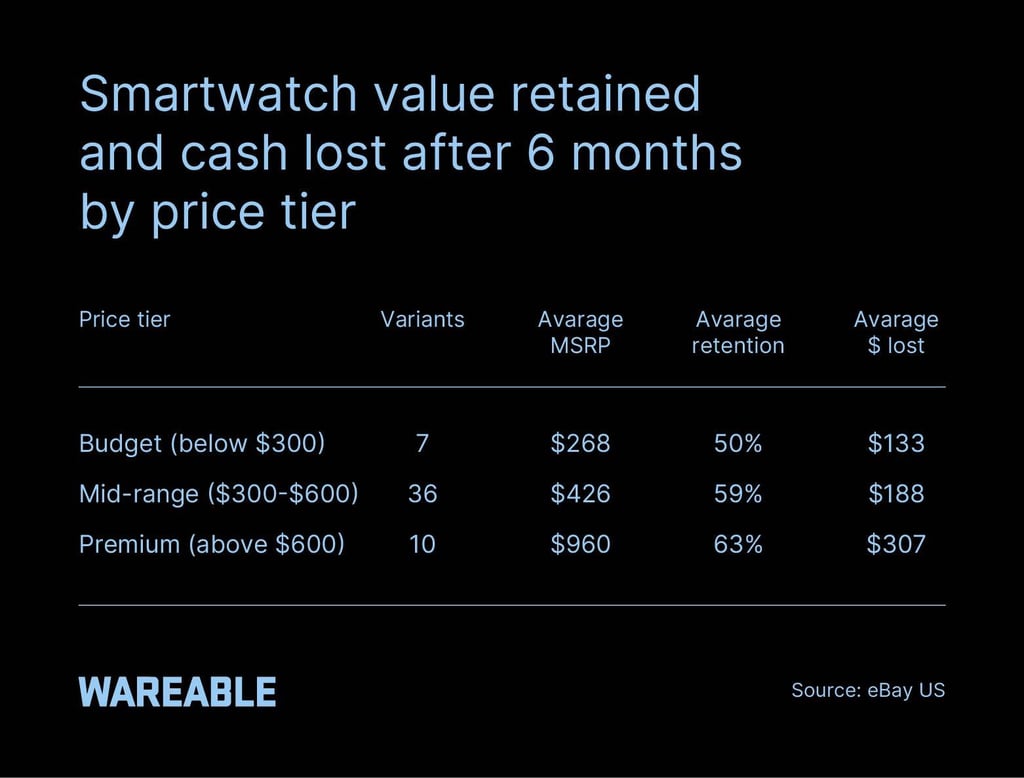
The general trend is that budget watches lose more value (on average, around 50% after six months), while premium models lose about 37% of their initial purchase price after half a year.
However, the premium smartwatches in our dataset launched at a steep average price of $960. Even though they lost less value as a percentage of the initial purchase price, they still generally lost more in dollar terms than budget watches.
On average, premium watches depreciate by $307 after six months of ownership, whereas budget watches lose $133.
Garmin watches tend to retain a lot of value
Our examined Garmin devices consistently kept over 60% of their original value, though Garmin also features the priciest watches in our dataset.
Garmin devices kept 69% of their original value, on average. That is significantly ahead of Apple, whose smartwatches retained 58% on average—and ahead of Google, whose devices kept around 56%.
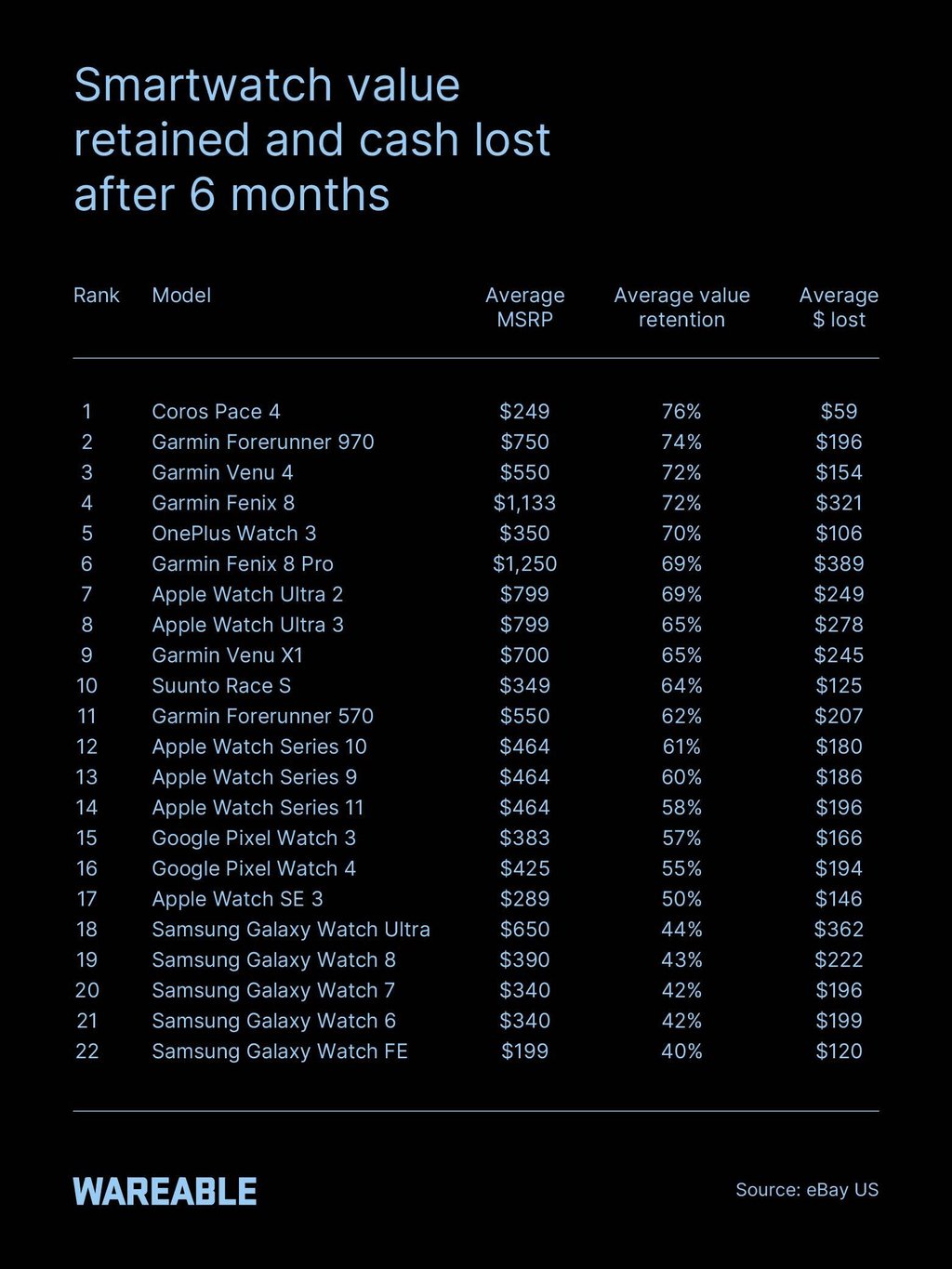
Samsung is in last place in terms of the % of initial purchase price retained after six months, with its smartwatches retaining only about 42% of their value.
The strongest Garmin models were the Forerunner 970 (74% value retention), Venu 4 (72%), and Fenix 8 (72%).
Coros Pace 4 is the best investment (maybe)
The best individual performer was the Coros Pace 4.
It launched at $249 and resold for an average of $190 after six months, keeping 76% of its value. That is an amazing result for a budget watch.
However, there’s one important caveat: these numbers are based on only 18 sales, so this is more or an early signal that this watch retains value well rather than as a very confident conclusion based on a lot of data.
Apple Watch is solid—especially the Ultra models
Apple had by far the biggest presence in the used market, accounting for 4,809 sales in our study—though that's probably no surprise.
Apple watches kept 58% of their original price on average.
The best result came from the Apple Watch Ultra 2, which retained 69% of its launch price. With a $799 starting price, it sold for around $550 on eBay.
At the other end of Apple's range, the Apple Watch SE 3 was much weaker, keeping just half its original price.
So, the pricier Apple Watch models hold their value better than the cheaper ones, a trend we see across almost all the smartwatch models and brands we analyzed.
Samsung buyers take the biggest hit
Samsung watches, on average, kept 42% of their original price after six months, and every device in the bottom five for value retention was a Samsung Galaxy Watch.
The most painful purchase is the Samsung Galaxy Watch Ultra; it’s a premium offering from the brand, but, unlike other premium models, it doesn’t hold value well, retaining just 44% of its initial purchase price after six months. This amounts to about $362 in lost value from the $650 purchase price.
This could present an opportunity for those seeking a more premium model at a lower cost. If this trend holds for newer generations—such as the Galaxy Watch Ultra 2—the secondary market would list this device for less than half of its original price by early 2027.
What explains the difference?
Conor Allison, Wareable's Chief Editor, highlights that these findings demonstrate the difference between specialized sports watches and the more conventional, mainstream options.
"Dedicated sports watches are valued as durable fitness tools, while traditional smartwatches face the same challenges as other modern electronics.
Garmin’s position at the top of the retention ladder—holding 69% of the initial purchase price on average—comes down to particular core utility. Unlike multipurpose smartwatches loaded with LTE, app stores, and smart integrations, dedicated running and outdoor watches are judged on tracking accuracy, battery life, and specialist software such as real-time mapping. These core functions do not lose relevance the moment a successor launches.
Conversely, Samsung’s placement at the bottom of the table—retaining only 42% of its launch price—underlines the vulnerabilities of the pure smartwatch category. Operating entirely within a smartphone-adjacent ecosystem means Samsung devices face relentless annual refresh cycles and heavy promotional discounting on new hardware. When annual upgrades are largely incremental—a pattern seen across Samsung Galaxy Watch lines, Apple’s mid-tier Series devices, and Google’s Pixel Watch lineup—consumers quickly recognize that last year's hardware isn't fundamentally different from this year's, driving down resale prices on previous models.
Going forward, Coros is the most intriguing challenger brand to track. Having entered the consumer wearable tech industry only in 2018, it has earned significant mindshare among runners seeking alternatives to Garmin, thanks to its focus on long battery life and competitive pricing. The Coros Pace 4 holding 76% of its $249 launch price—even with the caveat of a smaller secondary sample size—serves as an early indicator that lean, performance-led wearables continue to outperform general-purpose smartwatches in long-term value retention.