Oura Ring 5 review: The new gold standard

- Stunning, ultra-slim design
- Flawless software evolution
- Improved gold finishes
- Snug, spin-free fit
- The subscription paradox remains
- No legacy trade-in program
Smart rings have undergone a radical transformation in the past few years. What was once a niche hardware category full of early adopters and quantified-self enthusiasts has blown up into a mainstream category. Now, tech giants and dedicated health startups alike are fighting for the piece of real estate on your index finger.
Yet, throughout the explosive growth, one brand has consistently sat atop the throne: Oura.
On paper alone, that makes the Oura Ring 5 arguably the most important wearable tech launch of 2026. And when you consider the design changes the company has delivered, it’s no exaggeration to say that it has fundamentally reshaped the industry’s landscape.
Still, it drops into a highly competitive arena flanked by fresh hardware like the Ultrahuman Ring Pro and looming existential threats from the likes of Samsung.
For newcomers, the Ring 5 represents the most polished and best-looking way to enjoy screen-free health tracking. And for existing Oura owners considering an upgrade, this is far more than just a basic spec bump.
Simply put, the Ring 5 is quite comfortably the best smart ring ever manufactured from a design perspective, representing a monumental engineering leap that fundamentally changes how the tech feels in daily wear.
After having Oura's previous generations on my finger full-time for the last four years, I’ve spent the last two months with the latest iteration. Below is my comprehensive review.
Pricing, competition, and finishes
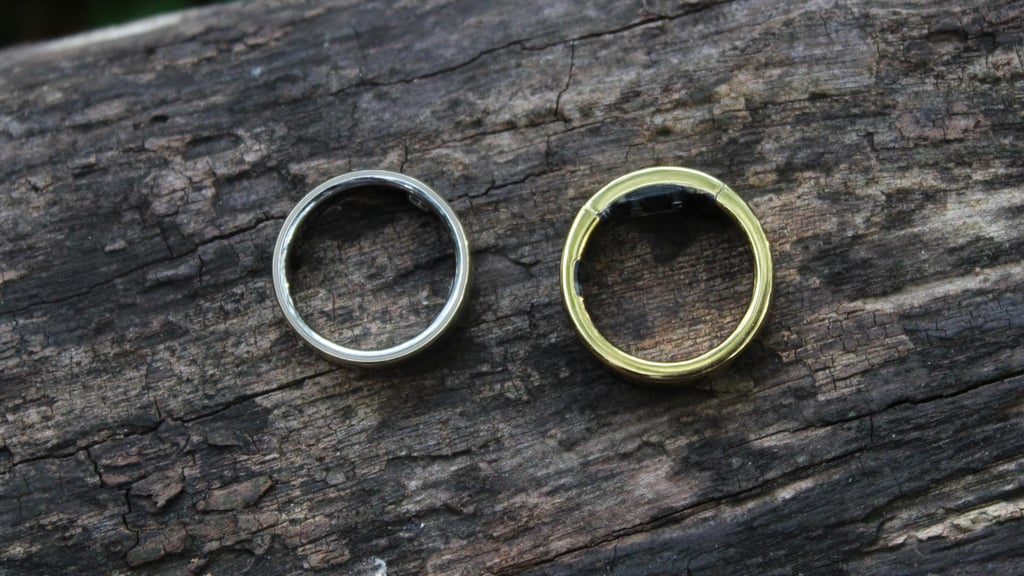
The Oura Ring 5 maintains a tiered pricing structure that varies depending on the aesthetic finish you choose, though the baseline cost of entry has jumped by $50 / £50 over the previous generation.
The entry-level Silver and Black models now start at $399 / £399, while the premium finishes—Stealth, Brushed Silver, Gold, and Deep Rose—climb to $499 / £499. That price bump positions Oura right at or above key subscription-free hardware rivals, including the Samsung Galaxy Ring ($399 / £399), Ultrahuman Ring Air ($349 / £329), and Ultrahuman Ring Pro ($479 / £429).
Across all versions, a sizing kit is included with purchase to test across the eight available ring sizes (sizes 6 through 13) before finalizing your fit.
Old gold
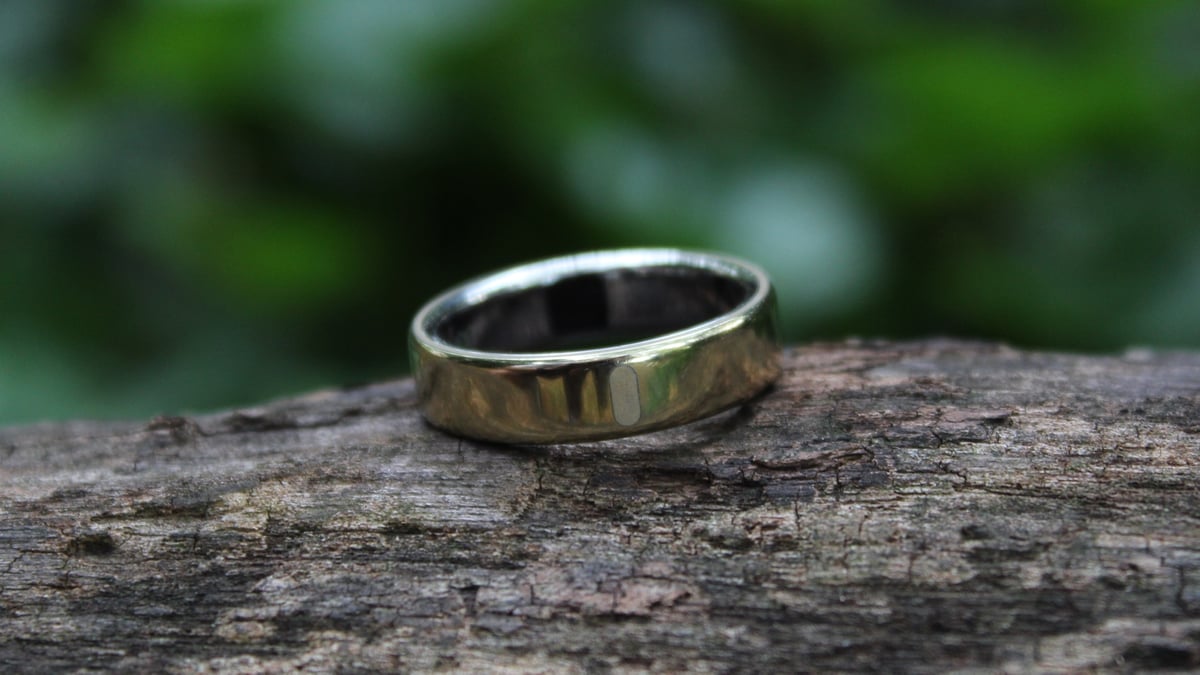
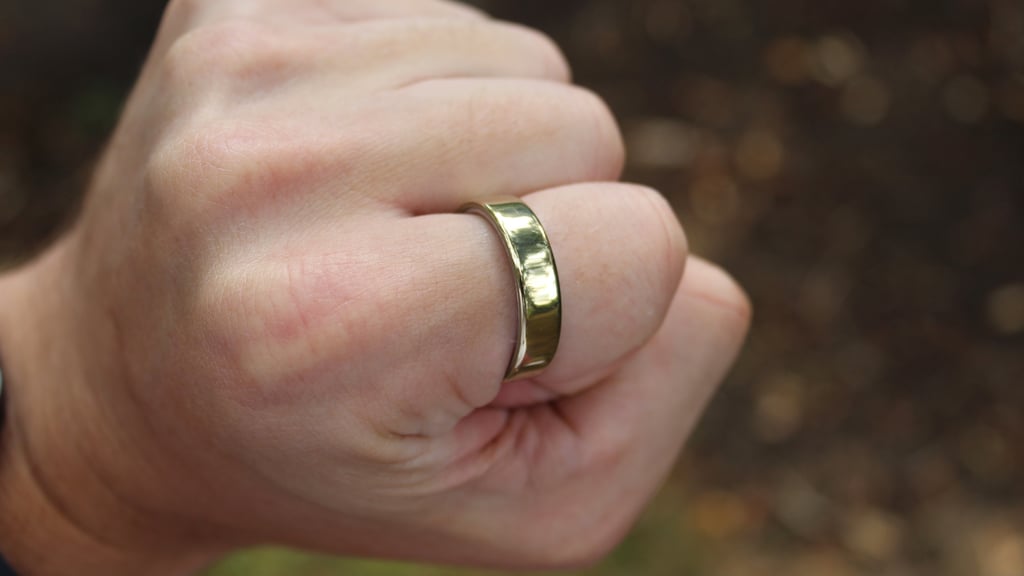
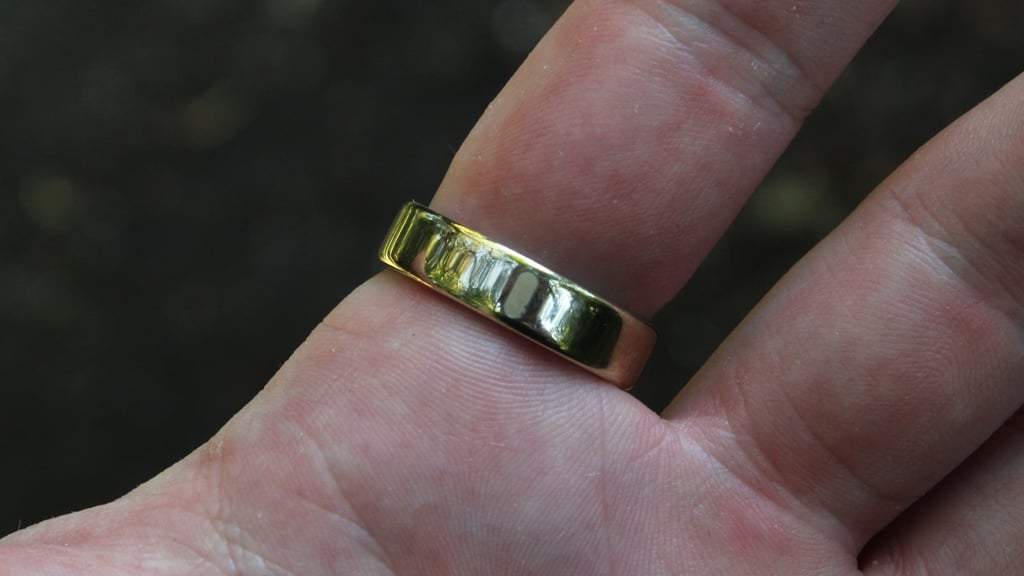
Oura has also smartened up its color palette this generation, most notably with a dramatic overhaul of its Gold finish (pictured throughout this review).
Over the past few years, a slightly tacky, overly bright yellow-gold style has seeped into almost every smart ring lineup on the market. Oura has corrected course here: the new gold looks exactly like proper jewelry-grade gold—rich, warm, and distinctly premium.
Alongside it sits the new Deep Rose finish, providing an excellently muted, sophisticated alternative for those who want a gold-adjacent tone without high-shine visual noise.
The silver and black variants round out the collection—though, as with previous generations, these entry-level finishes don't quite carry the same visual magic as their premium siblings. That, fundamentally, is why they are cheaper.
Is Oura worth it? The subscription value paradox
Before diving into the nuts and bolts of the hardware adjustments, we need to talk about arguably Oura’s biggest sticking point: the cost of entry.
There are no changes to the brand’s philosophy here, meaning that the hardware effectively becomes redundant if you cease the monthly subscription fee. It’s a harsh system, on the surface—and one that rival brands haven’t replicated… at least not in the same way.
Long-time readers of Wareable will be fed up with me referencing this, but, simply: not all subscriptions are poor value, and not all subscription-free offerings are inherently good.
Not entirely without reason, the wider tech community rejoices in unison when a smart ring competitor arrives without a recurring paywall. We saw this extensively when Samsung launched its original ring, and it remains a key talking point as the company develops the Galaxy Ring 2.
However, the common narrative that subscription-free means better value is fundamentally flawed—especially when analyzing a limited-evolution device like a smart ring.
Unpacking the value question
The last couple of years have seen the smart ring industry engulfed in patent infringement cases regarding the core design. Yet, hardware advancements (until now) have mostly converged. That's no surprise, considering they all comprise loosely the same collection of readily available optical, thermal, and motion sensors packed into a titanium loop.
And that means much of the ‘real’ value to this point—the engineering cost—has been in the software architecture, clinical validation, and the continuous algorithmic tuning required to turn raw data into actionable insights. A subscription model creates a predictable, recurring revenue stream that directly funds this continuous R&D.
This is why Oura has been able to roll out a frankly astonishing cadence of major feature updates over the past 2-3 years, including the total redesign of its app interface, Live Activity Tracking, Cumulative Stress metrics, a comprehensive overhaul of Cycle Insights, passive blood pressure pattern tracking via Health Radar, specialized GLP-1 Insights, and direct integrations with third-party clinical blood testing. And that’s just off the top of my head.
Conversely, most rival brands continue to tie the most meaningful software updates strictly to major hardware cycles. So, while you may ‘save’ by having a one-and-done cost, you’re still likely stuck with the software experience for 12 to 24 months until the company decides it is time to sell you a new ring. And, even if you don’t upgrade in that cycle, you run the risk of features not rolling back to older generations.
So, while it never feels good to know that your expensive ring becomes a functionally inert paperweight if you cancel your monthly plan—and that terminal feeling is still a valid reason to not want to get into bed with Oura—the flip side of the coin is that the brand is arguably the best digital health company in the world at making it feel like your subscription fee is actively ‘buying' you a fresh, evolving experience.
Missing a trick for loyal customers
Still, Oura hasn’t got everything right with the value and pricing here.
While I can make peace with the economics of the subscription, it feels a shame that the company no longer offers a structured trade-in program or any meaningful percentage-off incentives for existing Oura Ring 4 users with this launch.
When transitioning from Ring 3 to Ring 4, it offered a modest 10% loyalty discount. Dropping that entirely for this generation feels like a misstep that fails to reward brand loyalty, especially given the steep hardware prices—and the fact that the Ceramic Edition of the Ring 4 only arrived last October.
Design and comfort: Reaching the upper limits
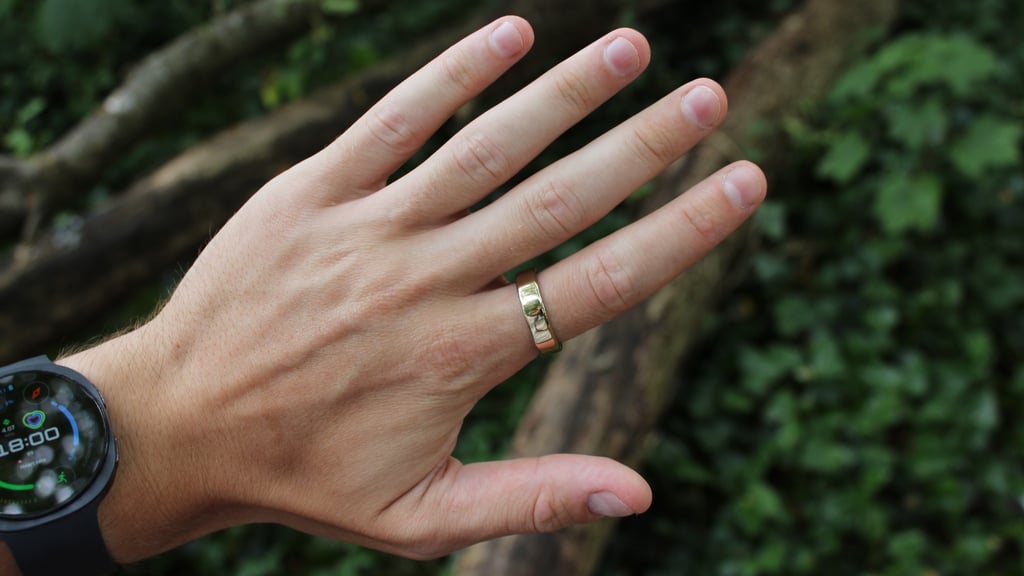
It’s always incredibly difficult to convey smart ring design improvements through static photography. Over the past few years, almost every major player has converged on the exact same basic form factor: a smooth band that (still) looks like tech rather than traditional jewelry.
Yet, when you size up the Oura Ring 5 with the Ring 4, the engineering leap is instantly apparent.
Oura claims an overall size and component reduction of roughly 40% compared to the previous generation, and, for once, the marketing metrics map directly to the real-world feel.
The natural weight reduction changes the entire experience of wearing a smart device. It sits on the finger with the weightlessness of a traditional ring or wedding band, completely separating itself from the bulkier feel of the devices we tested in 2024 and 2025.
Return of the bump
The internal fit also marks an unexpected return to Oura's Ring 3, albeit with a crucial refinement. While the Ring 4 opted for an entirely smooth, uniform inner circle by recessing its sensors, the Ring 5 reintroduces internal sensor bumps.
However, these are miles away from the aggressive nubs of the Ring 3 that left indentations on your finger. With the Ring 5, they are incredibly subtle, smoothly integrated domes that serve a brilliant secondary purpose: stabilization.
One of the mild annoyances of wearing a completely smooth smart ring is its tendency to spin freely throughout the day. I often found myself checking if the optimal sensor position had rotated away from the underside of my finger, or unconsciously spinning the band with my thumb while sitting at my desk or watching TV.
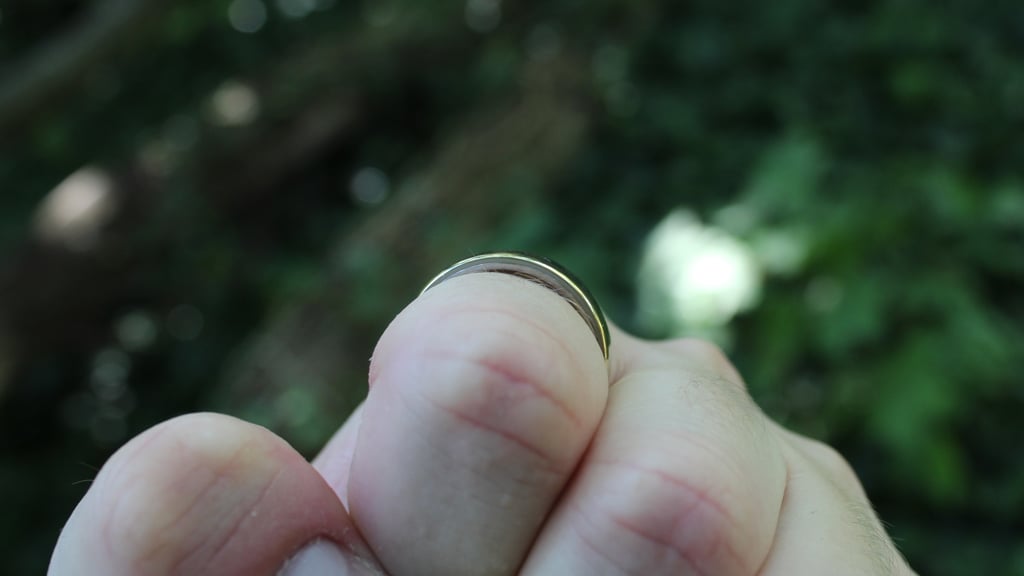
The refined bumps on the Ring 5 create a snug, secure fit that’s still just as comfortable as the Ring 4. Testing a standard Size 12—the same size worn during our long-term testing of the Ring 4—the Ring 5 simply stays put.
It’s also tough to overstate just how much the ring’s overall slimming redefines how it interacts with your hand during daily movements. When you close your hand into a tight fist, carry heavy grocery bags, or press your palm flat against a flat surface, the Ring 5 sits completely naturally. It eliminates that annoying, pinchy lateral bulk that routinely bumps against your adjacent fingers on thicker rings.
Disappearing on the finger
Evaluating long-term durability is always tricky during initial review windows, but my two months of continuous, unbroken wear have yielded some reassuring results.
Oura has utilized an upgraded protective PVC coating on the exterior of the titanium hull. And while it lacks the natural scratch-resistant properties of the specialized finish Ring 4 Ceramic Edition launched last year, it handles daily life far better than the old brushed silver finish of the standard Ring 4, which we collected an absolute web of micro-scratches within its first year of use.
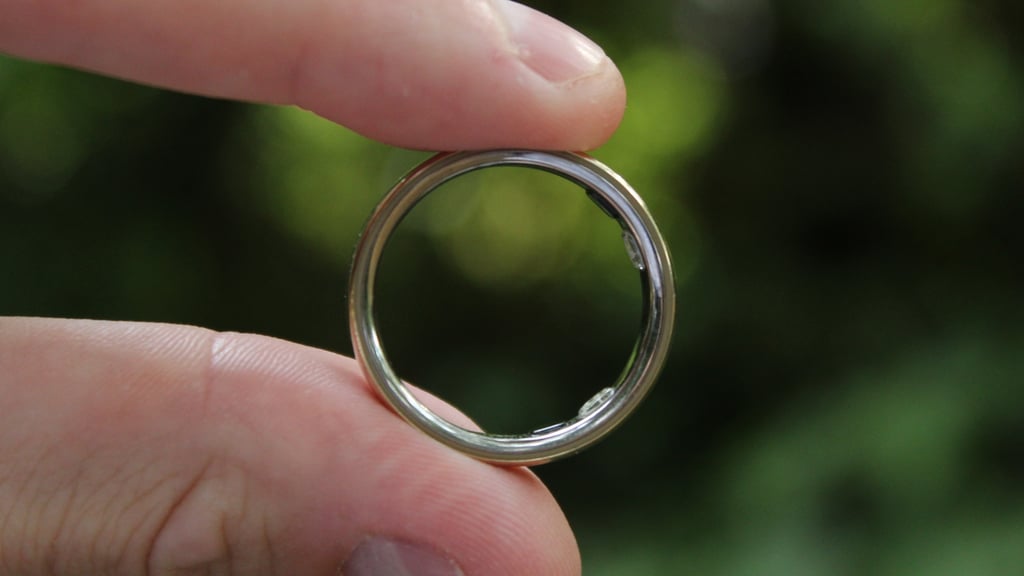
After eight weeks of washing hands, showering, running, cycling, and doing daily chores, my unit has picked up a couple of tiny, negligible dings, but nothing that is visible unless you actively hold the ring up to a light source to hunt for them.
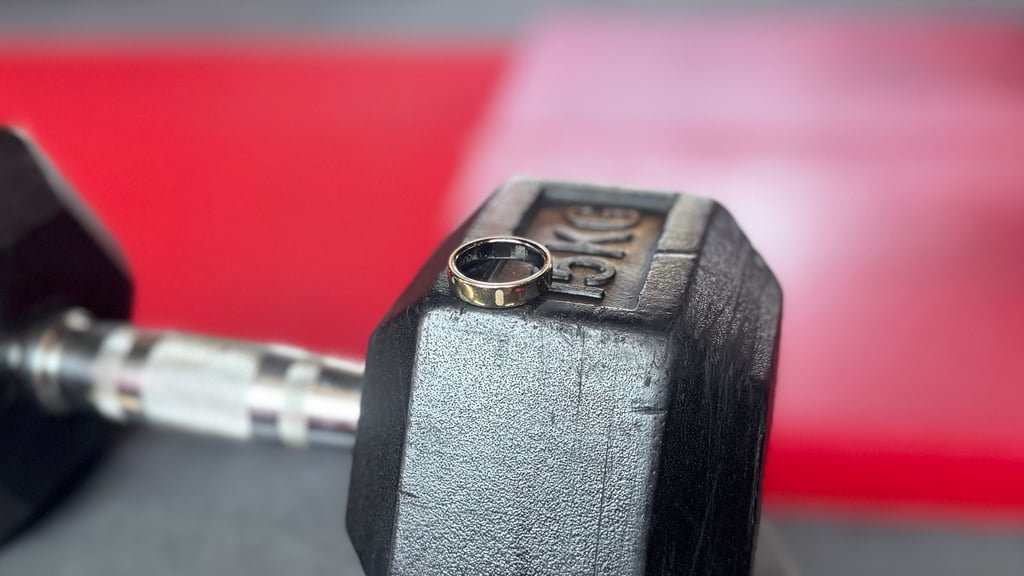
That said, I’d still issue a major warning regarding use in the gym. Even with the massive reduction in profile, I found lifting barbells or dumbbells, or hanging from the bars, a bit too uncomfortable to get used to on the Ring 5.
It’s better than other designs, sure—but whether it’s the risk of ring avulsion or just the simpler fact of it being exorbitantly more likely to pick up deep scratches, it just really doesn’t feel worth the basic tracking insights you get. But more on that later.
Software features: A rolling masterclass
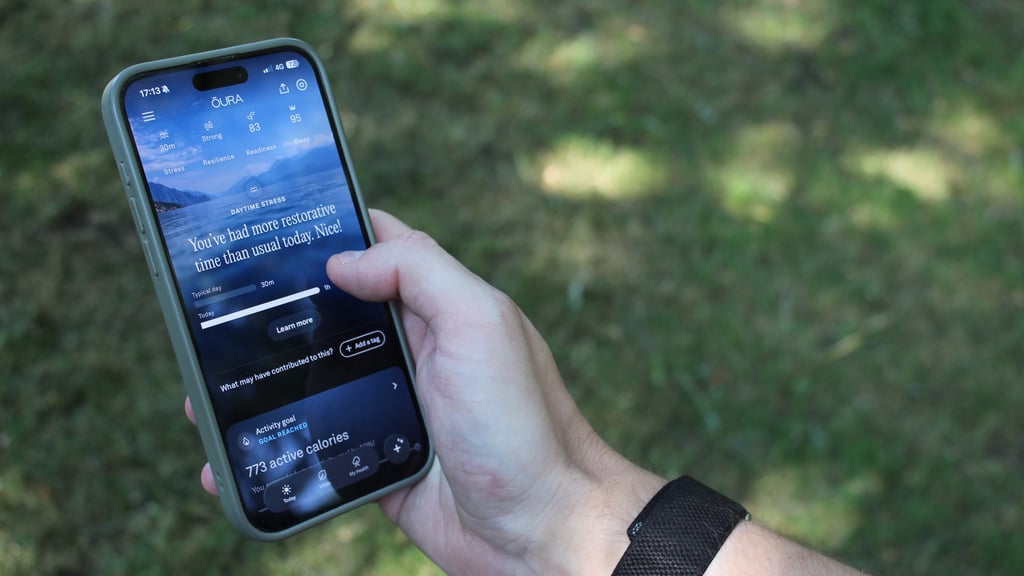
Reviewing Oura's software platform is uniquely challenging because—as discussed—unlike most, it’s a living, rolling experience. Thanks to that recurring subscription revenue, the app layout and feature set you interact with today are vastly different from what existed a year ago, and it will undoubtedly continue to shift over the next year, as well.
Oura now organizes its companion app into three distinct primary screens: Today, Vitals, and My Health. This layout provides a clean hierarchy that generally outclasses the data-dense layout of some rivals, like Ringconn, while remaining far more insightful and unified than generic ecosystems like Apple Health or Google Fit.
Today, Vitals, and My Health
The Today screen serves as the real-time center of the experience. It populates all your immediate, 'live' metrics—your current activity progress against your daily caloric goal, dynamic stress tracking throughout the afternoon, and a chronological timeline of your movement. Suspended at the top of this screen are your primary daily scores: Readiness, Sleep, Activity, and Stress.
The Readiness Score, meanwhile, remains a shining star of Oura's quiet, softer coaching philosophy. Unlike more aggressive recovery scores, like Whoop’s, which can plummet into the red because you had a late dinner or drink that tanked your at-sleep HRV, Oura’s score acts as a more gentle guide. With its adaptive messaging—and a broader view of insights like HRV—it prioritizes your systemic recovery over a rolling window rather than treating every single morning as an isolated crisis.
The Vitals screen lets you drill down into the clinical core of your daily stats, comparing metrics such as resting heart rate, HRV, respiratory rate, and skin temperature deviations directly against your personal historical baselines.
It’s also where the likes of legacy features like Sypmtom Radar live. So, if you have a sharp spike in resting breathing rate or a sustained elevation in skin temperature, Oura will flag this as a ‘minor’ or ‘major’ warning sign that your immune system is actively fighting something off. In the last year or so, I can think of a few occasions where it was able to pick up on mild colds and the like in the day or so before they really struck into full symptoms, giving you a bit of validation to take it genuinely easy rather than pushing through.
Rounding out the core is the My Health screen, which shifts the focus entirely to long-term, longitudinal wellness metrics. Rather than letting you get bogged down in the minutiae of a single bad night of sleep, it elevates deep data trends like Stress Resilience, Cardiovascular Age, Cardio Capacity, sleep regularity, and your foundational sleep chronotype.
It’s incredibly gratifying to see longitudinal trends take center stage here, since tracking changes over months and years is where the true preventative value of smart rings actually lives.
Dynamically adjusting to cover the trends
To truly understand the value proposition of the Oura ecosystem, you have to consider the frequency of major updates, as I mentioned earlier. Like any major app platform, the array is massive—and growing. So, in the interest of brevity, let’s summarise some of the most recent ones.
One major area for Oura—but not one I have the necessary tools to test—continues to be women’s health features. And recently, it has introduced specialized insights tailored for perimenopause and menopause tracking, alongside smart cycle adaptations for individuals utilizing hormonal birth control.
That’s similar to the GLP-1 insights, designed to assist users in managing their medications by helping them track dosing schedules, monitor body weight changes, and map related physiological side effects against their biometrics.
When you consider you can now also upload third-party blood tests into the app, which then uses AI-guided insights to cross-reference your internal biomarkers directly against your daily wearable data trends, it becomes a very varied health-tracking experience.
Oura also remains one of the few agile enough to follow the latest industry trends, be it new research in women’s health—also recently making its Oura Advisor AI trained on the latest literature in this area—or the knock-on effects of using GLP-1s.
For the Ring 5, Oura has also covered off some neat quality-of-life improvements, such as allowing you to pair and swap between multiple rings (such as an older Ring 4 and the new Ring 5) on a single account without breaking your data streaks or corrupting your baselines.
Tracking accuracy: Sleep and stress insights
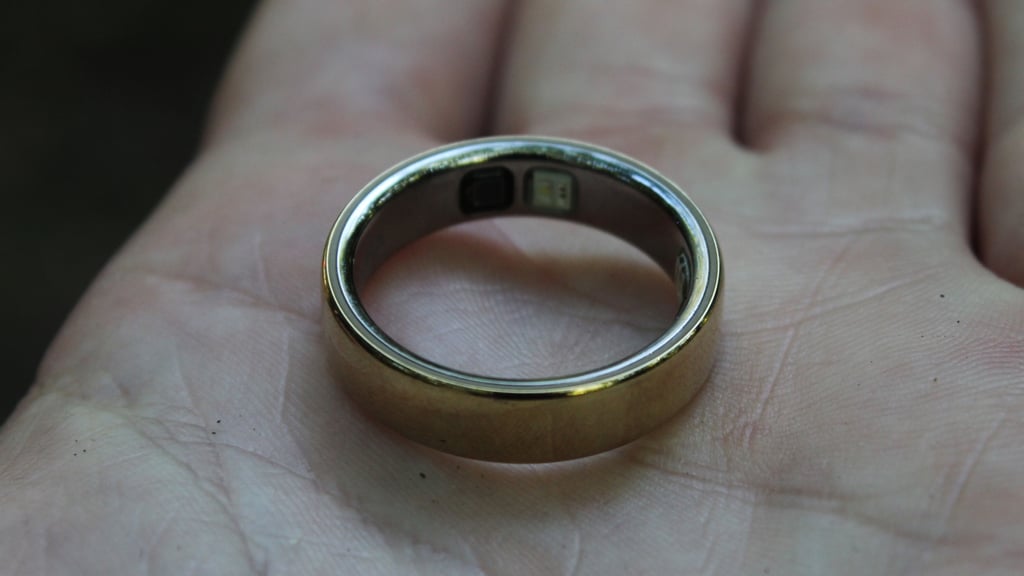
While the previous iteration focused on increasing the raw number of light channels, the Oura Ring 5 shifts its focus to pure optimization within its new compact footprint.
The ring uses a re-engineered sensor setup with 12 light pathways and brighter, upgraded LEDs. Oura specifically designed these hardware upgrades to provide stronger signal pathways and greater biometric accuracy across a wider range of skin tones than the Ring 4.
While I’m fortunate enough to have never been affected by the optical sensor degradation that can affect people with different skin tones, Oura deserves immense credit for actively working to engineer a solution to a systemic bias in the industry.
From a day-to-day data perspective, what does this all mean if you are upgrading from a Ring 4? In short, a continuation of what was already a gold-standard wearable.
The Ring 5 preserves the baseline. In my testing, I didn't notice any wild, overnight shifts in sleep or stress trends compared to the previous generation. Daytime Stress points remain as consistently and solidly plotted on the graph as they did on the Ring 4—which is exactly what you want.
The real-world sleep test
When it comes to pure sleep-tracking validity, the Ring 5 sits in a rare bracket. Most wearables in 2026 can do a decent job of mapping an uninterrupted eight-hour block of sleep. The real test of a device's algorithm is its ability to accurately spot when you are actually asleep versus when you are simply lying motionless in the dark, awake.
To put this to the test, I lined up the Ring 5 against the Eight Sleep smart mattress cover—the gold standard for screen-free sleep analysis. A perfect example of this dual validation can be seen in the data captured across a highly chaotic, interrupted night surrounding the recent England vs. Mexico World Cup game, which kicked off at a brutal 2:00 AM BST.
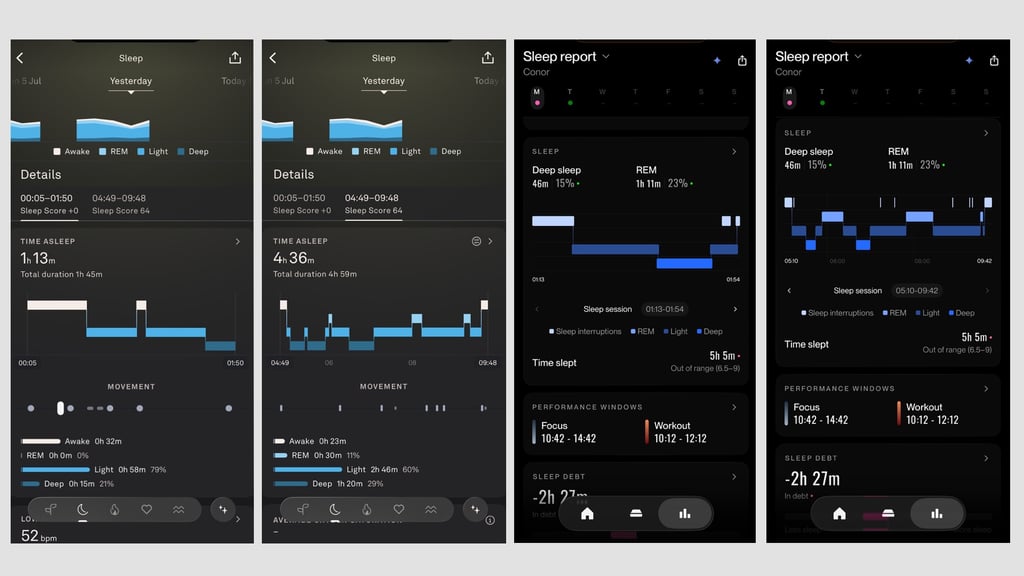
Let’s look at the game-night disruption. Oura got a decent grasp of my brief pre-game power nap, registering 1 hour and 13 minutes of sleep between 00:05 and 01:50, crucially clocking that I took around 20 minutes to fall asleep. Eight Sleep mirrored this behavior and registered almost the same wake-up time (my alarm was set for 01:50, and I physically got out of bed at 01:54).
After the final whistle blew—with England getting over the line—my adrenaline was high. But I still managed to drift off relatively quickly, as evidenced by the matching tracking from both Oura and Eight Sleep. Oura registered 4 hours 36 minutes from 04:49 onward (with roughly 5 hours total), and Eight Sleep captured a very similar picture for the same 5-hour block.
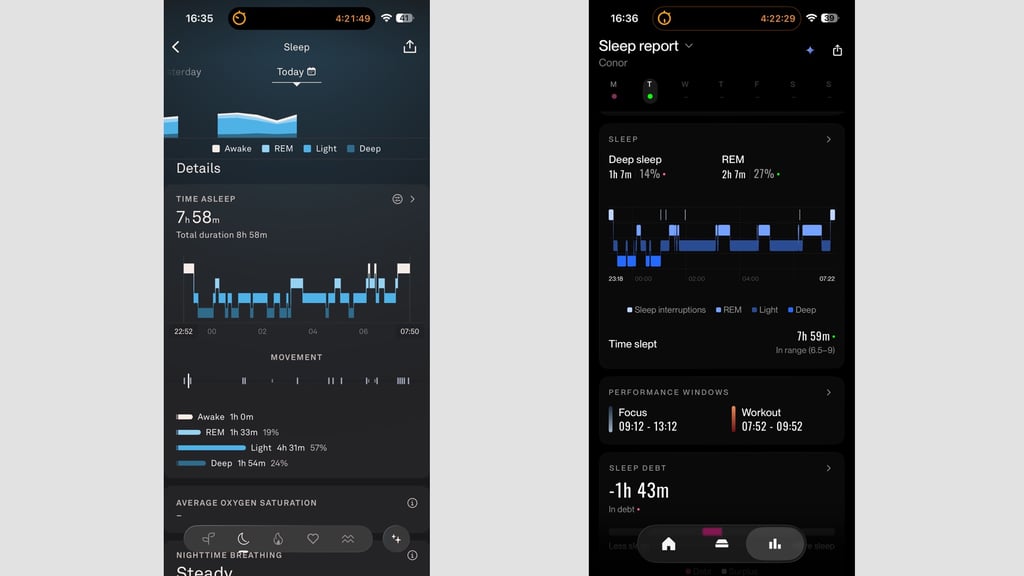
The next night, both systems successfully tracked a standard, healthy night of rest (shown below, with Oura logging 7 hours 58 minutes and Eight Sleep logging 7 hours 59 minutes).
A gentler approach
Suffice it to say that if your life involves highly irregular sleep schedules—whether you're frequently up in the night attending to a newborn baby or making frequent trips to the bathroom—the Ring 5 delivers some of the most accurate sleep/wake boundaries we’ve tested.
At Wareable—as we always say in reviews—we don’t put a massive amount of stock into the exact breakdown of REM vs. Deep sleep metrics. First, because you can't explicitly control or manipulate them with any real degree of granularity. Second, even medical-grade polysomnography (PSG) lab equipment isn't flawless, and consumer wearables generally top out at between 70% and 85% staging accuracy, depending on which study you trust.
Even with that caveat, we will say the Ring 5 consistently matches the general stage analysis of Eight Sleep very closely. So, take that for what it's worth.
Whatever the structure of your night sleep, it’s here where Oura’s tone also comes into play. On the morning following that highly disrupted World Cup night, the app didn't hit me with flashing red warning signs or a dramatic lecture. It acknowledged the heavily interrupted schedule with a gentle touch. Then, when I followed it up with a solid, restorative sleep the next night, the app responded with a perfectly pitched tone.
It’s something not every brand gets right—and creates a psychological environment where you treat the data as a helpful partner rather than a monitor to please.
Still the leader in holistic stress tracking
This philosophy translates seamlessly into Oura’s approach to stress tracking.
Alongside Whoop's 5.0 and MG generation—which we still love the 0-3 rev-counter style of minute-by-minute stress tracking—Oura is one of the only wearable platforms on the market that places an absolute, correct emphasis on systemic stress as a primary health metric.
Rather than just showing you a 0-100 number or an all-day color graph of your HRV fluctuations, Oura backs up its raw data with its excellent Stress Resilience feature, which arrived late last year.
Resilience is the ultimate actionable metric because it reframes stress as something you actively build tolerance to through consistent sleep and intentional physical recovery over time. It teaches you to look at your body's capacity holistically, ensuring that your data serves to empower your training and daily routine, rather than dictate it with artificial anxiety.
When it comes to the increasingly broad spectrum of health and wellness tracking, I still rank Oura’s stress insights as the most personally impactful and actionable I’ve encountered. And that’s not something I say lightly, having tested hundreds of devices over the last decade.
Activity tracking
While Oura has made massive strides in hardware refinement, the nature of the smart ring form factor means it remains fundamentally constrained in its ability to track active workouts. Still, it’s tried to deliver some improvements here.
The tighter fit and brighter, upgraded LEDs mean Oura boasts a 24% improvement in workout-tracking signal quality and a 19% increase in dynamic-tracking accuracy for activities like running or cycling.
The same major app upgrades that arrived with this latest generation are also being rolled back, including Live Workout Tracking and third-party heart rate strap pairing.
The steady-state test
To test the signal consistency under a sustained aerobic load, I put the Ring 5 through a two-hour indoor spin session.
While steady-state cycling is the gentlest hurdle in the testing wringer—lacking the rapid wrist movements of functional fitness or the impact vibrations of running—it provides a good baseline for sensor tracking. The results across the testing ecosystem were, encouragingly, tightly grouped.
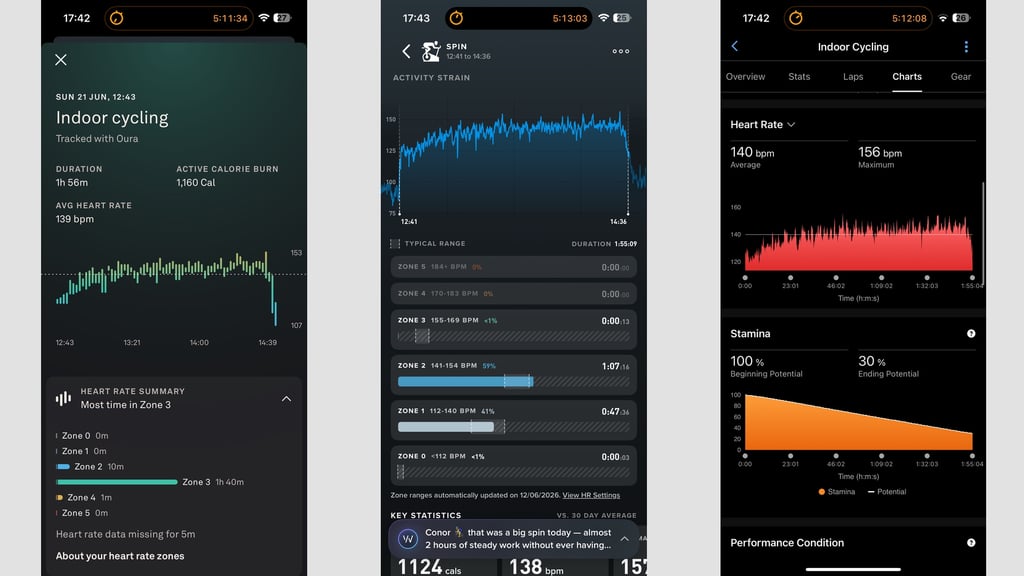
The gold-standard Garmin HRM-600 chest strap logged a flawless graph with a session average of 140 BPM. A Whoop MG worn simultaneously recorded a nearly identical activity strain curve, averaging 138 bpm, and, tracking the workout live, the Oura Ring 5 mapped a matching cardiovascular arc, averaging 139 bpm over the 1-hour and 56-minute duration. No dips or fuss—and that’s despite being pushed up against a handlebar the entire time.
The algorithmic calorie computation also tells a similarly reassuring story. Oura's active energy expenditure of 1,160 Calories closely aligns with Whoop's 1,124 Calories and mirrors Garmin's combined output. For steady, endurance-focused cardio with minimal movement, I feel confident that Ring 5 delivers clean data you can trust.
The primary tracker equation
However, despite the revamped design and the nicely executed Live Workout Tracking interface, I still wouldn’t choose the Oura Ring 5 as my primary fitness tracker.
This isn't because the hardware is technically incapable. While a finger-based sensor still struggles with the rapid heart-rate spikes of HIIT or heavy intervals, my hesitation is more about form-factor comfort and ecosystem utility. As I said earlier, working out while wearing a hard metal ring rarely feels comfortable or necessary when dealing with barbells, bike handlebars, or performing gripping movements.
Plus, Oura’s third-party integrations are so seamless that the ring doesn't need to do the heavy lifting. It syncs beautifully with platforms like Strava, pulling your primary workout data from dedicated watches or chest straps without breaking your active data streaks.
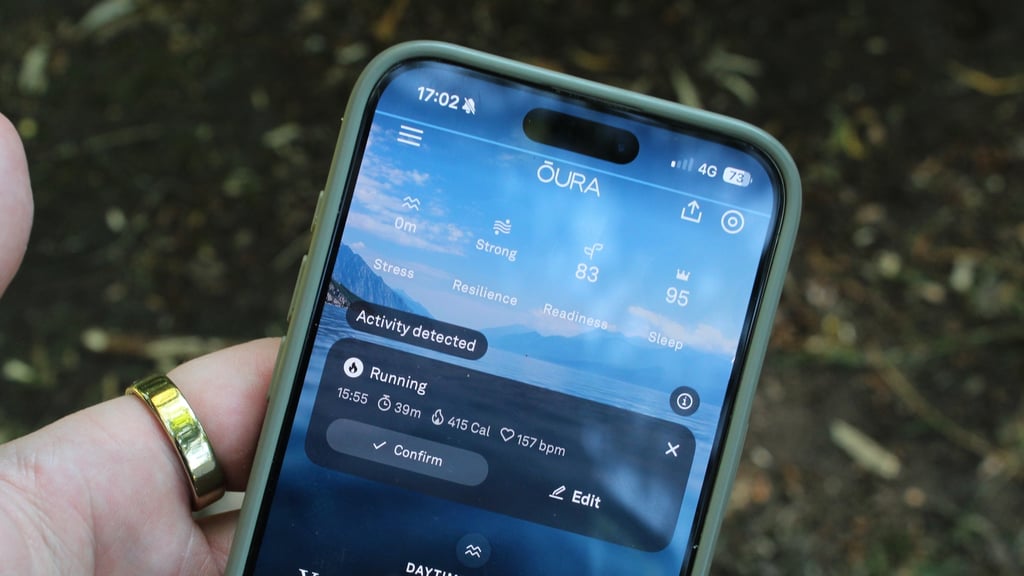
Granted, this assumes you own a multi-device setup. If you don't own a sports watch and rely on a single wearable, the Oura Ring 5 handles general, more basic fitness tracking better than any competitor. But the fundamental equation remains unchanged: if you genuinely care about proper athletic data analysis, a smart ring shouldn't be your primary tracking tool.
Where the Oura Ring 5 excels is as a passive background safety net. It automatically banks those unstructured 15-minute walks to the tube station—the everyday active movement you'd never manually start a Garmin activity for.
Quietly rounding out your total lifestyle volume in the background ensures your daily Activity Score reflects the true reality of your day. It remains a brilliant companion fitness tracker—and Oura continues to do the right things in this area to help the ring be the best it can be—but it ultimately remains a secondary instrument for serious training.
Battery life—and the upgraded Charging Case
Shrinking any device’s physical profile by 40% usually means one thing for battery life: big compromise.
That’s generally proved especially true in wearables, where battery cells occupy the vast majority of the physical volume, meaning any reduction in casing typically forces a direct trade-off.
It’s a testament to Oura's hardware engineering team that they have managed to keep the Ring 5's battery life completely competitive with the larger Ring 4's. Oura’s official spec sheets promise about seven days of use on a single charge, and our real-world testing confirms that claim—with one important caveat.
How we tested the battery
We routinely disable continuous blood oxygen (SpO2) sensing during long-term wearable testing. For the vast majority of healthy consumers who don't suffer from sleep apnea or specialized respiratory conditions, continuous SpO2 tracking is a pretty unnecessary battery hog that offers very little daily actionable insight.
And with SpO2 disabled on our Size 12 unit, we found the Ring 5 generally burns through a modest 6% to 8% of battery life during an eight-hour sleep cycle. Across a full 24-hour day of continuous wear, the total battery drain consistently stays under 15%. This means you can comfortably clip the ring on and completely forget about power cables for an entire week.
Oura still hasn't managed to match the multi-week battery thresholds of competitors like RingConn, which can last nearly two weeks on a single charge, but frankly, it doesn't need to. The core friction of smart rings has never been whether they last seven days versus 12; the friction point has always been physical bulk. Giving up a few days of hypothetical battery to achieve an ultra-slim, jewelry-like form factor is an engineering trade-off we would make every time.
Clamshell charging
Then there’s the updated charging case. Sold separately as a premium accessory upgrade, it's an annoying extra from a pure monetary standpoint. But in terms of sheer real-world utility, it’s pretty difficult to argue against.
The build quality feels exceptionally premium, moving away from the plastic feel of something like an Apple AirPods Pro to deliver an all-silver finish. For frequent travelers or power users, the case is a total game-changer.
I’ve found it to be a godsend when navigating the (mercifully reducing) airport security lines—instead of dropping a loose titanium ring into a plastic bin or my backpack full of cables, where it can easily get lost or scratched, you can snap it securely into the case and throw it in your carry-on.
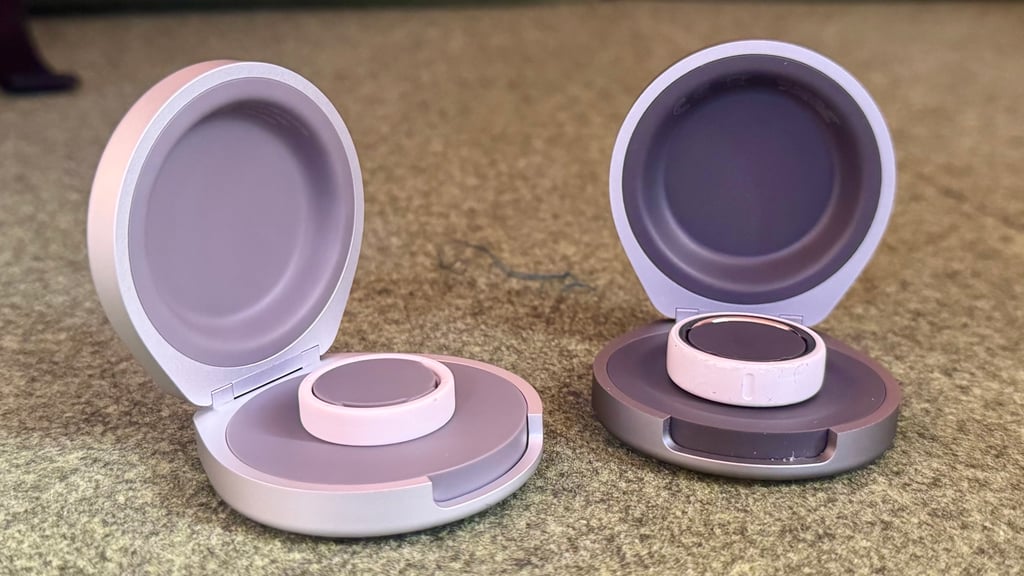
It also functions beautifully as a designated, safe home for the device when you intentionally choose to take it off—for me, prior to a workout at the gym.
Because the case tops up while it sits inside—provided you remember to plug it into a USB-C cable once in a while, obviously—it becomes virtually impossible to run out of battery. It all means you integrate the charging case into your daily lifestyle routine, and it makes it incredibly tough to go back to the out-of-the-box standard dock.
Summary: The industry leader for a reason
The Oura Ring 5 arrives at a fascinating moment in the history of consumer health tech. It represents a line in the sand. It proves that despite massive investments and ecosystem lock-in advantages from tech's biggest brands, specialized engineering and a relentless focus on algorithmic software development can still win the day.
It is bold—perhaps even foolish—to look at a technology category that's barely a decade old and claim we are already approaching the absolute upper limits of industrial design. Yet, when you slide the Oura Ring 5 onto your finger, it is genuinely difficult to imagine how a smart ring could get any thinner, lighter, or more discreet without sacrificing the physical space required for optical sensors altogether. It has successfully crossed the chasm from 'wearable technology' to 'authentic jewelry'.
Yes, the ongoing subscription paywall will continue to alienate a portion of the market, and Oura's refusal to offer a structured hardware trade-in incentive for loyal Ring 4 owners feels distinctly ungenerous. But if you judge a product purely by the quality of the experience it delivers, the Oura Ring 5 is an absolute triumph. It doesn't just retain the crown; it extends Oura's lead over the rest of the industry by a country mile.