- Measures core markers Battery-operated
- Lighter on the wallet Lacks retractable handle
- Syncs via Bluetooth and Wi-Fi
- Compatible with Apple Health and Google Fit
- Battery-operated
- Lacks retractable handle
Withings Body+ claims to be the best-selling smart scale in the US, so naturally, we had to test it for ourselves to see if it’s truly worth the buzz. Alongside competitors like Hume Health, Oxiline, and RENPHO, Withings caters to the growing popularity of habit tracking and body composition analysis.
As the most affordable scale in the Withings lineup, Body+ promises highly detailed insights into your health in just a matter of minutes. Intrigued by its price and popularity, we spent several weeks putting it to the test to see how it handles daily use.
Read on for my first-hand review of Withings Body+, covering its design, accuracy, app integration, and overall value.
| Product | Withings Body+ |
| Price | $99.95 |
| Dimensions | 12.8 x 12.8 x 0.9 in/327 x 327 x 23mm |
| App compatibility | Withings app, Apple Health, Google Fit, Fitbit, and 100+ others |
| Connectivity | Wi-Fi and Bluetooth |
| Metrics tracked | Weight, BMI, body fat, water percentage, muscle mass, bone mass |
| Battery | 4x AAA batteries |
| Multi-user support | Up to 8 users |
| Supported platforms | iOS 14.0+ and Android 10.0+ |
What does the Withings Body+ actually measure?
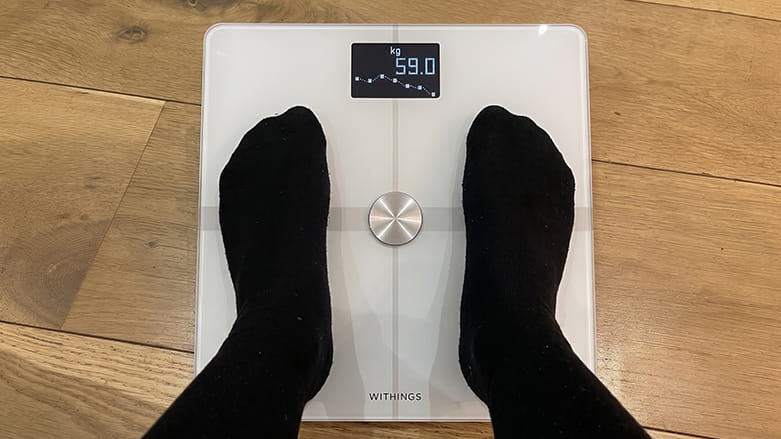
Withings Body+ sticks to the key biomarkers: weight, BMI, body fat %, water %, muscle mass, and bone mass. For some users, this can be beneficial, as having a plethora of data you don’t know what to do with can feel more overwhelming than helpful.
Withings Body+ collects these markers using BIA technology. Simply put, this technology estimates your fat, muscle, and water levels by sending low-level electrical current up your body.
Within the Withings lineup, Body+ strikes a balance between price and practicality. It only delivers the essential biomarkers that most people will find sufficient. To keep the cost more accessible, it also lacks Withings Precision Technology, which may mean that your health data could be less accurate than with other Withings products. Ultimately, this scale is Withings' way of offering a more affordable, everyday product to buyers.
Design and setup
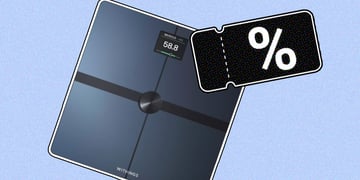
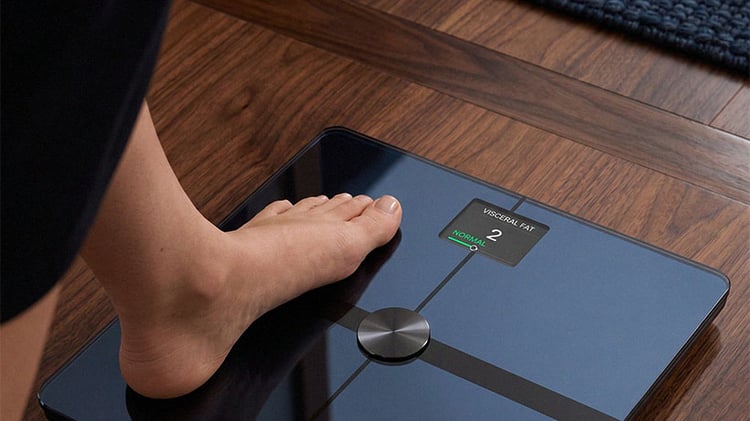
My first impressions of Withings Body+ design were positive. The device is modern, sleek, and avoids feeling bulky while maintaining a quality build. The platform is covered with tempered glass, featuring a metal medallion in the center that acts as a guide to position your feet in the exact same spot every time. Overall, stepping onto the scale felt stable.
It also features a black-and-white display that shows your metrics alongside a small progress graph. In my eyes, the graph is a slight design flaw—fitting it on the screen forces the main numbers to shrink, which may mean that anyone with poorer eyesight might have to squint to check their health data.
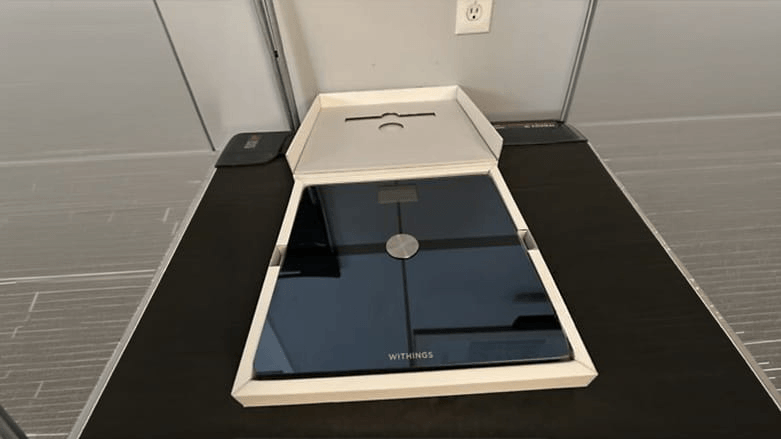
Another minor drawback is the power source—standard AAA batteries. While they do last up to 18 months, disposable batteries are neither sustainable nor convenient today. At least the first set of batteries comes with the device, so you don’t have to purchase them separately.
Alongside the device, the box includes four snap-on carpet feet to keep your readings accurate if you have to place the scale on a soft or uneven surface.
Overall, the setup experience was smooth. After unboxing it, I flipped the scale over and pulled the clear plastic tab poking out of the battery door. The screen turned on, and syncing it to the app took just a few minutes. If you’re interested in knowing more, I’ll dive into the process deeper in the next section.
App experience
As is standard with smart scales, syncing the device to the app requires setting up an account. With Withings, you can log in using Apple or Google, which is very convenient and saves you from having to come up with yet another password. Once you’re in, the app asks for your height, gender, and age—the basics.
With your profile set up, you can start the pairing process. First, you connect the scale via Bluetooth, which takes a single tap on the app's scale icon and syncs in just a few seconds. Once Bluetooth finds the device, it will ask to connect to your Wi-Fi.
Connecting to Wi-Fi is a big perk of this device. Because the scale pushes your data directly to Withings' cloud servers, your weigh-ins sync to your phone automatically, without having to pick it up. Plus, it uses that internet connection to pull up your previous data and display the morning weather forecast.
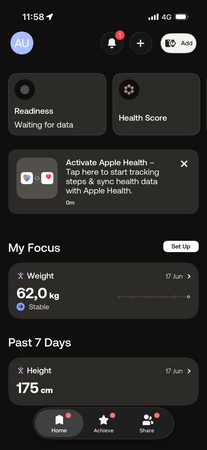
The dashboard design and data visualization are similar to other products I’ve tested. It’s nothing revolutionary, but it’s clear and gets the job done. It shows the raw data and tracks your progress, but it doesn’t really go deeper than that. It doesn’t offer detailed explanations or lifestyle recommendations—the app essentially hands you the data and leaves it up to you to decide what to do with it.
Another nice advantage of Withings Body+ is that it integrates with Apple Health and Google Fit, so you can keep all your health data in one place. Plus, it allows multiple user profiles, which is very convenient for sharing the scale with your household members.
How accurate is Body+
Like any scale, Withings Body+ is highly accurate for measuring your body weight. While the brand notes a 0.2lb (100g) margin of error, this is completely standard across the industry. For daily weight logging, I found that it does its job nicely.
However, when it comes to measuring body fat percentage, muscle mass, and water weight, the accuracy slightly drops. This is to be expected, as no at-home scale can measure body composition with 100% accuracy, since daily hydration levels and other factors can have an impact on measurements.
As with any competitor scale on the market, keep in mind it’s much better to look at long-term trends rather than absolute numbers.
Living with Body+
Since I was already using smart scales, working Withings Body+ into my daily routine was no issue. Previously, I would step on the scale first thing in the morning—after using the bathroom, but before eating or drinking—to get the most accurate measurements. I did the exact same with Withings to give it a fair test.
Because it sticks to key biomarkers, my daily weigh-ins were quick, usually taking under 30 seconds. A nice touch at the end of each body scan was the weather forecast, which helped me prepare for the day ahead.
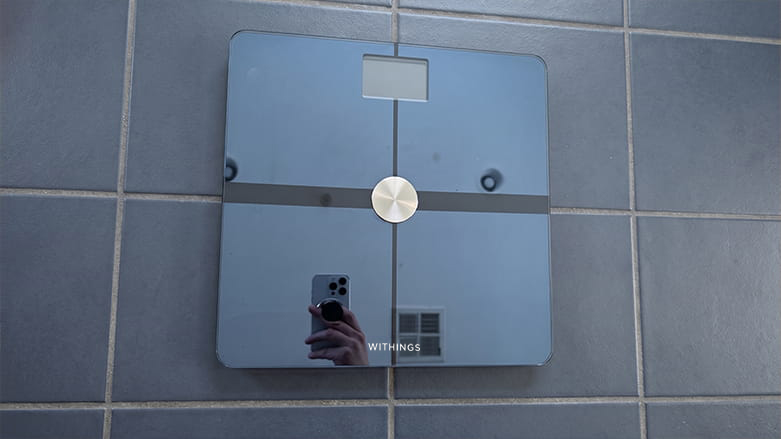
Sharing the scale with my partner allowed me to test the multi-user recognition, and without fail, every time we stepped on it, it never confused the two of us. Syncing was just as reliable thanks to the Bluetooth and Wi-Fi connectivity. I could weigh myself without worrying that my data would be lost, or that I needed my phone nearby to capture it. This meant I could use the scale with almost no conscious effort.
As someone dedicated to tracking my health data, it quickly became a staple in my morning routine rather than fading into occasional use. My only frustration was the small numbers on the screen, but because the scale pushed all the data straight to my phone, I usually just checked my stats there anyway.
Features and functionality
I already discussed Withings Body+ features like auto user recognition and Wi-Fi sync, which make sharing the scale with others and obtaining data easy.
However, I’m yet to mention the modes that Withing Body+ offers. One of them is athlete mode, which involves a different algorithm for calculating fat mass. The brand explains that athletes generally have a different body type, and activating this mode gives them the most accurate body composition data.
There’s also Baby Mode, which allows parents to weigh the smallest members of their family simply by holding them and stepping onto the scale, making it much easier to keep tabs on a child's growth.
The best part is that the data Withings Body+ collects is backed up by Bluetooth. If your Wi-Fi ever goes down, the scale saves your measurements to its internal memory and syncs via Bluetooth to ensure nothing is lost. It can hold up to 16 body scans, so even if you only realize later that there was a Wi-Fi interruption, your data will be safe and sound.
Personally, I can see features like auto-recognition, Wi-Fi sync, and Bluetooth backup being useful for everyone. After all, who wouldn’t want to share their scale with their household members and have the data sync seamlessly to the app? While the baby and athlete modes won’t be used by every single person, it’s great that parents and athletes have this option.
Pricing and value
Withings Body+ currently retails for $99.95. Since smart scales can range from $20 to $500, it falls into the more affordable category.
Even though it launched in 2017, I still see it offering great value in 2026. It reliably tracks your key biomarkers—like weight, body fat, water percentage, muscle, and bone mass—without hiding your health trends behind a monthly subscription.
While you can buy basic smart scales for $20, the Body+ justifies its cost with Wi-Fi syncing, which logs your data automatically without having to pick up your phone. Plus, it instantly recognizes up to eight users and offers customizable modes to fit different households.
It makes sense for anyone wanting hands-free, smooth daily tracking and seamless Apple Health or Google Fit integration. If you’re looking for segmental analysis or advanced heart and nervous system-related insights, then you’ll want to look at upgraded Withings models. Still, I see the Body+ as being more than enough for most users.
Limitations and who should skip it
Since Withings Body+ sticks to the essentials, it lacks advanced health metrics, such as visceral fat, vascular age, or heart rate. Because of this, data-heavy fitness users might not find it sufficient for tracking biomarkers and their progress.
Plus, the insight depth it provides is more limited compared to smart scales like Hume Body Pod, for example. It gives you raw data instead of turning it into actionable recommendations. This might be enough for people who just want to log their daily numbers, but those who prefer guidance might not find it the most helpful.
Additionally, please keep in mind that it’s not a medical-grade device, which essentially means that the measurements you track are best used for spotting long-term trends rather than being treated as absolute facts.
All things considered, I think there are better alternatives for serious athletes or health tracking enthusiasts than Withings Body+. If you’re one of them, you should probably skip it, as it simply doesn’t offer the deeper details required to support your needs.
Other smart scale reviews:
- Hume Health Body Pod review: More than just a smart scale?
- Hume Body Pod vs. Oxiline MD Pro: Which body composition tracker should you buy?
- Hume Body Pod vs. RENPHO MorphoScan: Which body-composition tracker should you buy?
Is the Body+ still worth it in 2026?
For most users, I see Withings Body+ as a worthwhile purchase in 2026. It’s easier on the wallet than most smart scales out there, and it tracks the core metrics that are more than enough for the average person. Plus, it offers a few handy smart features that budget competitors lack.
However, if you’re an athlete serious about tracking as many of your biomarkers as possible, you might want to skip this simplistic scale and look at Withings newer models, as they dive deeper into your health data to fulfill your needs. That said, I’d recommend Body+ for anyone looking for a reliable scale to keep on top of their health data.