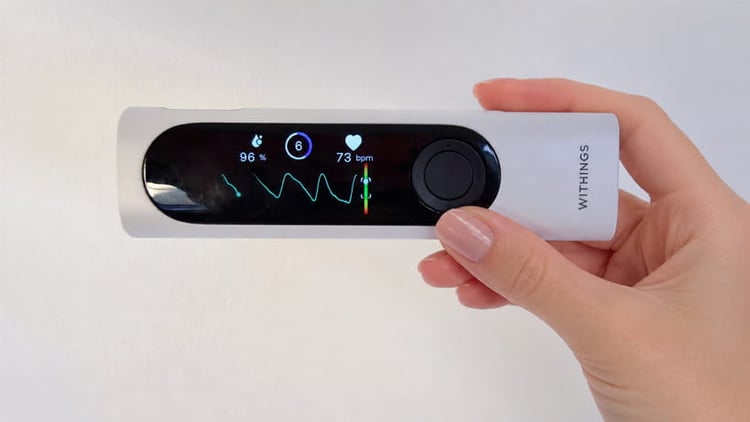
- 4-in-1 wellness monitoring device
- Compact and ideal for everyday use
- Consistent readings
- Excellent battery life
- Expensive upfront if you already own similar devices
- Digital stethoscope audio quality is disappointing
- Readings interpretation requires Withings+ subscription
With health tech devices finding their way into more homes than ever, it takes something truly unique to stand out. That’s exactly what Withings is aiming for with BeamO.
None of its individual features are revolutionary—you may already own a thermometer, pulse oximeter, or even a smartwatch with ECG capabilities. What makes BeamO different is that it combines four wellness tools into one compact, handheld device you can keep at home or easily put into a bag.
It’s easy to see why home health monitoring has become so popular. Whether you’re short on time, can’t get a same-day doctor’s appointment, or simply want extra peace of mind, having a way to check your well-being from home can be incredibly convenient. Just don’t mistake Withings BeamO for a replacement for professional medical care—it’s not a diagnostic tool on its own.
For my Withings BeamO review, I spent three weeks testing this tool in day-to-day use to see whether this ambitious all-in-one device lives up to its promises. Without further ado, let’s start.
| Product | Withings BeamO |
| Price | $249.95 |
| Battery life | Up to 8 months (rechargeable) |
| Sensors |
|
| Size and weight | 1.46 x 0.75 x 5.35in and 0.18lbs |
| Materials | Polycarbonate, stainless steel, silicone |
| Connectivity | Bluetooth and Wi-Fi |
| Measures | Body temperature, heart rhythm, SpO₂, heart and lung sounds, and more |
| Best for | Busy people who want a quick way to monitor their well-being |
What is Withings BeamO?
At first glance, Withings BeamO looks like a modern thermometer, or even a TV remote, if you ask me. In reality, it’s much more than that. BeamO is a handheld wellness monitoring device that packs four commonly used wellness tools into one gadget:
- Contactless thermometer. Measures your body temperature by scanning the temporal artery on your forehead.
- ECG. Built-in 1-lead ECG records your heart’s electrical activity in about 30 seconds, aiming to detect potential signs of atrial fibrillation (AFib) and measure your heart rate.
- Pulse oximeter. Measures your blood oxygen saturation (SpO₂) and heart rate, which may be helpful during respiratory illnesses.
- Digital stethoscope. Records heart and lung sounds that you can review yourself or share with a healthcare provider.
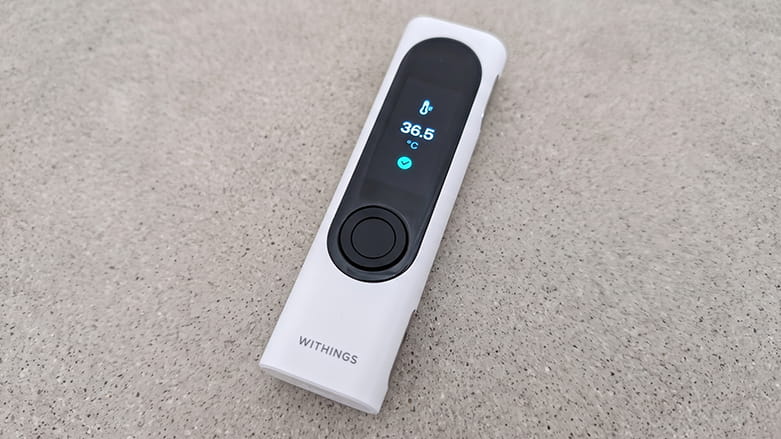
Withings likes to call BeamO the “thermometer of the future”, and I think that description is quite fitting, since it gives you a broader picture of your well-being in a matter of minutes. Basically, instead of reaching for several separate devices when you’re feeling under the weather, you can perform multiple wellness checks with a single gadget and keep all your measurements organized in the companion app.
The device has received FDA clearance for its intended uses, but it’s smart to set the right expectations. The goal isn’t to replace actual medical equipment or your doctor, but to give you an at-home monitoring tool that may help keep track of your health over time.
Who is BeamO actually for?
To me, Withings BeamO’s biggest advantage is convenience rather than brand-new functionality. I’d recommend it to anyone who likes keeping an eye on their wellness without cluttering their homes with separate gadgets. It makes particular sense for families with children, older adults, caregivers, frequent travelers, or people managing long-term conditions.
Just remember to think of BeamO as a home health companion—not a replacement for professional medical advice or routine checkups.
My take on BeamO price and value
From my perspective, Withings BeamO offers enough value to justify its $249.95 price tag. Still, I can also see why the upfront cost might make some buyers pause.
Think of it this way: if you don’t already have devices that offer BeamO’s core features, buying an all-in-one tool makes more sense. If you already do, though, I’d say ask yourself whether BeamO’s convenience alone is enough to justify the upgrade.
One thing I particularly appreciate is that Withings BeamO encourages you to focus on long-term trends rather than individual readings. Withings App automatically stores your measurements, making it easy to track temperature, heart rhythm, blood oxygen levels, and other metrics over time. Having that history may be far more useful than relying on a single measurement when you’re feeling unwell.
Withings also includes free shipping, a 30-day return policy, and a 2-year manufacturer’s warranty. Nothing too unexpected, but these buyer protections add some reassurance if you’re hesitant about the investment.
Should you get the Withings+ subscription?
For most people, I’d skip it. BeamO works perfectly well without a Withings+ subscription—you don’t lose access to any of the device’s core measurements or hardware features.
The subscription mainly adds AI-generated wellness insights, personalized coaching, and services like Cardio Check-Up, where eligible ECG recordings can be reviewed by a cardiologist, depending on the region. Those extras may appeal if you’re using other Withings products, but I don’t think they’re essential for everyone, so I’d save the $9.95/month (or $99.50/year).
Getting started: Setup and app experience
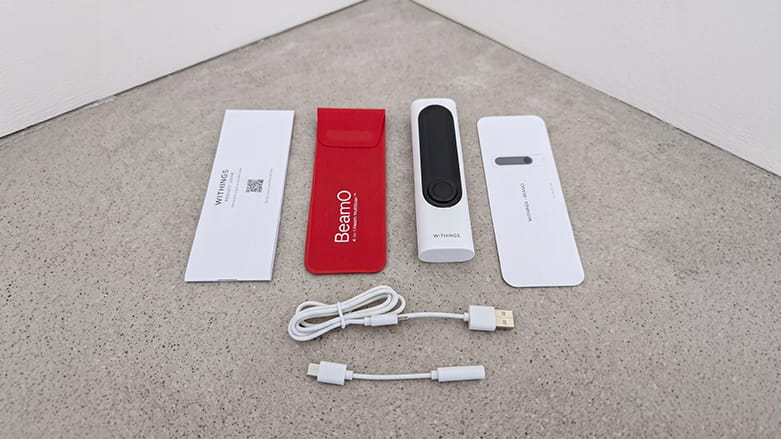
To be straight with you, I was a little nervous to use Withings BeamO. It was the first time I’ve got my hands on this type of device, and all those medical-sounding features made me think there would be a steep learning curve.
Surprisingly, that wasn’t the case. You’ll need to install Withings App on your iPhone or Android first, and then the app prompts guide you through the setup process step by step.
BeamO supports both Bluetooth and Wi-Fi, but if you’re planning to use it mainly at home, I’d recommend connecting it to Wi-Fi during setup. In my experience, it made syncing feel more reliable.
Another feature I appreciated is support for multiple user profiles. This is especially practical if more than one person in your household plans to use BeamO—everyone’s measurements are stored separately in the app, making it much easier to keep track of individual well-being histories.
Just a thing worth considering is that the app mainly shows your measurements and long-term trends without interpreting them for you. While some premium Withings+ features offer insights, your readings should still be viewed in context. To interpret such information, you need prior knowledge, willingness to research, or consultation with a healthcare professional.
My issue with Withings App
Overall, I found the app easy to navigate. The dashboard is clean, graphs are simple to read, and it’s straightforward to browse previous measurements. Still, while I wouldn’t call Withings App bad, I can’t truly compliment it either.
The biggest issue I encountered—and one that’s often reported by other users on Reddit and Withings support forums—is syncing delays. Sometimes, measurements don’t appear in the app, requiring a manual refresh, reconnecting the device, or even reinstalling the app. This issue takes time to fix, and I found it bothersome enough to call out in my Withings BeamO review.
Testing BeamO's wellness features in everyday life
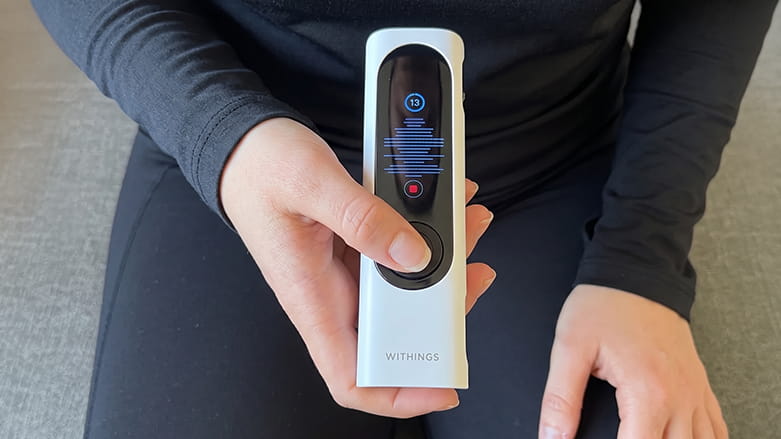
Using the thermometer
As you might expect, the thermometer ended up being the BeamO feature I used the most and the easiest to understand. According to Withings, the HotSpot Gen2™ sensor automatically locates the temporal artery to help you with a session. All you have to do is point it at your forehead, follow the on-screen guidance, and within seconds results appear on the display.
I was very impressed with the consistency. Taking several measurements back to back produced very similar results, which is exactly what you want from a home thermometer. After a few weeks of testing, I also noticed something I’d never really paid attention to before: my temperature wasn't exactly the same every day, despite not being sick.
I’ve read that body temperature naturally fluctuates throughout the day, and research shows that in women it typically rises by around 0.5–1.3°F at certain menstrual cycles.
That said, BeamO isn’t a cycle-tracking device, since it isn’t designed to measure basal body temperature after waking up. Fluctuations I noticed may have been due to other factors, but you should treat this more like an interesting observation rather than a confirmed feature.
Recording an ECG
The ECG feature was almost as easy to use: you place two fingers on the electrodes and stay still for about 30 seconds while BeamO records. Once it’s finished, the app displays your heart rate and checks for potential signs of AFib.
Personally, I think the greatest value isn’t the single reading but building wellness history. If you ever experience palpitations or your doctor asks whether you’ve noticed changes in your heart rhythm, having several recordings ready to export might be useful.
At the same time, it’s worth remembering that BeamO can’t replace a full 12-lead ECG device used in medical settings.
Listening to heart and lung sounds: Digital stethoscope
This is the feature I found the least convincing. Although easy to use, the recordings don’t do much on their own unless you know what you’re listening for. Unlike the ECG, there isn’t a straightforward “normal” result displayed on the screen, leaving you guessing what those sounds mean.
That’s also where BeamO feels kind of unfinished. The recordings are primarily meant to be shared with a healthcare professional rather than interpreted at home. I also found the audio quality quite poor.
Overall, for online doctor appointments, I can see the feature being potentially useful, but as a standalone reason to buy Withings BeamO—I think it’s the weakest of the four.
Monitoring with pulse oximeter
The pulse oximeter is another function that I believe adds value to Withings BeamO. Using it is as quick as placing your finger on the sensor and waiting a few seconds for your blood oxygen saturation and heart rate to appear on the display. Keep in mind that readings may be affected by finger placement, movement, or even cold hands, so don’t panic if the first attempt fails.
During my testing, readings were repeatable, although understanding what the numbers actually meant took a bit of research. I found BeamO much more useful for spotting trends than obsessing over numbers. This gives you context over time.
Verdict: Should you buy Withings BeamO?
After spending several weeks with Withings BeamO, I think it’s one of the more practical wellness gadgets I’ve tested. It doesn’t try to replace your doctor, but it does make it much easier to track your well-being. You also don’t have to use every feature every day—the value comes from having them available whenever you need them and building a history over time.
I’d skip BeamO if you already own a reliable thermometer, pulse oximeter, and an ECG-capable device, as its price is quite high upfront. Also, look elsewhere if the digital stethoscope is your main reason for buying, since it’s the least reliable feature.
On the other hand, I’d recommend Withings BeamO if you want an all-in-one home wellness companion. Families and caregivers may find it especially helpful due to multiple profiles. Frequent travelers may like its compact size and quick sessions.
As for me—BeamO succeeds because it makes routine wellness checkups simple, convenient, and easy to stick with. It’s actually a worthy consideration for anyone.
Our other health monitoring device reviews:
Best pulse oximeters in 2026: Tested and compared
Best ECG smartwatch: Our experiences and ECG explained
Best wrist pulse oximeters in 2026: For sleep, recovery, and health tracking
1 resource