Retimer glasses review: Can light therapy glasses really improve sleep and energy?


- Hands-free design
- Comfortable and lightweight, can be worn with regular glasses
- Helps to track sleep patterns and make progress over time
- Only focuses on improving sleep, not suitable for other use cases
- Light can be too bright if you have very sensitive eyes
Apart from drastically changing your lifestyle habits, there aren't many non-drug options to enhance your sleep, but that’s where light therapy comes in. If you’re often dealing with jet lag, working shifts, or struggling to sleep with seasonal changes, light therapy devices like Retimer 3 might be a good choice for you.
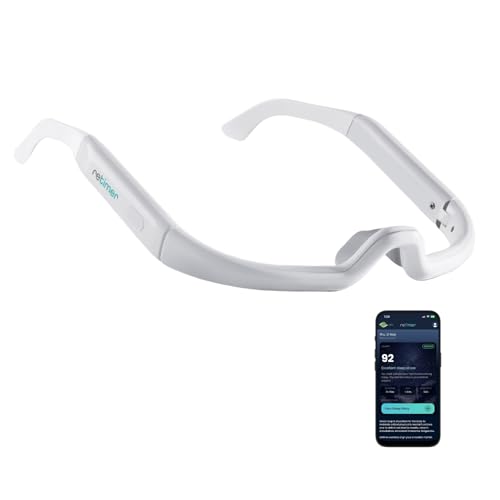
Unlike seasonal affective disorder (SAD) lamps, Retimer 3 comes in the form of glasses, allowing you to move around while receiving light therapy sessions at home. It’s similar to top brands like AYO or Luminette 3, but Retimer 3 shines a blue-green light right under your eyes, rather than bright blue light above them.
While Retimer 3 has a different design from its competitors, I was interested in whether this approach makes it easy to use it daily. For this review, I tested Retimer for several weeks to evaluate comfort, effectiveness, and the practicality of using the device long-term.
What are Retimer glasses, and how do they work?
Retimer 3 glasses are a device that targets and adjusts your circadian rhythm, your internal clock. Your circadian rhythm controls your daily cycle—when you feel awake and when you feel sleepy. If your internal clock is out of sync (often due to seasonal changes, jet lag, or shift work), it might be harder for you to maintain a regular sleep schedule.
Light therapy from Retimer 3 emits specific blue-green wavelengths, which may affect your circadian rhythm. However, since the circadian rhythm controls both your awake and sleep time, it’s important to consider the timing of your light therapy sessions.
If you’re having trouble sleeping at night, you should use Retimer in the morning. Conversely, if you want to feel more rested in the morning and potentially wake up more easily, you should perform your sessions at night.
Design, comfort, and first impressions
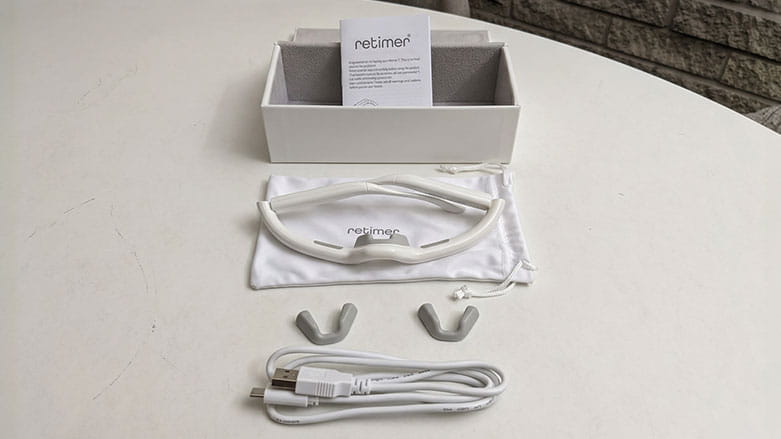
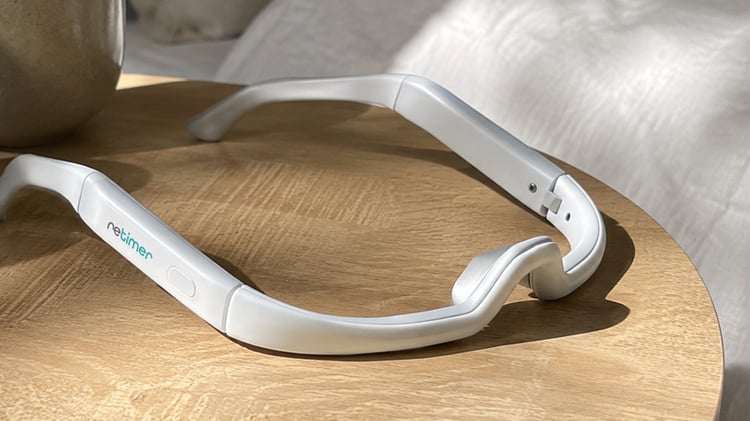
When I first received my Retimer 3, I noticed how compact it is. It came in a relatively small box. Inside it, you’ll get a USB charging cable, instructions, the device itself, and a few nose pieces to help adjust and fit it comfortably to your face.
The glasses came in a small, soft bag that you can use as a travel case. The box itself also seems quite compact yet sturdy, so if I were you, I would keep it and use it when traveling as well. I believe that sometimes a simple bag isn't enough to keep the device safe from accidents.
Retimer 3 is made out of plastic and silicone. Overall, it’s very light, but it's also quite premium quality and firm. Since it’s lightweight, it feels very comfortable to wear during sessions, especially if you’ll use the additional nose pieces and adjust the glasses to fit your face.
I also liked the modern, minimalist design. Other light therapy glasses are usually very bulky, but Retimer 3 is nothing like that. If you wear regular glasses, you don’t need to take them off during light therapy sessions with Retimer 3. Since it’s underneath your eyes, you can wear both glasses at the same time.
Setup process and everyday usability
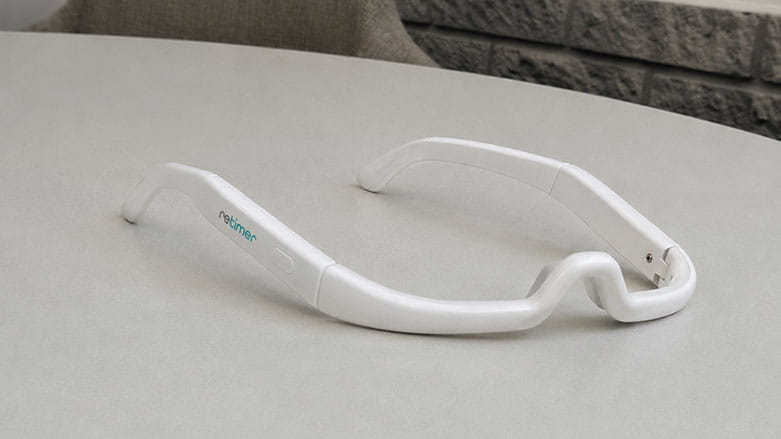
I found Retimer 3 to be quite straightforward, with no unnecessary features and minimal settings. It also comes with detailed instructions in the box and a quick overview of how to get started, so you shouldn’t encounter much trouble.
To start using these glasses, first fully charge them and download Retimer’s app on your iOS or Android phone. You’ll also need to pair it using Bluetooth. To do so, turn on the glasses using the side button, and a blue light will appear once it recognizes the device. If it didn’t work at first, I found that you need to simply press and hold the button again.
If you have never used such devices before, be aware that the light can seem bright at first, especially if you have sensitive eyes. However, you should get used to it quickly. Besides, it has two brightness levels (Low and Regular), so you can adjust it. If you find the Regular mode too bright, you can switch to Low, which should be much more comfortable.
During my tests, I also noticed that it doesn’t need to be charged very often. A full charge took me about an hour. After that, I used it for about six sessions before I needed to charge it again.
Since the setup process was quite easy and it doesn’t require much input per session, I believe it's easy to use Retimer 3 daily. The best part is that it’s hands-free, meaning that you can read or walk around during your sessions without interrupting your schedule.
Living with Retimer for several weeks
To fully understand if light therapy might be effective for you, you’ll need to use it for quite some time. For this review, I used Retimer every day for over a month.
The first week was all about getting used to daily light therapy sessions. During this time, I found that Retimer 3 is definitely a lightweight, straightforward device. However, even then, I still had to re-adjust the glasses a few times for them to fit perfectly on my face.
The most convenient thing about Retimer 3 is that it’s hands-free. While I at first tried relaxing during my sessions, it quickly became too boring for me, and I simply moved on with my day by working, cleaning up, or reading with Retimer 3 on.
By the second or third week, I was completely used to the device, and it had become a natural part of my routine. During this time, I also noticed how useful Retimer’s app is. Using it, you can log your sleep and view your report, which shows how long and how efficiently you slept. While this doesn’t seem very extensive, it definitely motivates you to stay on track with your sleep schedule.
It doesn’t give instant results, so you will need to use it consistently for quite some time if you want to potentially change your sleep patterns. Even using it for a month, I wouldn’t say that my life changed completely. I did try going to bed earlier, and it usually helped me to fall asleep faster. However, I’m almost certain that changes in my sleep schedule had a greater impact on my rest than blue-green light alone.
Pricing and overall value
There are definitely way cheaper light therapy gadgets than Retimer 3. However, I still believe that it offers a competitive price. Comparing it to other devices, Retimer costs similarly to AYO and is only slightly more expensive than Luminette 3.
If you’re not sure just yet, you can easily test it out first. Retimer 3 offers a 30-day money-back guarantee, giving you more than enough time to decide whether it's for you. If you decide to stick with it, you also get a 1-year warranty.
While not the cheapest option, I believe the price is justified given the value Retimer 3 offers. The device's biggest advantage is its comfort. This is one of the key factors: if the gadget is comfortable to use, you are more likely to stick with it in the long run.
What you should know before using Retimer 3
The whole purpose of light therapy is relaxation, circadian rhythm balancing, and better sleep patterns. However, as with other at-home gadgets, you should be aware of potential side effects, especially if you use it incorrectly.
Although Retimer 3 is generally safe, in rare cases, you may experience eye strain, headaches, or nausea. If you feel any of these symptoms, I recommend stopping the session. Even if you don’t experience any of these symptoms, using the device incorrectly can further disrupt your circadian rhythm.
Besides, if you have any eye conditions, have undergone eye surgery, or take medication that might increase photosensitivity, you should consult with your doctor before using Retimer 3 or any other light therapy glasses. The brand itself even recommends not using the device if you have bipolar disorder, as it might trigger manic episodes.
Other light therapy device reviews:
- Luminette glasses review: A sleep tool that can genuinely shift your rhythm
- Kiierr Laser Cap review: Easy-to-use but slow results
- BON CHARGE Red Light Face Mask review: Premium-feeling mask that makes consistency easier
- Flikeze red light therapy panel review: A solid red light therapy panel for beginners
Verdict: Should you buy Retimer glasses?
The blue-green light that Retimer 3 shines is closely related to improving your internal clock, if used consistently. I believe that Retimer 3 might be a good choice if you’re someone who’s working shifts or travels a lot and needs help with your sleep schedule. However, if you’re looking for a quick fix, it’s not the device for you.
While the price is quite premium, I believe that it’s justified considering the quality Retimer offers. Most importantly, it’s a comfortable, lightweight, and beginner-friendly device. This means that it won’t be hard to use daily as it requires only minimal input. If you’re ready to use it daily for quite some time, Retimer 3 might be worth it.
-
Journal of Biological Rhythms.
-
Sleep and Breathing.