My Muse 2 review: helpful meditation tool or expensive wellness gadget?

- Ideal tool for meditation tracking
- Unique technology
- Gamification elements
- High price for what it is
- Frequent connectivity issues
I have lost count of how many times I have tried to incorporate meditation into my routine. If I had to guess, I'd say around 10. Sometimes I would quit after 2–3 days; I once managed to stick it out for the whole month, but nothing beyond that.
For me, meditation felt unrewarding. I know it is helpful in so many ways, but seeing no improvements straight away made the boredom unbearable. Besides that, I sometimes felt anxious during my sessions.
This is why Muse 2 appealed to me: give me anything that helps to sustain motivation, and I will test it out. Additionally, I was interested to see if my unexpected nervousness would show up in the stats—I am a big fan of tracking things, as if mere tracking has the power to change my life for the better.
In this Muse 2 review, I will share all I’ve learned about Muse 2 during a one-month testing period: from how it helped with consistency to whether biofeedback actually improved my focus.
| Product | Muse 2 |
| Product type | Biofeedback meditation headband |
| Price | $249.95 |
| Subscription | Not required, $109.99 per year |
| Sensors | EEG, PPG, accelerometer, gyroscope |
| Tracks | Brain activity, heart rate, body movement, breathing |
| Best for | People who struggle with meditation consistencyData-driven personalitiesPeople who enjoy gamification |
What is Muse 2 and how does it work?
Muse 2 is a device for people who want to improve their meditation sessions.
The way it aims to achieve that is quite unique: it monitors your brain activity, heart rate, breathing, and body movement to give you real-time feedback. Essentially, it is a tool that nudges you when your mind wanders.
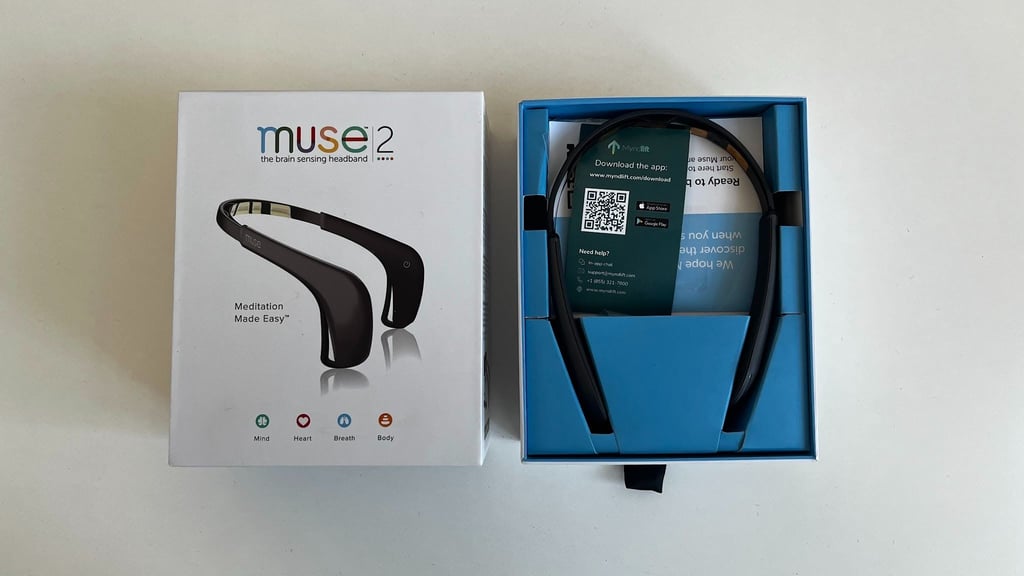
While this initially sounded gimmicky to me, when you read more on how Muse 2 tries to achieve that, the device has some rationale behind it. Muse 2 has several sensors: EEG to detect brainwaves, PPG to detect heart rate, and an accelerometer for movement and breathing.
Some of these sensors are common in the wellness niche; for example, accelerometers are found in phones and wearable fitness devices, but an EEG sensor is a rare find in consumer devices.
So, what is it? EEG stands for electroencephalogram, a technique used to measure electrical activity in the brain. At medical settings, EEG may be used to diagnose epilepsy—but Muse 2 is not intended to be used as a medical device.
In fact, it uses fewer sensors than medical equipment, but the goal is totally different here. The brand states that Muse 2 may detect potential shifts in brainwave activity, either alpha, beta, and theta wave patterns, which, in turn, are translated into real-time feedback during your meditation session.
In practice, you are guided by sounds. When your mind is calm and focused, the sounds you hear are gentle weather sounds. As your mind starts to wander, the soundscape follows: the weather picks up, the wind grows louder.
The way I see it, Muse 2 is meditation on training wheels, which, depending on your perspective, is either brilliant or entirely missing the point.
Price, subscription, and value
At a retail price of $249.95, the Muse 2 is positioned as a high-end device. While it can be used for free, to unlock more insights, AI coaching, and extra guided meditations, you will have to pay an extra $109.99 per year.
The free version of the app gives you access to the core feature—real-time EEG biofeedback during meditation sessions—along with basic post-session stats. That's enough to use the device, but the library of sessions feels limited after a few weeks, especially if you like variety.
Assessing its overall value is complex, given that the Muse 2 occupies a distinct niche where alternatives typically offer a different set of tools.
For instance, when compared to meditation apps, Muse 2 is more expensive. Headspace costs $69.99 per year—with no hardware to purchase. And if you want a physical gadget, there is Sensate—a device you put on your chest during relaxation sessions. This one is priced slightly more at $269.00, although their premium (also optional) is cheaper, at $49.99 per year.
But the selling point of Muse 2 is probably EEG: after all, the ability to directly measure brainwave activity is something meditation apps and vibration-based devices cannot replicate. Whether that data actually makes you a better meditator is debatable, but it does offer something genuinely unique at this price point.
Compare this to Sens.ai, which likewise uses EEG technology, but at a significantly higher cost of $1,250. However, Sens.ai is categorized as a brain-training device rather than a dedicated meditation tool.
To sum up, Muse 2 is genuinely unique in its niche—not because it's the best meditation tool on the market, but because nothing else does quite the same thing.
Design, comfort, and first impressions
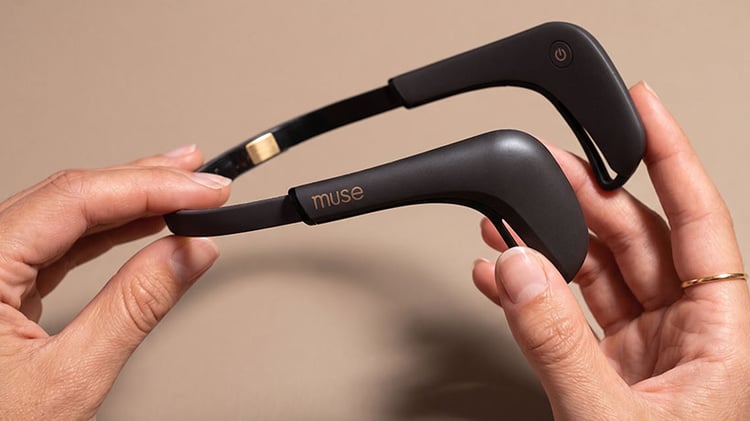
Muse 2 looks like a slim, curved headband. It's lightweight and sits across your forehead, with two arms that rest behind your ears. The sensors make contact with your forehead, which is where the EEG and PPG readings are captured.
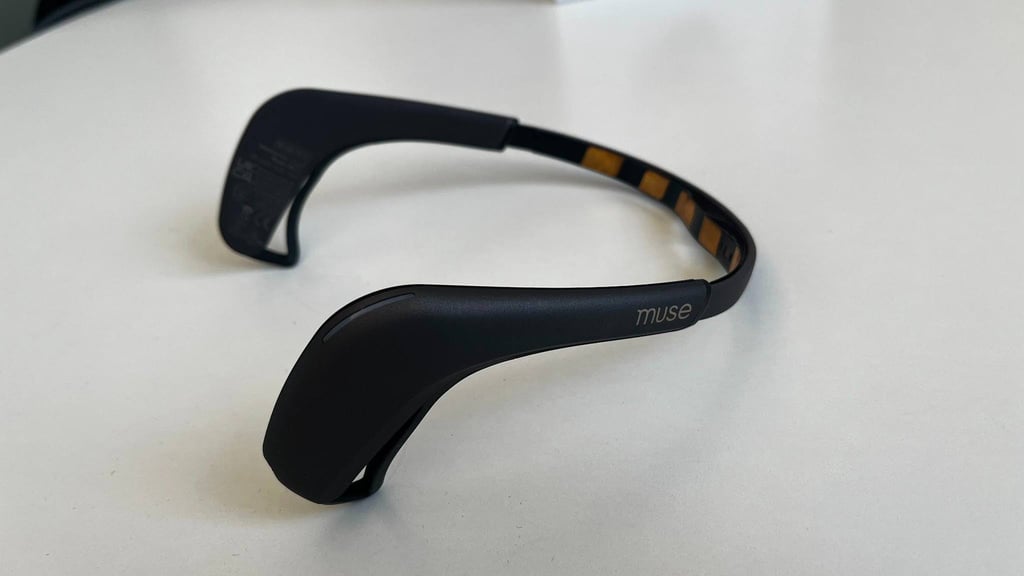
The headband size is adjustable and I didn’t have any issues with the fit. I asked a few of my colleagues to try it on, and this yielded no complaints whatsoever.
Muse 2 feels delicate—most likely to keep the weight low to increase comfort. There is no case in the box, which I found disappointing: there is no way I would carry this thing around without one.
On the other hand, it is not a device to use in public: even if you like meditating outside, being seen with the Muse 2 is most likely to draw unwanted attention from passersby. Muse 2 design is unconventional, like something pulled from a sci-fi set. Every time I explained it to friends, the reaction raised eyebrows and skepticism rather than genuine enthusiasm.
App experience and everyday usability
Muse 2 is controlled through the app—and that was quite troublesome during my testing.
On most days, the headband paired without issues. But at least a few times a week, it simply wouldn't connect immediately, and it would take several attempts before the app recognized the device. Looking at user reviews, this is clearly not just my experience: connectivity complaints are by far the most common criticism of the Muse app.
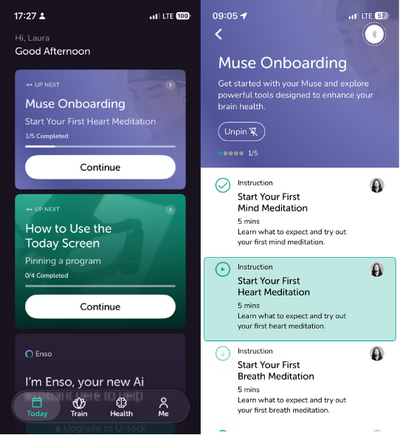
Once connected, setting up wasn’t complicated, especially since you learn how Muse works through the onboarding program. You choose the type, set the duration, and start. After the session, you get a breakdown showing how much time you spent in "calm," "neutral," and "active" brain states.
What kept me coming back, however, was the various awards you get for your meditation sessions. As someone hooked on Apple Fitness goals, this felt familiar—but instead of physical challenges, I was challenging myself to go deeper into meditation.
Seeing a score after each session, watching my calm percentage trend upward over days, and trying to beat my previous sessions made meditation feel more like a skill I was building rather than just sitting still. But after a while, I noticed that I was chasing the score rather than actually being present. In a way, I was optimizing for the app, and those newly gained skills didn’t transfer to sessions without Muse 2.
My experience using Muse 2
Week 1
The first week was chaotic: getting used to Muse 2 wasn’t as easy as I expected. During my first session, I needed to adjust the band three times—quite a lot for a 5-minute session. To make the matter worse, hearing the rain getting stronger (signaling that my mind is wandering) made me anxious. No wonder I scored 21% “calm” on my first session. Quite disappointing, especially since the app told me that on average, beginners score 41%.
After the initial adjustment period, I finally got the hang of it—and this is when it became more fun. Seeing the graphs of my brainwaves felt stimulating, unlike what I'd feel after a traditional meditation session. Additionally, the awards started rolling in for things like hitting a streak or completing a certain number of “calm” minutes. I found myself wanting to meditate just to see what else is there to unlock.
Weeks 2–3
After having my baseline ready from the first week, I started comparing the stats. My calm percentages were gradually climbing—not dramatically, but enough to notice week over week.
The anxiety I sometimes experience during meditation showed up in the stats. Restless sessions consistently scored higher on "active" and lower on “calm”. Seeing that data was oddly reassuring—but, I will be upfront, it did not match all the time.
For instance, I had one terrible session after a dentist appointment during which I became preoccupied with dental ache instead of my breathing (go figure), and yet, the app congratulated me on a great performance. In a way, I was meditating—but my focus was on pain instead of what I “should” be focusing on. Besides that, I wasn’t calm during the session, and Muse 2 didn’t pick up my lingering worry about the appointment.
Week 4
Upon the final week, I was excited to finally drop the device. While the gamification elements kept me coming back, I once again found myself drifting away from meditation. Not only does it take my precious time, but it also reveals various aches and pains that I haven’t noticed before—not the fault of Muse 2, of course. On the good side, I must admit that Muse 2 increased my compliance. But I wasn’t testing in a vacuum: I was preparing for this publication after all.
Does Muse 2 actually improve meditation?
This depends on what you mean by "improve."
If you mean: does it help you sit down and meditate more consistently? In my case, yes—but with a massive asterisk. I completed a full month of near-daily meditation, which is more than I've managed in years. Whether that was Muse 2, I can’t honestly say, but in the end, it felt like I was coming back for the awards on the screen, not the meditation itself, which I would argue defeats the purpose.
On top of that, I'm not convinced it made me a better meditator. The skills I developed felt tied to the device—dependent on the audio cues and the scores rather than rooted in any deeper awareness.
That said, for someone who struggles to meditate at all, having any structure and feedback is arguably better than having none. Whether Muse 2 is the bridge that eventually leads you to a self-sustained practice probably depends on the person. For me, it wasn’t—but I can see how it could help others.
Accuracy, science, and credibility
Muse 2 uses four EEG electrodes to pick up electrical activity in your brain. Medical-grade EEG setups can use 32 or more electrodes, so four is a significant reduction—so the question is whether that’s enough to tell you anything meaningful.
Based on what I found, the answer is: yes, it might. For what Muse 2 is assessing, its technology may be sufficient, and the headband has been used in several studies to assess whether it actually picks anything up.
For instance, in one study, Muse headband was used to classify stressed versus non-stressed mental states. Researchers recorded EEG signals from 35 participants while they watched emotionally charged clips, then built a deep learning model to sort the data into stress and non-stress categories. As per the paper, they achieved 93.17% accuracy.
More relevant to everyday use, a pilot study gave the Muse headband to 40 healthcare professionals during the COVID-19 pandemic. After 90 days of short daily meditation sessions (averaging about 6 minutes each), researchers observed statistically significant reductions in stress and improvements in resilience, quality of life, and cognition. This is not surprising, knowing that meditation itself has been linked to these and similar effects.
In other words, the sensors in Muse 2 have been studied for accuracy and seem to be sensitive enough to pick up certain changes in brain activity. The associated benefits of using Muse 2 could be linked to meditation itself, and you do not have to use the band if you want to achieve them.
Reviews of other relaxation devices
Pulsetto: Learn more about non-invasive vagus nerve stimulation and how it may help increase stress resilience
Best vagus nerve stimulation devices: Delve deeper into VNS devices
Sensate: A calming device for quick mindfulness sessions
Final thoughts
For me, Muse 2 seemed like a gimmicky device that aims to be high-tech but ultimately serves as a motivational tool rather than helping you delve deeper into meditation. At $249.95, it's a significant investment, and I wouldn’t jump into the purchase before trying something else.
But if you've tried everything else and nothing has made meditation stick, Muse 2 might be the nudge you need. EEG biofeedback is genuinely unique, and there's nothing else at this price that offers the same. If you find gamification elements helpful for habit-building, Muse 2 does them well. But in the end, you do not need a device to start meditating—and sometimes the traditional way is just enough.
-
Computational Intelligence and Neuroscience. Stress Classification Using Brain Signals Based on LSTM Network.
Stress Classification Using Brain Signals Based on LSTM Network.
-
Journal of Primary Care & Community Health.
Mindfulness Using a Wearable Brain Sensing Device for Health Care Professionals During a Pandemic: A Pilot Program.
-
Cureus.
Meditation and Its Mental and Physical Health Benefits in 2023.