- Very easy to use
- Affordable
- Has four wavelengths
- Lacks advanced features
- Build quality feels budget
- Hanging setup can feel awkward due to stiff cable
Red light therapy (RLT) has quickly become one of the biggest wellness trends in recent years. But as more brands enter the market, I wonder if you really need to spend hundreds or thousands of dollars for a decent experience.
| Product name | Bestqool Half-Body Red Light Therapy Pro100 |
| Price | $319 |
| Rating | 3.5/5 |
| Verdict | Best for first time red light therapy buyers |
| Key specs | 630nm, 660nm (red light) + 850nm, 940nm (near-infrared)100 dual-chip LEDsFDA-cleared10–25 minute sessions |
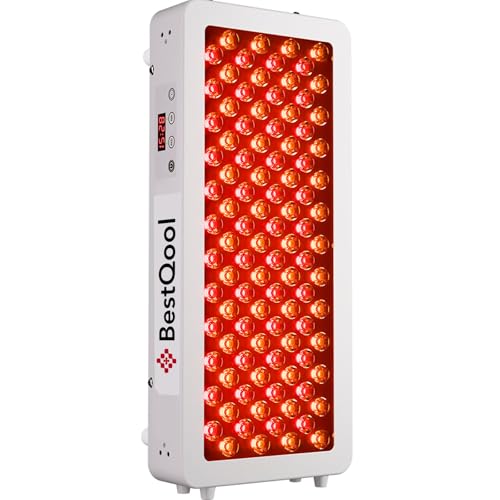
I thought it would be a good idea to test budget-friendly panels to see which ones are worth attention and which feel cheap as soon as you switch them on. I already tried a couple, and now it’s time for Bestqool Half-Body Red Light Therapy Pro100.
This panel is a simple way to try RLT without spending a lot. Before I ordered it, I saw that it’s much more basic than high-end panels. It’s small, light, and doesn’t have app control or extra features.
That simplicity intrigued me, and I wondered if it could still be useful in my daily routine. Over the past four weeks, I used Bestqool Pro100 to see whether it can deliver the same results as premium competitors.
My first impression
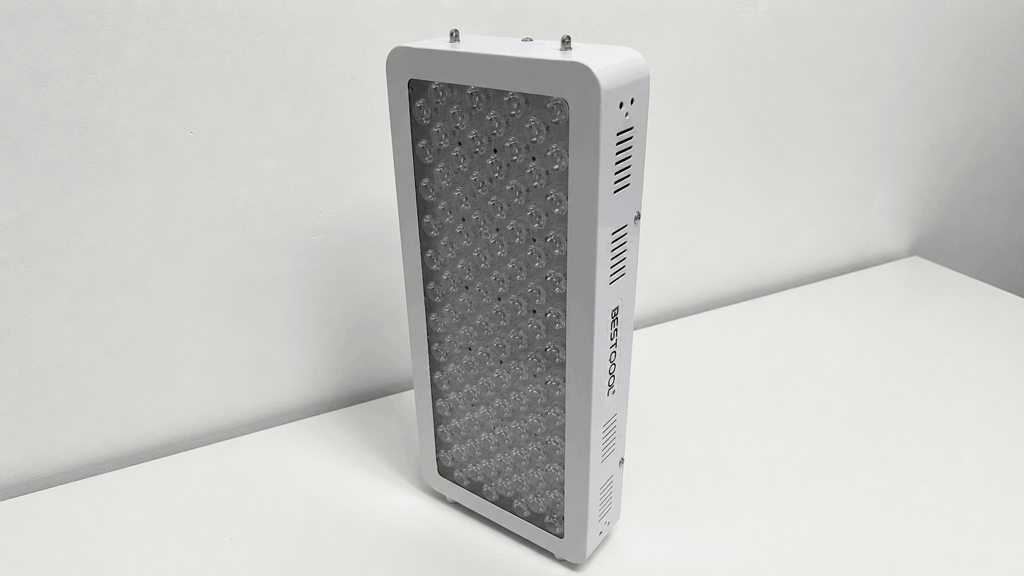
I instantly noticed that Bestqool Pro100 feels much more budget-focused than panels like PlatinumLED BIOMAX 450, which I recently tested. The difference in build quality is obvious straight away. It doesn’t have the same solid, premium feel. But, honestly, you shouldn’t expect that at a lower price.
However, it’s way easier to carry it around the house. It’s almost half the weight of BIOMAX 450, which felt like lifting a heavy panel every time I moved it.
I also noticed that you can buy an adjustable mobile stand separately, but for a panel this small, it looked too bulky. It only makes sense if you plan to stack multiple units or buy the larger version.
I would have preferred a simple tabletop stand, as the one BIOMAX 450 has for added support, because the four rubber feet work fine, but don’t feel secure on every surface.
How practical is this to use at home?
It’s one of the simplest panels I have tried. You basically turn it on with a single button on the side, and that’s it. There is a built-in timer from 10 to 25 minutes, which I found useful. Just knowing myself, I would forget the time and sit in front of it for ages, which is not advised.
One thing that surprised me for a budget device is that it includes four wavelengths, which is impressive at this price. However, unlike premium panels, there are no preset modes or more control over settings.
If you appreciate voice commands or the ability to adjust power intensity, you’ll be disappointed with Bestqool Pro100. On the plus side, you can choose between red light only and near-infrared, which adds some flexibility, but in my opinion, it is not enough.
There is also one friction factor that annoyed me quite a bit. The included hanging kit is nice. The problem arises when you actually try to hang it.
The power cable you plug into the back is quite stiff, making the panel hang unevenly instead of sitting straight. Because of that, I found it more practical to use it on a flat surface rather than mounting it.
Did I enjoy using it?
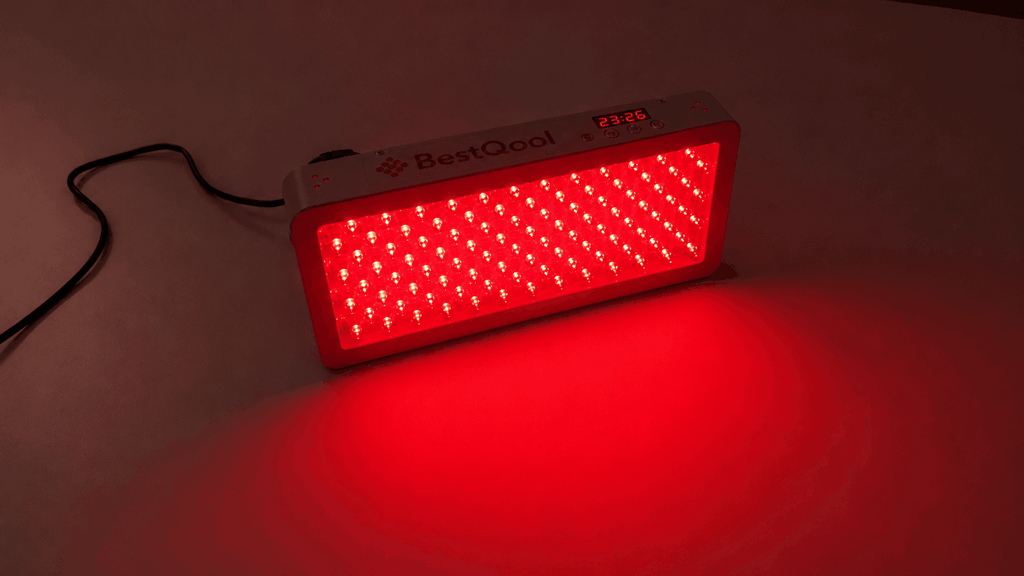
In the first few days, Bestqool Pro100 was easy to get into. You don’t need to read the manual to understand its features, modes, and setup, as usually happens with feature-heavy panels.
It felt familiar quickly since I’ve tested a few other RLT panels before and had an existing routine. After week one, it blended into my daily routine easily. I’d switch it on, set the timer for 15 minutes, and let it run while I read a book or watch a movie.
By weeks 3–4, the experience didn’t change much, mainly because I only used it for a short testing period and wasn’t planning a long-term routine.
Overall, I didn’t face major challenges, but I also didn’t feel strongly attached to it. Yes, it’s a great RLT panel for people who have never tried one before, but for more advanced users like me, it was a bit boring.
Have I noticed anything after 4 weeks of using Bestqool Pro100?
Compared to some other RLT devices I’ve tested for longer periods, four weeks with Bestqool Pro100 is relatively short. Because of this, I can only talk about smaller changes I noticed rather than bigger ones.
Most RLT devices rely heavily on consistency over months, not weeks, and Bestqool Pro100 didn’t feel different in that regard. One thing I noticed for sure, which happened with almost every panel I’ve tried, is that morning sessions seemed to put me in a better mood for the rest of the day.
Maybe that’s because having any routine or wellness ritual feels mentally grounding, or maybe RLT may help support energy levels and seasonal mood shifts in some people.
As for physical improvements, the effects were subtle. My skin looked slightly glowier and less tired on some mornings, but nothing dramatic enough to confidently credit the panel alone. Also, it’s hard to say whether any of this should be attributed to Bestqool Pro100 or other panels I’ve already tried.
I also didn't notice much relief in my muscle tension after four weeks. That's probably the main thing to remember with these devices: they may help your routine, but big improvements are unlikely, especially in a short test period.
Bestqool vs. alternatives
If we look at other panels on the market, Bestqool Pro100 brings strong competition to the budget category. For example, compared to Hooga PRO300, one thing that distinguishes Bestqool Pro100 is the wavelength variety.
For a similar price, Hooga PRO300 offers fewer wavelengths, while Bestqool Pro100 includes four.
Against something like the MitoPRO 300+, the comparison shifts. It also offers four wavelengths, but the overall design feels more premium. The trade-off is that you’ll pay more for that refinement.
Then there’s PlatinumLED BIOMAX 9th Generation range, which is on the opposite side of the market. Those panels are larger, more powerful, and packed with extra features like adjustable intensity and voice control.
Those are for people who want more than just a basic plug-and-play panel. But all those extra features and options mean a much higher price. That's where Bestqool Pro100 stands out—it stays affordable but still feels like decent quality.
Is Bestqool Pro100 worth the investment?
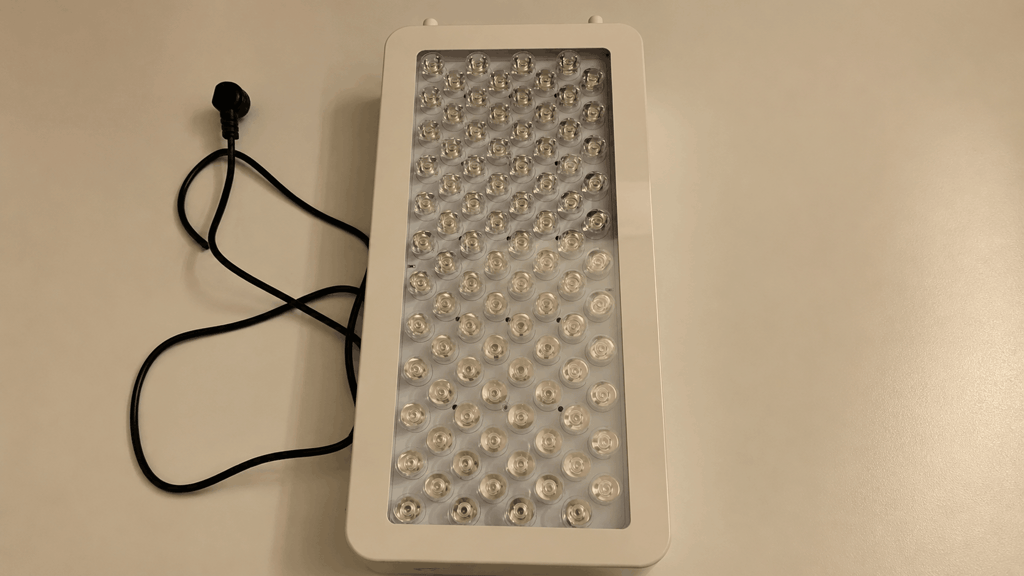
I think Bestqool Pro100 is fairly priced for what it offers, especially compared to budget-friendly and premium panels. It doesn’t compete with high-end devices in features and design, which is why it stays accessible.
So, is it worth your money? In my experience, yes, but mainly if you’re looking for something simple. It makes sense if you want to try RLT for the first time and aren’t sure whether you’re ready to splurge. You can always upgrade later to something more powerful or feature-rich.
Things to know before buying Bestqool Pro100
It's a good idea to think about a few practical things before buying the Bestqool Pro100. That way, you can be sure it fits your needs and expectations, not just what looks good on paper.
Size and coverage
Bestqool Pro100 is a mid-size panel, so it’s good for targeting your face, neck, shoulders, or upper body. It’s not meant for full-body use, so it’s best for focusing on certain areas.
Price and value
It sits in the more affordable category, which is one of its main strengths. You get four wavelengths at a lower price, but you accept a more basic design and fewer premium features.
Safety
Like with any RLT device, there are a few things to remember before using it. It’s important to stick to the recommended session times, since longer use doesn’t necessarily lead to better results.
As the panel is bright, use the included eyewear or keep your eyes closed during close-range sessions. Most importantly, remember that Bestqool Pro100 isn’t a standalone solution for your health concerns—it may only help as part of a broader routine.
Plug-and-play simplicity
Bestqool Pro100 is simple in design and features. You just switch it on and use it. This might appeal more to RLT beginners. If you want advanced controls, customization, or smart features, this probably isn’t the right panel for you.
Final word
Overall, Bestqool Pro100 does the job without making RLT complicated. That said, after testing it alongside other panels, I think there are better options if you want more power, features, and a higher-quality design.
In the end, it all comes down to your preferences. There is nothing wrong with wanting a simple RLT panel, and that’s where Bestqool Pro100 fits.
-
The Journal of Nervous and Mental Disease.