We explored the best-rated TENS units for home use—here are our suggestions for comfort, convenience, and daily use
With so many health tech gadgets on the market today, it might be difficult to work out which ones are actually useful and which are simply the latest trend. If you’re looking for a drug-free, non-invasive way to help manage pain at home, a TENS unit is one option worth checking out.
Transcutaneous electrical nerve stimulation (TENS) is a well-studied technology that may provide short-term pain relief for some people by delivering gentle electrical pulses through the skin. While it isn’t a replacement for prescribed treatments or guaranteed to work for everyone, many people use it as part of their daily support.
In this article, we’ve gathered our picks for the best TENS units for home use after researching the technology and testing some of the most standout models in 2026. Our recommendations are here to help you find the option that best fits your lifestyle and needs.
Quick picks: Best TENS units for home use
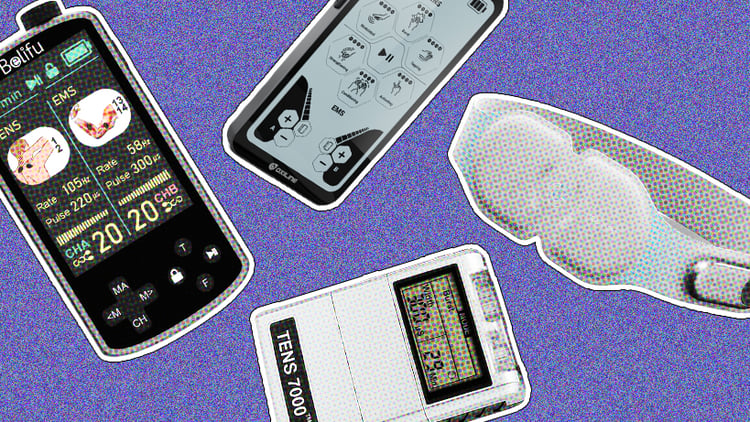
- Oxiline TENS XS Pro: Best for feature-rich and versatile use
- Oxiline TENS Q Pro: Best for lower back discomfort support
- TENS 7000 Digital TENS Unit: Best for experienced users
- Belifu TENS & EMS Unit: Best for value seekers
How we tested TENS unit models for home use
First, we want to emphasize that pain is highly individual, and while TENS technology has decades of research supporting its role in pain management, results may vary person to person. That’s why our recommendations focus less on how effective TENS therapy feels and more on what it’s actually like to live with these devices.
Over the past month, we tested each model daily to grasp its setup, operation, and overall usability. We paid particular attention to where and how these gadgets can be used, and what type of person they may suit the most.
These observations about controllers, electrode pad quality, battery life, modes, intensity levels, and portability were gathered by multiple Wareable testers and combined to create our article of the best TENS units for home use.
Oxiline TENS XS Pro
Best feature-rich TENS device for home use
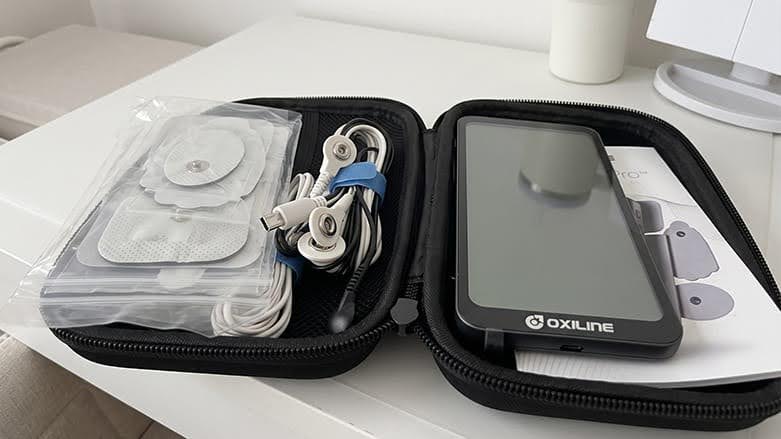
- Channels: Dual-channel
- Modes: 24 TENS and EMS modes with 10 intensity levels
- Battery: Rechargeable
- Pads: 6 total (3 types)
- Price: Mid-range
Whether you’re already an experienced user or you’re looking for your first TENS device, our Wareable team agreed that Oxiline TENS XS Pro is one of the most well-rounded options we tested.
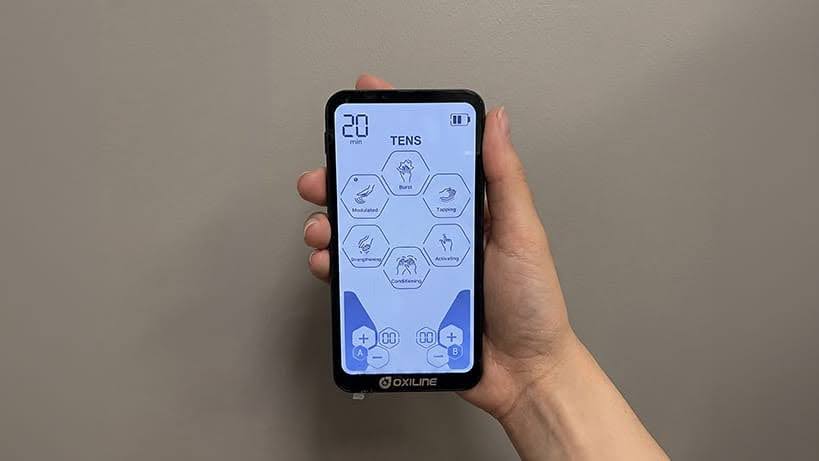
It combines a large touchscreen, a modern interface, and a great selection of preset programs. The two output channels can be adjusted independently, which allows you to target multiple areas with different intensity levels if needed. Overall, day-to-day testing was easy, and the step-by-step manual kept the experience straightforward.
XS Pro is a wired TENS unit, so each electrode pad connects to the handheld controller via cables. Although this setup restricts movement during a session, we still found it overall comfortable, and several of our testers commented on how modern and premium the design feels compared to many traditional TENS units. So, if looks matter for you—it’s your best option.
We also really appreciated the fast charging, though the battery life was a little less impressive. In our experience, it typically lasted around a day and a half between charges, depending on session frequency and intensity.
The 24 preset TENS and EMS modes are organized into six categories: modulated, burst, tapping, strengthening, conditioning, and activating. In reality, we kept returning to just a handful of favorites, but variety might appeal to more people.
- FDA-cleared device
- High-quality and durable electrode pads
- Lifetime warranty
- Can be used over multiple body areas
- Pricier than some comparable TENS units
- Battery life could be better
Oxiline TENS Q Pro
Best for the lower back and abdomen sessions
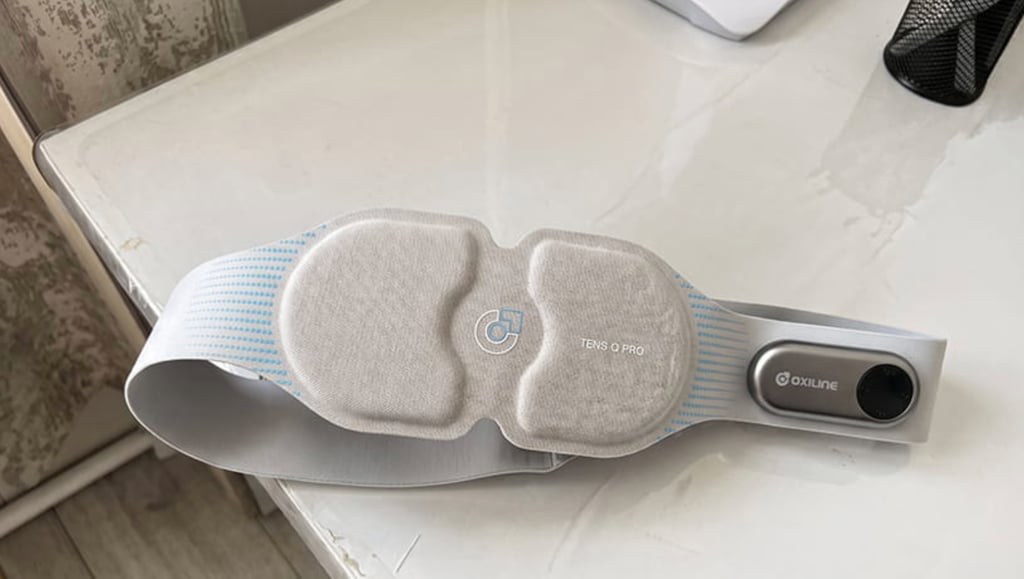
- Channels: Not applicable
- Modes: 6 modes with 3 heat levels
- Battery: Rechargeable
- Pads: 4 integrated electrodes
- Price: Low-to-mid range
If your main concern is lower back or abdominal pain, we recommend Oxiline TENS Q Pro. It’s a wireless TENS unit with electrode pads built directly into a waistband, so it’s designed specifically for the torso. Besides, the hands-free design makes it easy to move around while wearing it both at home and outside.
Out of all the TENS devices we tested, Q Pro was probably the simplest to use. Once the ultra-thin waistband is in place, it stays comfortably snug throughout the session, and the soft and stretchy material doesn’t restrict your movement. We even wore it while playing tennis and barely noticed it was there. Just keep in mind that the belt can get quite warm, especially when using the heat function.
This Oxiline device also combines TENS and EMS, offering you six stimulation modes and three heat levels that reach roughly 100–113°F. Together, these features give you a convenient all-in-one device for the lower back.
Sadly, since it is a waistband, you can’t use it on your arms, legs, or other parts of the body. If you’re looking for a more versatile TENS unit with repositionable pads, this isn’t the best fit for you. Also, we noticed actual battery life fell short of the brand’s advertised two weeks. It usually lasted us 3–5 days on a single charge.
- Amazing choice for portability
- Package includes 13in waistband extender to suit every body type
- Soft and stretchy material
- Targets only the torso area
- Not very customizable
TENS 7000 Digital TENS Unit
Best advanced wired TENS unit
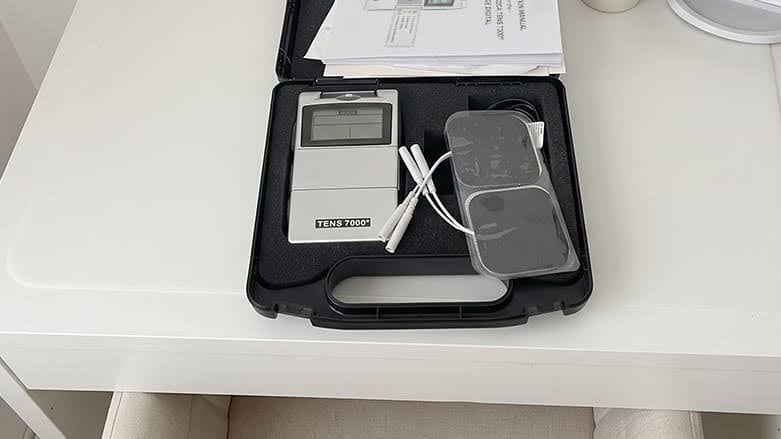
- Channels: Dual-channel
- Modes: 5 modes with adjustable intensity and pulse settings
- Battery: 9V battery
- Pads: 4 total
- Price: Low-range
For those who are already familiar with TENS therapy and want an upgrade—we believe TENS 7000 Digital TENS Unit is worth your consideration. It’s an affordable wired device that offers more customization than many entry-level models without having a huge learning curve.
It definitely isn’t the sleekest gadget around. In fact, it looks quite bulky and old-fashioned compared to newer touchscreen models like Oxiline TENS XS Pro. Yet, we were left surprised by the build quality and the strength of the stimulation.
Despite offering more advanced controls, it never felt intimidating to use. The five preset modes cover the basics and seem very well thought out, while the manual adjustments let you fine-tune each session to your own preferences.
We’d say the biggest difference compared to simpler TENS units is that you’re responsible for setting both the pulse width (duration) and pulse rate yourself. If you’re new to these settings, we’d suggest starting with lower settings and gradually increasing the intensity. The manufacturer recommends pulse rates between 70 and 120Hz for most applications, though the choice ultimately belongs to you.
Naturally, there are a few trade-offs at this price. The unit runs on a replaceable 9V battery rather than a rechargeable one, and you only get four 2 x 2in electrode pads in the box. Both should last through several seasons with proper usage, but you’ll eventually need replacement batteries and pads. We’re not saying it’s a deal-breaker, but it’s something worth keeping in mind before committing to TENS 7000.
- Well-designed preset mode
- Highly customizable session settings
- Easy to understand controls
- Very small electrode pads
- Battery isn’t rechargeable
- Old-fashioned design
Belifu TENS & EMS Unit
Best for maximum value
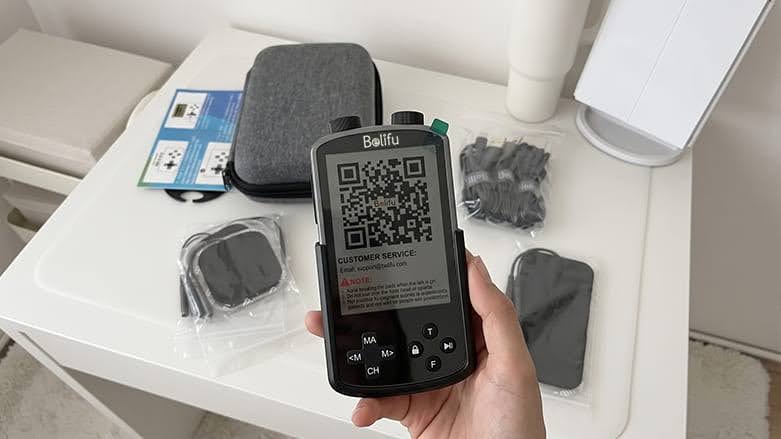
- Channels: Dual-channel
- Modes: 36 modes with adjustable intensity, pulse width, and frequency
- Battery: Rechargeable
- Pads: 10 total (2 sizes)
- Price: Low-to-mid range
Belifu TENS & EMS Unit may suit you if you want a long-term device that offers plenty of room to grow. With 36 preset TENS and EMS modes, along with adjustable intensity, pulse width, and frequency, it gives you far more settings to experiment with than most TENS units.
We’d describe the setup as quite traditional. It features dual independent channels, which allow you to use up to four electrode pads at the same time. Better yet, the box includes 10 reusable pads in two different sizes, so you won’t have to worry about buying replacements any time soon.
That said, much like TENS 7000, we wouldn’t call Belifu particularly beginner-friendly. To be honest, it’s even more complex—after spending about a month testing it, we still feel like there are features we hadn’t fully explored. If you’re considering it, don’t be discouraged if everything doesn’t click right away. This is very much a trial-and-error type of device, and once you get used to the controls, the flexibility becomes one of its biggest strengths.
- Includes plenty of electrode pads
- Highly customizable sessions
- Available in two color options
- Electrode pads are relatively small
- Controls may feel overwhelming
- Battery lasts only up to 60 hours per charge
TENS technology principles at a glance
What is TENS?
TENS is a non-invasive, drug-free therapy that delivers electrical impulses via electrode pads placed on the skin. These pulses stimulate sensory nerves and may help provide short-term pain relief, likely by triggering the release of the body’s natural pain-relieving chemicals.
While TENS has been used in physical therapy and rehabilitation for decades now, the evidence isn’t completely straightforward. The results vary depending on the type of pain, device settings, and overall individual response.
Also, keep in mind that TENS devices are primarily designed to help manage pain rather than treat its underlying cause, so they shouldn’t replace other prescribed treatments. If you’re experiencing persistent or chronic pain, it’s important to discuss your symptoms with a healthcare professional instead of relying on TENS alone.
Is TENS safe?
For most healthy adults, TENS is considered safe when used according to the manufacturer’s instructions. Potential side effects are mild and temporary, with the most common being slight skin redness where the pads were attached, muscle twitching during a session, and temporary sensitivity in the targeted area.
However, TENS isn’t suitable for everyone, and you should check with your doctor before use if you:
- Have a pacemaker or other implanted electrical device
- Are pregnant
- Have cancer
- Have epilepsy
- Have certain heart conditions
- Have deep vein thrombosis
How to use TENS?
Correct electrode pad placement is often more important than choosing the highest intensity. As a general rule, place the pads:
- Around the painful area rather than directly on it
- On clean and dry skin
- A few centimeters apart from each other
- Over soft tissue instead of bony areas
Most TENS units include placement guides for lower back, shoulders, knees, and elbows, so you don’t have to guess where the pads should go. Just don’t apply electrodes on the neck, eyes, head, directly on open wounds, or across the chest.
Once pads are in place, start with the lowest intensity and gradually increase it until you feel a strong but comfortable tingling in the area. If the stimulation starts to feel painful or your skin becomes irritated, stop the session and give the area some time to recover before using the device again.
How to pick the best TENS unit for home use
With so many TENS units on the market—and each one advertising different features, modes, and specifications—there’s no shame in feeling quite overwhelmed. For that reason, we created a short guide to point out the features that actually matter:
- Wired vs. wireless. Consider if freedom of movement during a session matters to you. Wired TENS units restrict you to one place, while wireless models are far more portable and can be convenient if you want to do chores or work out while using TENS.
- Number of channels. Most wired TENS units offer two independent channels, allowing you to use more electrode pads at once, control the intensity separately, and target multiple areas to save your time.
- Targeted area. Think where you plan to use the device most often—is it the torso? Broad areas like thighs and back? Or smaller locations such as knees and elbows? Then choose a device with electrode pads that can meet your needs.
- TENS vs. a combo. Most models combine both TENS and EMS technologies in one unit. If EMS isn’t something you’re looking for, a simpler device may be all you need—and it may also cost less.
- Programs and intensity settings. Preset modes are great for beginners, while adjustable settings offer more flexibility for experienced users. Just don’t get too focused on the number of modes, as a few well-designed programs may be more valuable overall.
- Replacement pads and long-term costs. Good quality electrode pads can last for a long time with proper care, but at some point you’ll need to replace them. Check that replacements are available to purchase and come at a price you’re willing to pay.
- Warranty and customer support. Finally, don’t overlook the practical details like a good warranty, responsive customer support, and clear return policy. These can make a big difference if you run into any issues with your device.