Best red light therapy for hip pain: Our top picks for pain relief

We tested numerous red light therapy devices—here are our top picks for hip pain relief in 2026
If you’re dealing with hip pain or ache and are looking for ways to better manage it, you've probably heard of red light therapy. RLT devices are non-invasive, at-home solutions that are often associated with reduced inflammation and overall faster recovery.
However, it’s important to remember that such devices cannot replace medical treatments and might only help support your recovery. This is why we decided to test them ourselves. If you want to learn more about red light therapy devices for hip pain relief and what devices are worth considering, continue reading this article below.
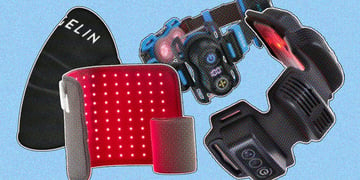
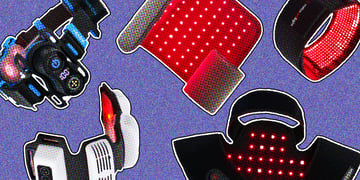
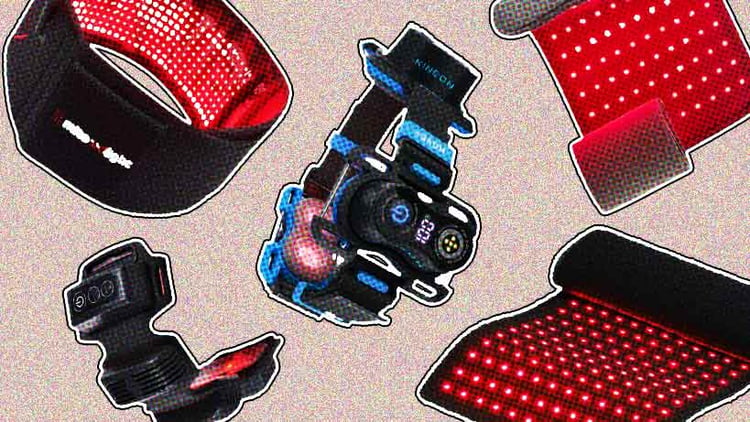
Quick picks: Best red light therapy for hip pain
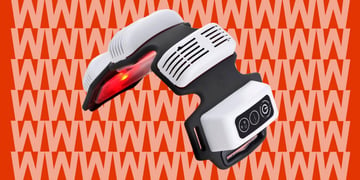
- Kineon Move+ LED & Laser: Overall best red light therapy for hip pain device
- FlexBeam: Best RLT for hip pain device with multiple programs
- MitoQUAD Wavelength Belt: Best premium-feel red light therapy device for hip pain
- Megelin Red Light Therapy Belt Plus: Best affordable red light therapy belt for hip pain
- Novaa Deep Healing Pad: Best flexible design RLT pad for hip pain relief
How we tested red light therapy devices for hip pain
To really understand how red light therapy devices work and how they differ from one another, especially for hip pain, we tested them one by one for several weeks.
During that time, we mostly focused on comfort and build, as not all devices are suitable for hip sessions. We also considered their wavelengths, overall performance, quality, and usability. Once we narrowed down the list to the top choices, we were also interested in seeing their pricing and how they compare to one another.
Kineon Move+ LED & Laser
Best overall red light therapy for hip pain
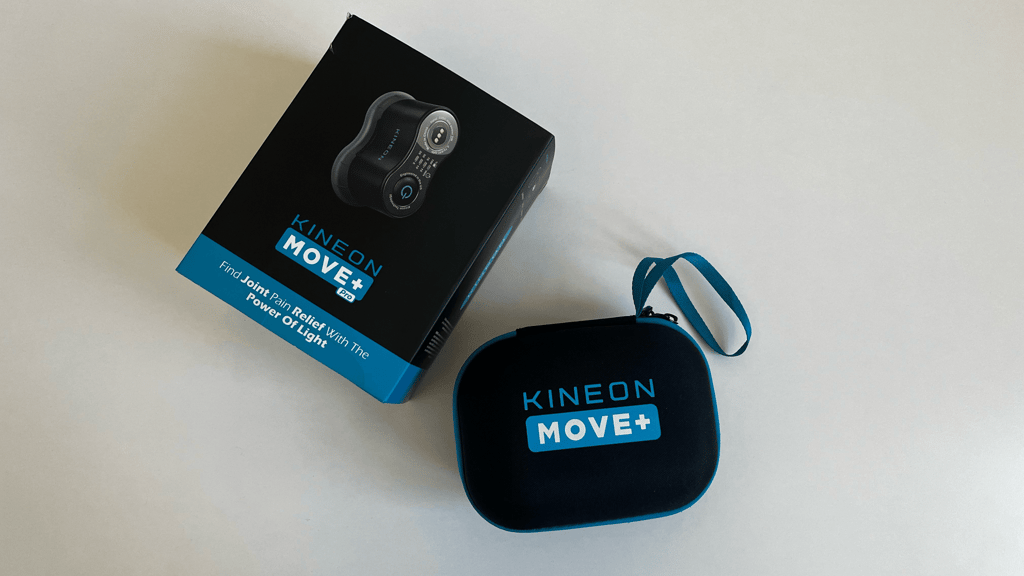
- Type: Modular strap
- Session length: 10–15 minutes
- Price: $499
Kineon Move+ LED & Laser is the best red light therapy device for hip pain due to its dual laser and LED technology. By combining 660nm deep-red LEDs and 808nm near-infrared laser diodes, it reaches both surface and deeper tissue, including your hip joint.
Finding a device that covers your hip directly is not the easiest task, but due to Kineon’s flexible design, it proved to be very convenient. According to the provider’s recommendations, we usually used it for 10–15 minutes each session during our tests.
On the other hand, using it for the first time might not be that effortless. Before you start, you must first set up the strap with the quick-release clips and mount the modules before securing it on your hip. It’s also important to note that to comfortably use it on your hip, you will need to purchase the Extender Strap.
Overall, the device is very sturdy, giving it a premium feel. It’s completely hands-free and wireless, so you can work and do house chores during your sessions. It’s also smaller in size and comes with a travel case, so it’s definitely portable.
If you’re looking for an RLT device to target deeper tissue issues, Kineon Move+ is worth considering. However, while it’s ideal for targeted hip sessions, it will not be very useful if you want to cover larger areas.
- Dual LED and laser technology
- Hands-free, wireless design
- Portable, comes with a travel case
- Setup learning curve
- Not suitable for larger area sessions
FlexBeam
Best customizable red light therapy for hip pain device
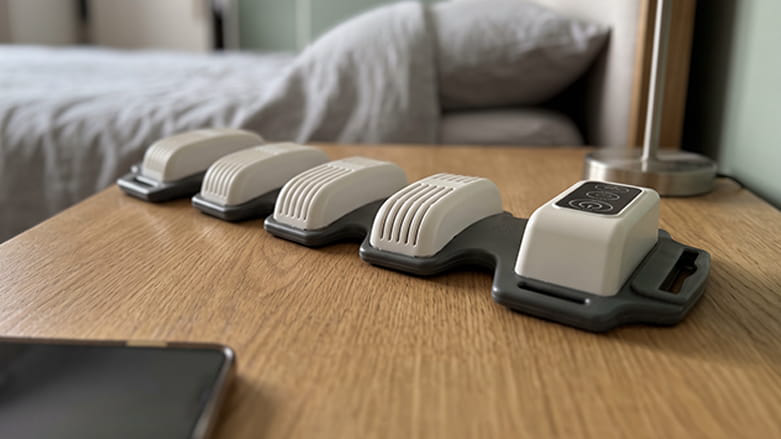
- Type: Modular strap
- Session length: 10 minutes
- Price: $509
FlexBeam is another top red light therapy device for hip pain that offers a unique, contoured design and three programs for different cases. It uses an array of red (peaking at 622nm) and near-infrared (peaking at 814nm) LEDs, reaching both surface and deeper tissue.
What we liked the most is the three programs: Program 1 uses red light, Program 2 shines red and near-infrared light, and Program 3 uses only near-infrared light. The latest is the best choice for potentially managing hip pain, as near-infrared light reaches deeper tissue. Each program is set to last 10 minutes per session.
When we tested it out, it proved to be very user-friendly. It has only three buttons on its interface (on/off, program select, and play/pause). It’s also hands-free, wraps comfortably around the hip with Velcro bands, and is definitely portable. However, compared to Kineon Move+, it’s a bit bigger and comes with a larger travel case, which might not be ideal for more frequent travelers trying to save space.
We can definitely recommend FlexBeam for those looking for something specifically designed for hip and lower back sessions. Just keep in mind that it is slightly bulkier considering that it’s still a smaller targeted coverage device.
- Three different programs for different needs
- Flexible, contoured design
- Has built-in cooling fans
- Larger compared to other similar devices
- Expensive pricing
MitoQUAD Wavelength Belt
Best medical-grade red light therapy device for hip pain relief
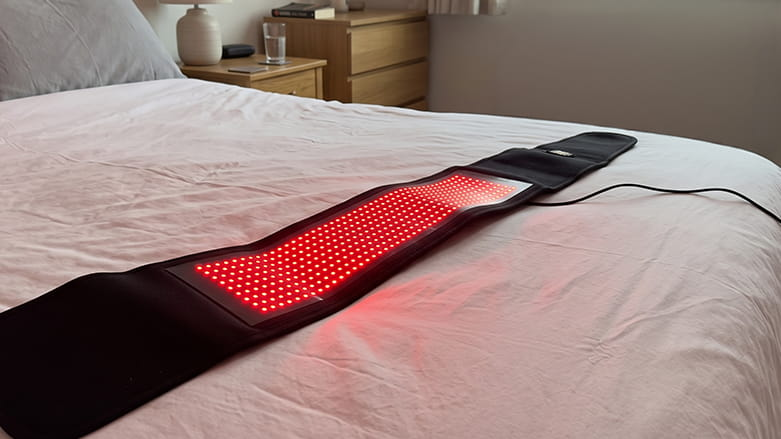
- Type: Belt
- Session length: 15–20 minutes
- Price: $349
MitoQUAD Wavelength Belt also made the list as the best red light therapy device for hip pain due to its medical-grade yet still very convenient design. With the TriChip technology that packs over a thousand LED chips into 405 diodes and four different wavelengths (630nm, 660nm, 810nm, and 850nm), MitoQUAD might help to support hip pain.
When we tested it out, MitoQUAD proved to be very flexible, lightweight, and easy to use. All you have to do is wrap it around your targeted area, in this case, your hip, choose the intensity and the mode on the controller, and enjoy a 15–20 minute session. For continuous power, you have to plug it into an outlet, or you can use a MitoQUAD’s power bank for a wireless experience. However, it is sold separately and, at the time of our research, it wasn’t available.
Another huge advantage is the device’s size, which offers broader coverage. This way, you can not only comfortably wrap it around your hip, but also use it for other areas, if needed.
Overall, MitoQUAD Wavelength Belt is ideal for more extensive coverage and comfortable wrap design. Still, it’s not completely wireless, which might not be ideal if you want to move around during your RLT sessions.
- TriChip technology
- Four different wavelengths
- Broad coverage
- Not completely wireless
- Additional power bank currently unavailable
Megelin Red Light Therapy Belt Plus
Best cheap RLT device for hip pain management
- Type: Belt
- Session length: 15–30 minutes
- Price: $179
Megelin Red Light Therapy Belt Plus is one of the most affordable yet still professional-feeling devices for hip pain. With 660nm and 850nm wavelengths, it targets both surface-level issues and aims to penetrate deep into joint tissues for pain relief.
Compared to Kineon Move+ and FlexBeam, Megelin’s RLT belt is definitely much bigger. Despite that, it’s still very lightweight, so if you have the space, you can easily move it around and take it with you on trips.
Overall, we found it very comfortable, as you can wrap it around your hip. It also covers quite a broad area at once and packs over a thousand LEDs utilizing a 3-in-1 chip design. To use it, just wrap it around, plug it in, and enjoy 15–30 minutes of relaxation.
What’s more, it comes with adjustable straps, which keep the belt secured across different body areas. We also found that these straps ensure that the device can be comfortably used by people of different shapes and sizes.
If you’re looking for a device that works as both a belt and a pad and covers larger areas, the Megelin Red Light Therapy Belt Plus is one of the best choices. It’s also the cheapest out of all top five devices, so it’s perfect if you’re on a budget. Just keep in mind that it needs to be plugged in, so you can’t really move around during sessions.
- Affordable pricing
- Large coverage
- Adjustable straps
- Longer session time
- Corded design
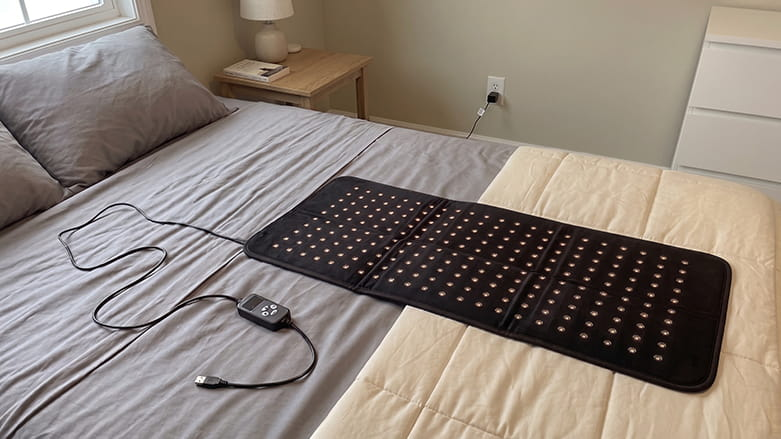
Novaa Deep Healing Pad
Best portable red light therapy for hip pain
- Type: Pad
- Session length: 20 minutes
- Price: $314.91
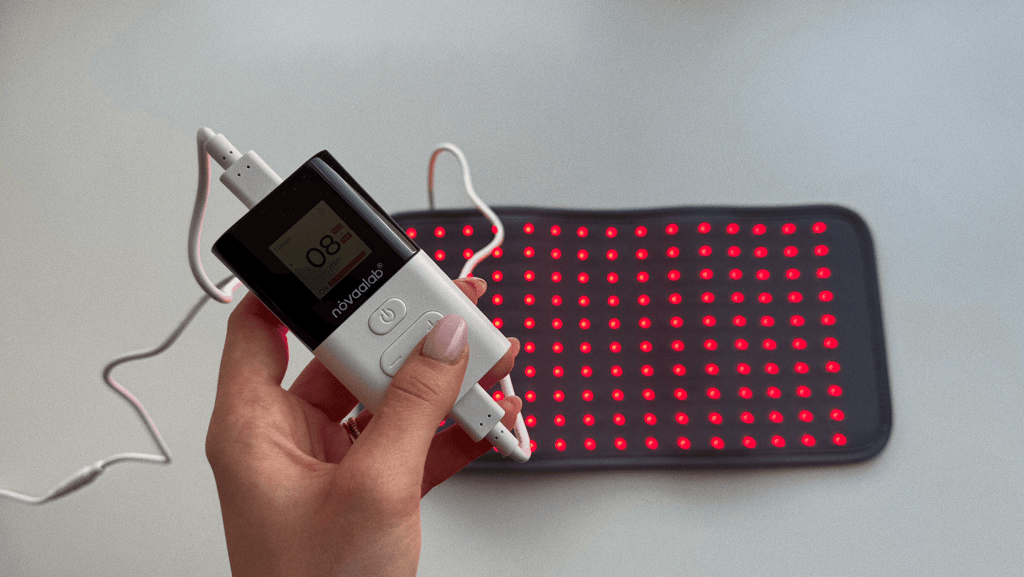
Lastly, Novaa Deep Healing Pad is also one of the best red light therapy devices for hip pain due to its flexible and portable design. It utilizes 660nm red lights and 850nm near-infrared lights, which are closely linked to reaching deeper into joint tissue.
Just like Megelin Red Light Therapy Belt Plus, it can be used as a pad or a wrap, which is ideal if you need a device for multiple areas. You shouldn’t have much issue with it, as it comes with a controller to start/end sessions, adjust the duration, and choose a mode (different wavelengths). While you can definitely adjust the duration, the provider recommends 20-minute sessions.
Compared to other pads, it’s also quite practical, as you can fold it and carry it with you when traveling. However, it is also a device that needs to be plugged into a power source, which limits your ability to move around during your RLT session.
After our tests, we believe that Novaa Deep Healing Pad is best for people who are looking for a portable yet very flexible pad for different body areas. However, keep in mind that compared to other pads, it’s not that big, so it won’t cover multiple areas of your body at once.
- Can be used as a wrap and a pad
- Comes with an easy-to-use controller
- Lightweight and portable
- Won’t cover multiple body areas at once
- Needs to be plugged in
Compare the best red light therapy devices for hip pain
| Device | Type | Red wavelength | NIR wavelength | Irradiance | Treatment area | Session length | Portable | Price | Best for |
| Kineon Move+ LED & Laser | Modular strap | 660nm | 808nm | 80mW | Targeted | 10–15 minutes | Yes | $499 | Targeted pain relief |
| FlexBeam | Modular strap | 610–650nm | 800–850nm | 110 mW/cm² | Targeted | 10 minutes | Yes | $509 | Customizable red light therapy sessions |
| MitoQUAD Wavelength Belt | Belt | 630–660nm | 810–850nm | 18mW/cm² | Broad | 15–20 minutes | Yes | $349 | Extensive coverage sessions |
| Megelin Red Light Therapy Belt Plus | Belt | 660nm | 850nm | 120 mW/cm² | Broad | 15–30 minutes | Yes | $179 | Affordable red light therapy sessions for hip pain |
| Novaa Deep Healing Pad | Pad | 660nm | 850nm | 150 mW/cm² | Broad | 20 minutes | Yes | $314.91 | Red light therapy sessions while traveling |
Does red light therapy really help with hip pain?
Red light therapy devices might help to manage hip pain and support recovery, but it cannot substitute medical treatments.
RLT, also known as photobiomodulation, shines red and near-infrared light on targeted areas, delivering specific wavelengths (600–1020nm) of light. These wavelengths stimulate cellular energy production and might even help reduce inflammation, which often causes joint discomfort. Due to this, red light therapy could potentially help manage hip pain, but there are limits.
Unfortunately, red light therapy cannot regrow tissue, repair joint damage, or reduce inflammation completely. It’s only a supportive measure—not a cure. If you’re dealing with more severe pain or have advanced conditions, we recommend seeking medical treatments rather than using RLT at home.
How to use red light therapy for hip pain
Using red light therapy devices is quite easy, as they usually don’t have many unnecessary settings, but for a smooth and safe experience, we recommend following your device’s instructions.
Positioning is one of the most important factors. If you’re using a device that touches your skin, it will shine directly on your targeted area. However, if you’re using an RLT panel, distance it around 6–12 inches away, so that the light reaches your hip. Also, be sure to use it on your bare skin since RLT cannot effectively reach your skin through fabric.
While session duration depends on the device, you will need approximately 10–30-minute sessions 3–5 times a week.
Keep in mind that using it for longer won’t necessarily bring better results. Your cells can only absorb a certain amount of energy at once. Overall, we believe that using red light therapy consistently is much more beneficial than using it irregularly with longer sessions.
Is red light therapy safe for hip pain?
At-home red light therapy is a non-invasive procedure that doesn’t use any chemicals, so, in general, it’s safe to use. However, you should still be cautious and follow the provider’s guidelines.
While RLT devices don’t use any actual heat, you might notice a slight warmth on your skin during sessions. Even though this shouldn’t be very noticeable, it might not be ideal for people with more sensitive skin. We recommend testing the device on a smaller area first, and if you notice any redness or irritation, stop using the device.
Even if you use red light therapy for your hip only, remember that the LED lights are quite bright. Avoid staring at the lights directly, and if you have very sensitive eyes, consider wearing protective goggles.
As with any other at-home wellness device, it’s also advisable to consult a healthcare provider before using such gadgets. Especially if you’re pregnant, have implants, or have more severe health conditions.
Other recovery and wellness reviews
Best red light therapy devices for pain relief (2026): What actually works?
Best red light therapy for back pain (2026): What actually helps?
Best red light therapy for shoulder pain (2026): Tested picks
Best red light therapy for knee pain 2026: Tried and tested
Final verdict
Red light therapy might help support hip pain relief and recovery. While it’s definitely not a cure, it can be a great addition to your routine, but not all devices are suitable for deeper tissue penetration.
After testing multiple RLT devices, we found that Kineon Move+ is the ultimate winner due to the advanced LED and laser technology, wireless portability, and modular strap design.
Nonetheless, the best choice for you depends on your specific needs. If you’re looking for a more budget-friendly RLT device, NOVAA Deep Healing Pad might be the better choice. For those looking for broader coverage, a great alternative would be MitoQUAD Belt.
FAQ
There isn’t one answer to how long it takes for red light therapy to work on hip pain, but you will need to use it consistently. Usually, red light therapy devices should be used for at least 4–8 weeks, multiple times a week, even for the slightest results. Even then, there are no guarantees, as it varies from case to case.
Red light therapy might help relieve your hip arthritis pain, but it cannot reverse it. Due to the wavelengths it uses, RLT stimulates cellular energy production, which is associated with reduced inflammation and recovery. While it might be suitable as an additional step in your hip pain relief, it’s not a medical treatment, and it cannot treat serious conditions.
You should use red light therapy for hip pain at least 3–5 times a week for around 10–30 minutes, depending on your device. You should also use it consistently for an extended period of time, at least 4–8 weeks.
Whether red light therapy is better at night or in the morning depends on your specific needs. If you notice that your hip is stiffer after a long day, you might benefit more from using RLT at night. However, in most cases, it depends on your preference.
-
AIMS Biophysics.
Mechanisms and applications of the anti-inflammatory effects of photobiomodulation
-
Journal of Orthopaedic Surgery and Research.
Optimizing LED photobiomodulation parameters to prevent cartilage matrix degradation in knee osteoarthritis: in vitro and in vivo study