Why You Can Trust Wareable
Founded in 2014, Wareable brings together journalists and experts who have reviewed over 1,000 products, including smartwatches, fitness trackers, smart rings, smart home gadgets, and health tech devices.
Our team combines hands-on testing, in-depth research, and expert insights to evaluate product performance, assess manufacturer claims, and help readers make informed decisions.
Study: Where wearable interest is booming worldwide
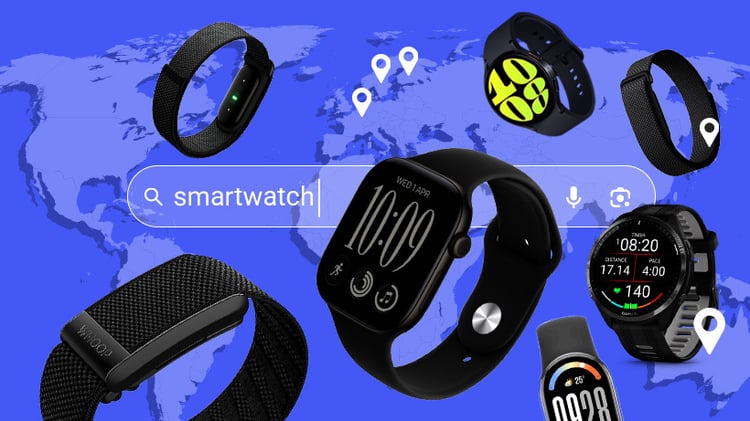
Australia has the world’s biggest appetite for smartwatches and fitness trackers—narrowly ahead of Japan—according to a new analysis of 12 months of Google searches across 101 countries.
The two countries, though, get there very differently. Australia leads in fitness trackers and ranks second in smartwatches, while Japan leads in smartwatches but ranks only 38th in trackers, with 69 smartwatch searches for every tracker search.
Apple dominates brand interest worldwide, accounting for 76.3% of brand searches and ranking first in all 101 countries. Meanwhile, Garmin out-searches Samsung in the US, UK, and Australia, among others.
Our analysis uses Google's search-volume data from September 2025 to August 2026 for generic, brand- and device-specific keywords, including local-language equivalents, normalized per 100,000 internet users in each country.
It’s vital to view search interest as a barometer of brand mindshare rather than a direct tally of retail transactions. While search data provides a powerful baseline, regional search engine preferences—like Naver in South Korea—and specific market restrictions mean raw volume is just one piece of the puzzle.
Conor Allison
The true insight comes when we contextualize these search spikes against global device shipment data. In places like Western Europe or Australia, massive search volume for established brands often reflects active post-purchase ecosystems—users looking for support, straps, or software updates. Meanwhile, rapid search growth in emerging tech hubs signals pent-up consumer intent before local distribution fully scales. Search data shows us where the cultural appetite and brand affinity live; cross-referencing it with physical sales figures tells us where the market is actually converting.
Countries with most wrist-wearable searches
These are the countries with the most searches for wrist-wearables per 100k internet users, where we looked at all the combined keywords across both categories, fitness trackers and smartwatches, as well as device-specific searches, like “Apple Watch,” “Whoop Band,” etc.:
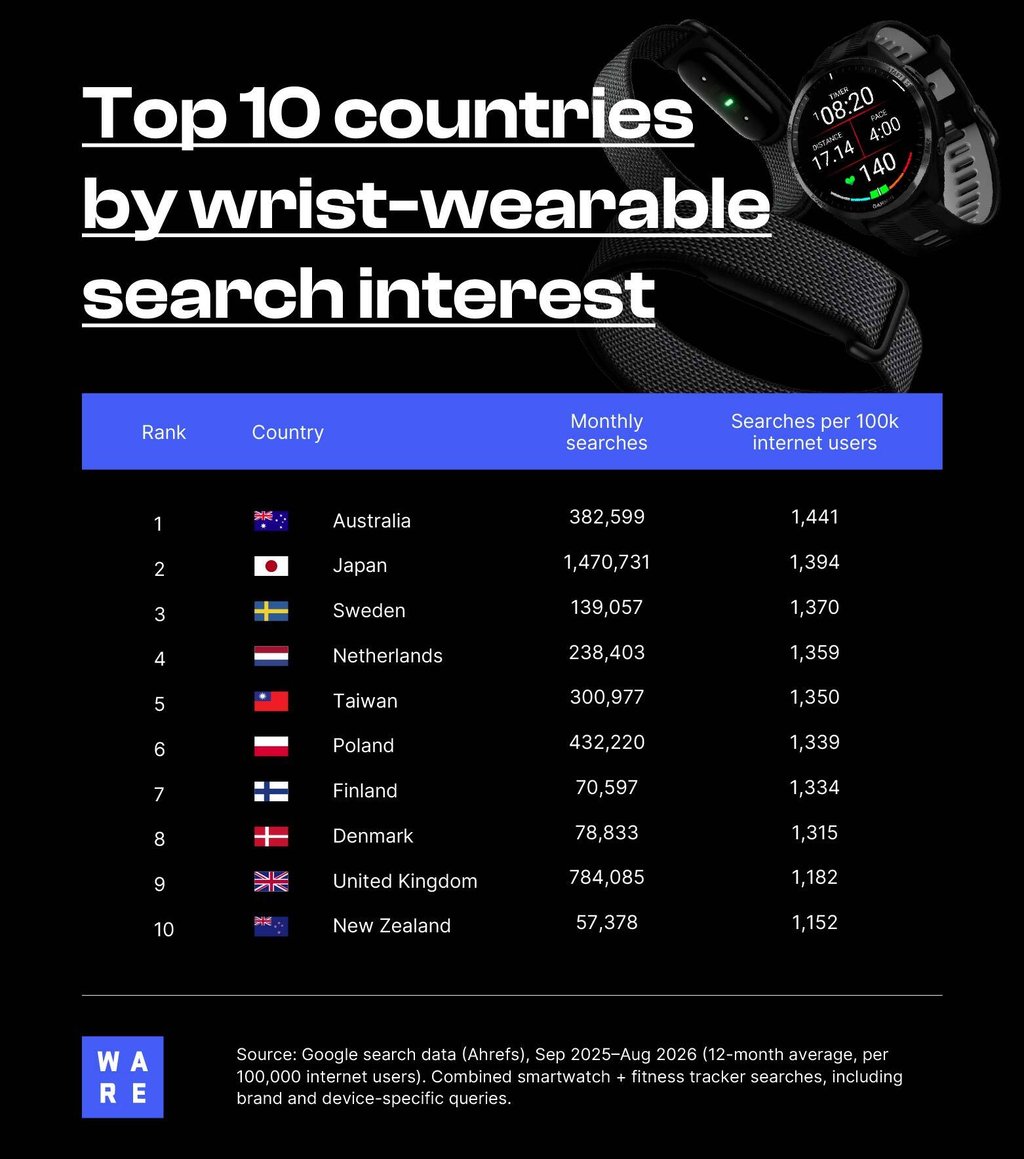
1. Australia: It’s first for trackers and second for smartwatches, so Australia gets to the top of the overall wrist-wearable rankings by leading in both categories. Its overall search rate for wearables is around 4.9 times the global average. People in Australia search for wearables 382,599 times per month, or 1,441 times per 100k internet users.
2. Japan: First for smartwatches but only 38th for trackers. There are around 69 smartwatch searches in Japan for every tracker search. Around 1,470,731 searches per month in total for wearables, or 1,394 per 100k internet users—4.8 times the study-wide average.
3. Sweden: The highest-ranked European country. Sweden ranks third for smartwatches, but only 18th for trackers. Around 139,057 searches per month in total, or 1,370 per 100k internet users—4.7 times the average.
4. The Netherlands: Has strong interest in both categories: fourth for smartwatches and third for trackers. Combined total comes out to 238,403 searches per month, or 1,359 per 100k internet users.
5. Taiwan: Taiwan has the highest proportion of smartwatch searches using brand-specific rather than generic terms. Taiwan is sixth for smartwatches and seventh for trackers. Around 300,977 searches per month, or 1,350 per 100k internet users, which is also 4.6 times the global average.
6. Poland: Sixth overall and in the top ten for both categories: seventh for smartwatches and eighth for trackers. Around 432,220 searches per month, or 1,339.1 per 100k internet users—4.6 times the study-wide average.
7. Finland: Seventh overall, but fifth for smartwatches. Tracker interest is lower, at 13th, which moves it down the combined ranking. Around 70,597 total searches per month, or 1,334 per 100k internet users—4.6 times the study-wide average.
8. Denmark: Places eighth for smartwatches, but 14th for trackers. Around 78,833 searches per month, or 1,315 per 100k internet users.
9. The UK: Ninth overall, but fourth for trackers. Brand keywords account for nearly 93% of its smartwatch searches. Around 784,084 searches per month combined, or 1,182 per 100k internet users, which is 4 times the global mean.
10. New Zealand: Around 57,378 searches per month, or 1,152 per 100k internet users.
Countries with the highest interest in smartwatches
These are the top 10 countries with the most smartwatch-related Google searches per 100k internet users:
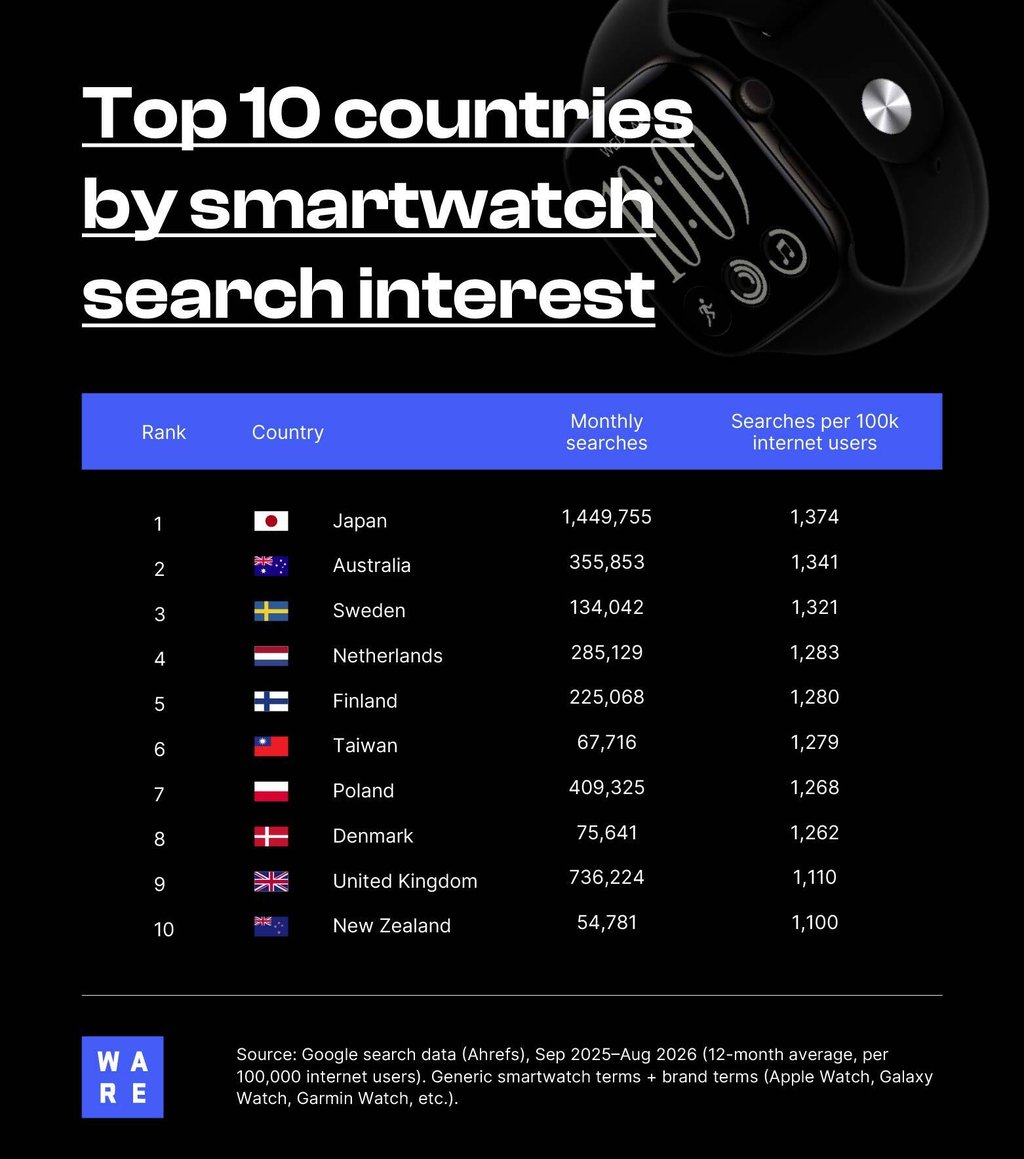
1. Japan: The most smartwatch-interested country in the ranking, totaling 1,449,755 searches per month, or 1,374 per 100k internet users.
2. Australia: Only around 2.4% behind Japan for smartwatch interest, whilst also leading the tracker ranking. Around 355,852 searches per month for smartwatches, including both general and brand-specific queries.
3. Sweden: An average of 134,042 searches per month for smartwatches, or 1,321 per 100k internet users—3.3 times the global mean.
4. The Netherlands: Fourth for smartwatches and third for trackers, making it one of the countries near the top of both lists. Totaling 225,068 searches per month, or 1,282.7 per 100k internet users—3.2 times the study-wide average.
5. Finland: Fifth for smartwatches, two places higher than its overall wearable ranking. Around 67,716 searches per month, or 1,280 per 100k internet users.
6. Taiwan: Sixth once brand searches are included, but only 82nd if we look at generic smartwatch keywords. Manages 285,129 searches per month, or 1,279 per 100k internet users.
7. Poland: Seventh overall in this category, but third for generic smartwatch keywords. So Poland’s position isn’t only down to brand searches, which is the case in countries like Taiwan and the UK. An average of 409,325 smartwatch-related queries are entered into Google in Poland every month.
8. Denmark: Around 75,641 searches per month, or 1,262 per 100k internet users.
9. The UK: Ninth with brand searches included, although only 50th when looking at generic smartwatch keywords alone, like “smartwatch” or “smart watches.” But when we include brand-specific smartwatch searches, like “Samsung Galaxy Watch,” the UK jumps to 9th.
10. New Zealand: People in New Zealand search around 2.7 times more for smartwatches than the global mean. Around 54,781 smartwatch-related searches per month, or 1,100 per 100k internet users.
Countries with the highest interest in fitness trackers
Top ten countries most enthusiastic towards dedicated fitness trackers:
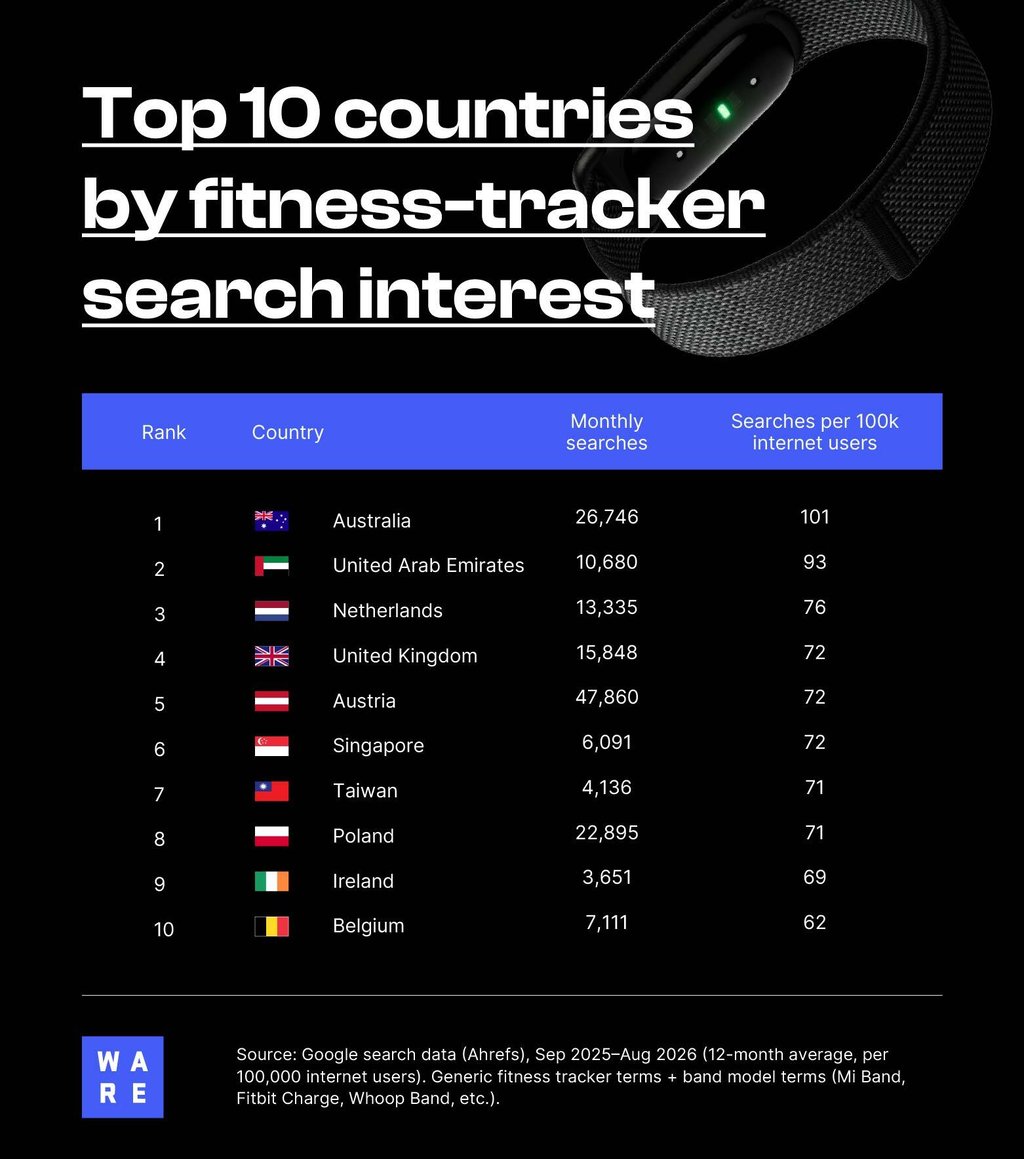
1. Australia: First for dedicated trackers, with around 8.6% more searches per 100k internet users than the second-ranking UAE. Around 26,746 searches per month, or 101 per 100k internet users, which is 3.3 times the global average.
2. The UAE: Second for trackers, but 37th for smartwatches – one of the highest contrasts in the study. Trackers account for 16.3% of its wearable searches, compared with 5.4% across the dataset. Around 10,680 searches per month for fitness trackers, or 93 per 100k internet users—3 times the study-wide average.
3. The Netherlands: Third for trackers, whilst also placing fourth for smartwatches. Around 13,335 searches per month in total, or 76 per 100k people on the internet.
4. The UK: Fourth for trackers, five places above its smartwatch ranking. Around 47,860 searches per month, or 72 per 100k internet users.
5. Austria: Fifth for trackers, but 23rd for smartwatches. Around 6,091 searches per month, or 72.0 per 100k internet users—2.4x the average.
6. Singapore: Sixth for trackers, but 19th for smartwatches. Around 4,136 searches per month for fitness trackers, or 72 per 100k internet users.
7. Taiwan: Close to its sixth-place for smartwatches. Around 15,848 searches per month, or 71.1 per 100k internet users.
8. Poland: Eighth for trackers and seventh for smartwatches. Around 22,895 searches per month, or 70.9 per 100k internet users.
9. Ireland: Ninth for trackers and just outside the smartwatch top ten, at 11th. Around 3,651 searches per month, or 69 per 100k internet users.
10. Belgium: Tenth for trackers, despite placing 26th for smartwatches. Around 7,111 searches per month, or 62 per 100k internet users, which is still significantly above (2x) the study-wide average.
Brand searches – Apple dominates
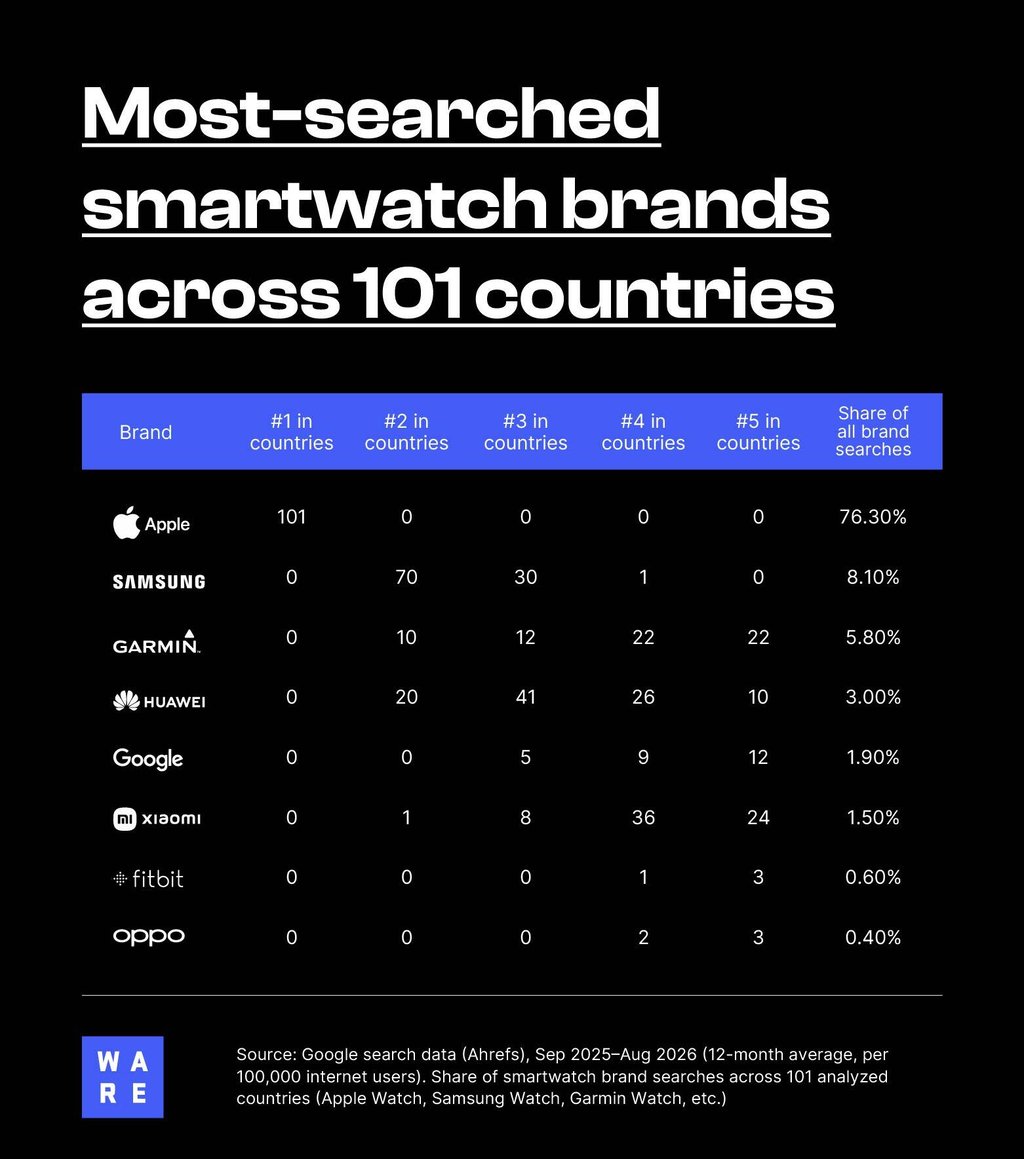
It probably wouldn’t be surprising that Apple is the most searched-for smartwatch brand in most countries, but perhaps it’s a bit surprising that it comes first in all 101 countries, and almost always significantly ahead of the second place in terms of the percentage of brand-related wrist-wearable searches.
Worth noting, though, that brand searches likely include existing owners looking for support, tips, or accessories like straps, not just people in the market to buy.
Second place has some competition, mainly between Samsung, Garmin, and Huawei. Xiaomi also sneaks into second place one time – in Taiwan it’s the second-most-searched smartwatch brand.
Apple: 76.3% of smartwatch brand searches across the dataset, around 9.4 times Samsung’s share. It ranks first in all 101 markets.
Samsung: 8.1% of brand searches and second place in 70 countries.
Garmin: 5.8% of brand searches and second place in ten countries.
Huawei: 3.0% of brand searches and second place in 20 countries.
Google: 1.9% of brand searches, but no first- or second-place finishes.
Xiaomi (1.5% of brand searches) placed second in one country and third in eight, but mostly finished fourth or fifth, while Fitbit (0.6%) and Oppo (0.4%) never ranked higher than fourth in any market.
Note: Although Google acquired Fitbit in 2021, we tracked Google (Pixel Watch) and Fitbit brand searches separately for this analysis.
Some countries are almost exclusively searching with brand-specific keywords
Taiwan ranks 82nd when we look only at generic smartwatch keywords, but jumps to 6th when brand searches are included.
The UK moves from 50th to 9th, and Australia from 38th to 2nd. Brand keywords account for 98.5%, 92.8% and 92.4% of their respective smartwatch searches.
So looking only at searches like “smartwatch” would miss most of the interest in these countries.
Huawei has the largest share of searches in Arab countries
Huawei’s share of smartwatch brand searches is especially high in Kuwait (32.5%), Saudi Arabia (26.4%), Oman (23.1%) and Bahrain (21.8%).
It ranks second in all four, with shares around seven to eleven times its average 3.0% share across other countries.
Garmin favoured in New Zealand and Kyrgyzstan
Garmin’s brand-search share is highest in New Zealand and Kyrgyzstan, at 21.1% and 20.6%.
That’s around three and a half times its overall 5.8% share. Garmin also gets more searches than Samsung in Australia, the UK, the US, Singapore, Malaysia, Ireland and the Philippines.
India’s local budget brands garner significant attention
A few local, budget brands in India make up a notable share of searches. Apple and Samsung still come first and second, but local brands get more attention than Garmin (1.6%).
Fire-Boltt accounts for 8.0% of India’s smartwatch brand searches, boAt for 4.8% and Noise for 2.4%. Together, that’s 15.2% of wrist-wearable brand searches.
The US is outside the top ten, but still gets plenty of searches
The US gets around 2.07 million wearable searches per month, but ranks 33rd overall once we adjust for internet user population.
It’s 34th for smartwatches and 19th for trackers. Its overall search rate for wearables is around twice the study-wide average.
Apple gets around 69% of US smartwatch brand searches, followed by Garmin at 14% and Samsung at 10%.
Methodology
This study uses average monthly search volumes from September 2025 to August 2026. The Google search data for selected keywords was extracted using Ahrefs.
Coverage includes countries and territories listed by the World Bank, excluding China and North Korea. Countries must meet certain internet-user and search-volume thresholds to qualify for ranking.
Country inclusion thresholds are:
- At least 1 million internet users.
- At least 1,000 monthly generic smartwatch searches for the generic smartwatch ranking.
- At least 1,000 monthly generic-plus-brand smartwatch searches for the combined ranking.
- At least 500 monthly tracker searches for the fitness tracker ranking.
- At least 1,000 monthly smartwatch brand searches for the brand ranking.
Keyword examples are:
- Generic smartwatch interest: “smartwatch,” “smart watch,” and local terms like “montre connectée” and “reloj inteligente.”
- Combined smartwatch interest: generic smartwatch terms plus brand terms, such as “apple watch,” “galaxy watch,” and “garmin watch.”
- Fitness tracker interest: generic terms like “fitness tracker,” “activity tracker,” and local terms, plus model terms like “mi band,” “huawei band,” “galaxy fit,” “fitbit charge,” and “whoop band.”
- Smartwatch brand interest: one term per brand in the form “ watch,” along with product names like “galaxy watch,” “pixel watch,” and “redmi watch”; “ smartwatch” for Noise, boAt, and Fire-Boltt; and local-script brand terms in 10 languages.
These are examples of keywords and naming rules, not an exhaustive list that includes all keyword variations.
Search volumes are divided by each country’s estimated internet-user population and multiplied by 100,000. Internet-user estimates use the World Bank’s Individuals using the Internet (% of population) indicator multiplied by Population, total, using the latest available year. Taiwan uses 22.3 million internet users, based on Statista’s 2025 figure.
Google-only search data can understate interest where other search engines have substantial usage, including Yandex in Russia and Belarus, Naver in South Korea, and Seznam in Czechia. Countries affected by sanctions, conflict, or internet restrictions carry additional caveats. Search interest is an indicator of attention—not a count of unique searchers, purchases, or device owners.