Best red light therapy for joint pain: Our top picks for pain relief and recovery

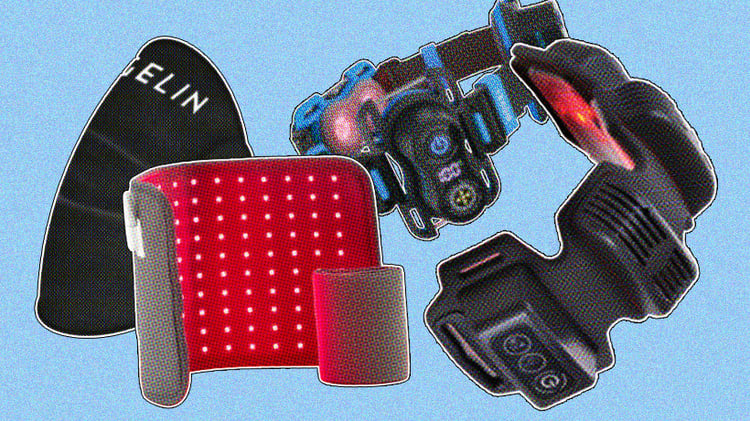
After thorough testing, we rounded up the top red light therapy devices for joint pain that are worth trying out
Red light therapy is increasingly being used to help support recovery and manage various types of discomfort, including joint pain. That is because red and near-infrared light have been researched for their potential anti-inflammatory and healing properties.
While this might sound promising, not everyone may benefit from red light therapy—it largely depends on the underlying cause of your discomfort and the device you choose.
In this guide, we help you navigate red light therapy options and find the right device for your needs.
Quick picks: Best red light therapy devices for joint pain
- Kineon MOVE+ LED & Laser: Best for on-the-go targeted sessions
- Recharge Health FlexBeam: Best for powerful and versatile sessions
- Mito Red Light MitoQUAD™ Wavelength Belt: Best for stationary sessions
- Megelin JointLux Laser+LED Light Therapy Wrap: Best for joint-only sessions
- NovaaLab Light Pad: Best for everyday comfort
How we tested red light therapy devices for joint pain
Our recommendations for red light therapy devices are based on thorough research and hands-on testing. We start by diving deep into product specifications, such as wavelength types, irradiance (light intensity), coverage area, treatment distance, and session length.
Next, we move to real-world testing to see how well the devices do in a variety of everyday settings—at home, on the go, and applied to different joints. During it, we focus on portability, build quality, comfort during sessions, and how easy the devices are to use and customize.
We also consider safety, analyzing the precautions provided by manufacturers and researchers. Finally, with all this in mind, we compare the device's price against its overall performance to ensure you get the best value.
Kineon MOVE+ LED & Laser
Best for: On-the-go targeted sessions
- Type: Modular strap
- Wavelengths: 660nm (deep-red) and 808nm (NIR)
- Treatment area: Joints and larger areas
- Session length: 5–15mins
- Price: $499
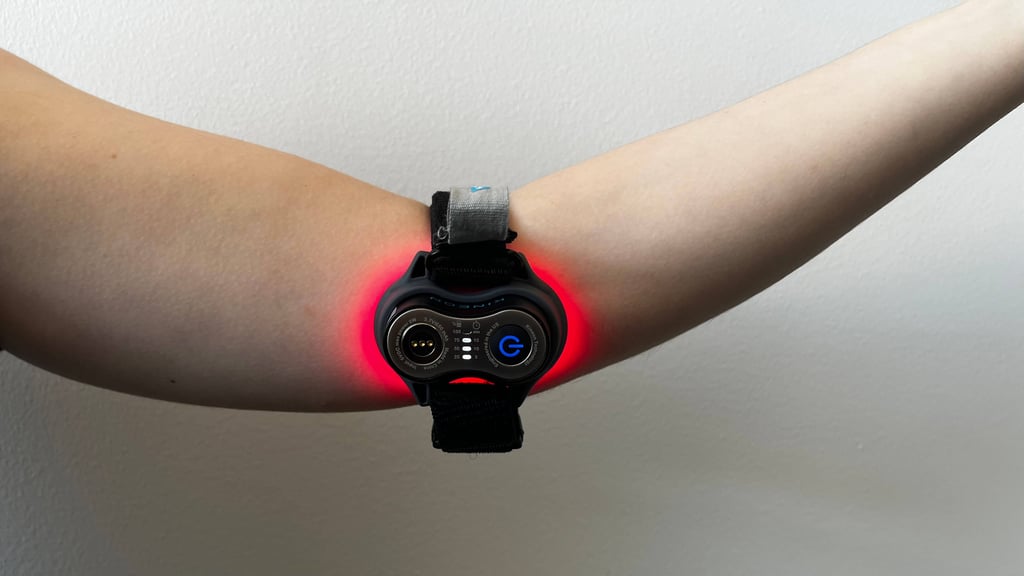
Our top contender on this list, Kineon MOVE+ LED & Laser, pairs red light therapy and lasers in a compact strap. The dual approach delivers optimal light, while its design provides direct-to-skin light therapy to areas like knees, shoulders, ankles, and elbows. What further sets it apart is that it emits light in 10–60Hz pulses rather than a continuous stream of light.
You can also place it over larger muscle areas like the hips and lower back, as the strap extends to 39.5 inches. If it doesn’t reach the area you want to target, you can additionally purchase an extender that provides around 7.8 inches of length.
While the initial setup and attaching the modules to the strap require a bit of effort, the rest is smooth sailing. Treatments only take 10 to 15 minutes daily (up to twice per day), and the device automatically shuts off after each session. Plus, you can track your progress on the companion app, which offers personalized session insights and educational materials.
Overall, it is a comfortable, lightweight, and portable red light therapy device with up to 4 hours of battery life, making it suitable for those who want targeted, on-the-go relief for managing joint discomfort.
- Features lasers
- Portable
- Compatible with app
- Longer setup time
Recharge Health FlexBeam
Best for: Powerful and versatile sessions
- Type: Modular strap
- Wavelengths: 610–650nm (red) and 800–850nm (NIR)
- Treatment area: Joints and larger areas
- Session length: 20–30 minutes
- Price: $479
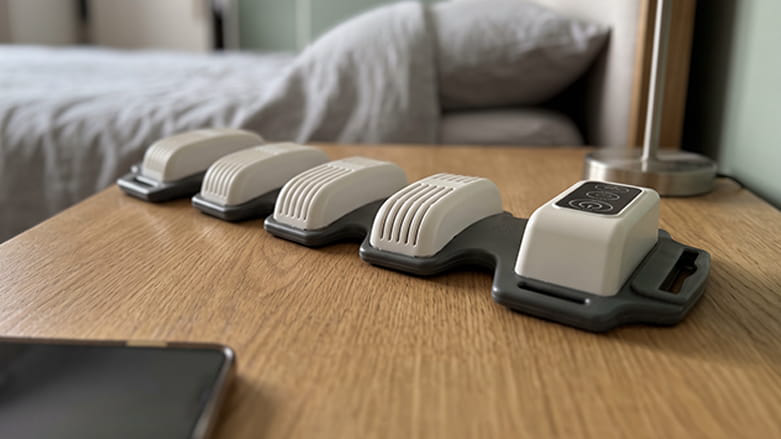
Similar to the Kineon, Recharge Health FlexBeam utilizes a modular strap design with its own unique spin on it. It’s much larger (11.6 x 9.25 x 2.83 inches), and its three modules are connected by a flexible silicone band that ensures direct contact with the skin.
It wraps around the body using three different types of Velcro bands, which makes it more versatile and suitable for joints and larger areas of the body. Since the device has fewer building blocks than Kineon, I noticed that it’s much easier to set up and use on larger areas.
While it’s still smaller than traditional stationary panels, FlexBeam remains powerful, delivering an irradiance of 110mW/cm². It is completely wireless and can last up to 90 minutes on a single charge.
Although it comes with a companion app featuring structured protocols, placement instructions, and guided programs, the app is optional. The device can be operated easily using three convenient physical buttons to power it on and off, pause or resume a session, and change between its preset modes.
The three preset programs are skin and surface healing (primarily red light), muscles and tissue (a blend of red and near-infrared light), and deep tissue and joints (near-infrared light only). Each program runs on a 10-minute cycle, and the device will automatically power off when it’s complete.
One of its drawbacks compared to Kineon is its lack of lasers. However, if it’s not something you prioritize, this device still features a unique and powerful design that is highly portable and versatile.
- Powerful
- 3 preset programs
- Convenient controls
- Lacks lasers
Mito Red Light MitoQUAD™ Wavelength Belt
Best for: Stationary sessions
- Type: Belt
- Wavelengths: 630nm, 660nm (red) and 810nm, 850nm (NIR)
- Treatment area: Joints and other larger areas
- Session length: 15–20 minutes
- Price: $349
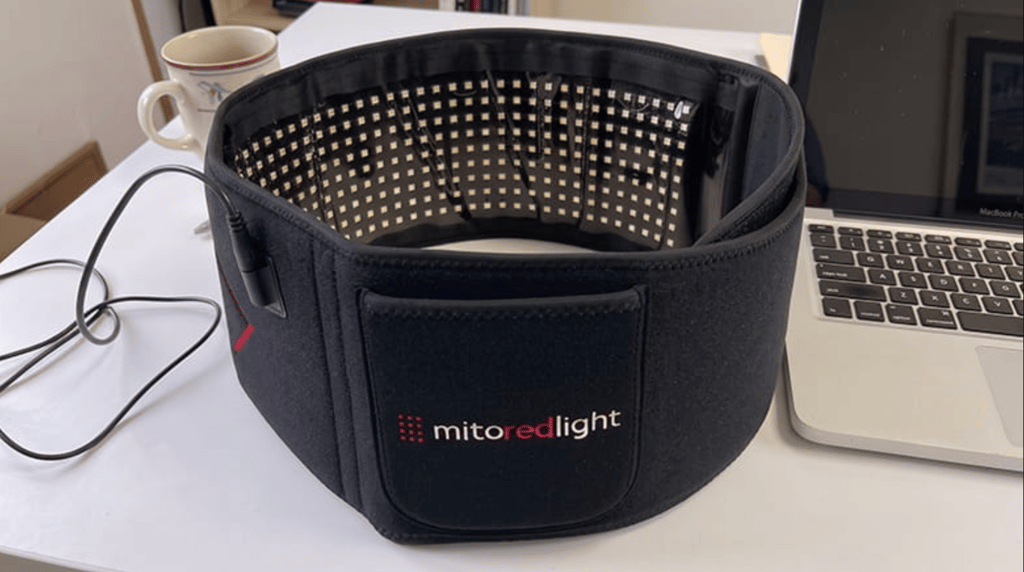
Equipped with four light wavelengths, MitoQUAD™ Wavelength Belt is another standout on our list. It features 1,215 LEDs, the majority of which are near-infrared chips—a frequency studied for its ability to penetrate deeper into tissues to aid muscle recovery, joint support, and circulation. The high number of LEDs also ensures that the targeted area has complete and even coverage.
While belts are commonly used on the abdomen, lower back, hips, and torso, its soft and pliable material allows you to wrap it around joints like knees and shoulders. Your recommended daily 15–20 minute sessions can also be customized via the provided controller. You can choose five intensity levels and options to run red light, near-infrared (NIR) light, or both together.
The belt has a lower irradiance of 18 mW/cm², which may make it gentler for more sensitive skin. However, the most unfortunate part about this belt is that it doesn’t currently have a wireless option, though the brand markets it as one of its most appealing qualities.
Still, if you tend to relax during your red light sessions, this device is a comfortable option offering four different wavelengths.
- Four wavelengths
- Customizable
- Comfortable design
- Wireless option unavailable
Megelin JointLux Laser+LED Light Therapy Wrap
Best for: Joints-only sessions
- Type: Wrap
- Wavelengths: 660nm (red), 850nm and 1064nm (NIR)
- Treatment area: Knees, elbows, ankles
- Session length: 15 minutes
- Price: $169
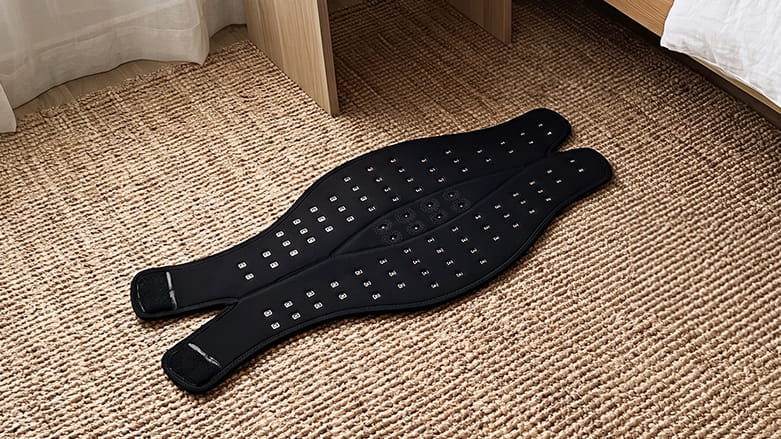
Megelin JointLux Laser+LED Light Therapy Wrap is exclusively designed for joints, specifically the knees, elbows, and ankles. It’s made of a flexible material that wraps flush against the skin, minimizing light leakage and prioritizing comfortable sessions.
It’s one of the most powerful devices on this list, using 84 LED bulbs alongside 8 laser bulbs to deliver an irradiance of up to 150mW/cm². However, since it’s so powerful and compact, the battery offers only up to 45 minutes of wireless runtime. This means you’ll have to charge the device after each session if you target more than one joint.
Despite this, we really appreciated how straightforward it is to operate. It features only two buttons directly on the wrap: one for turning it on and off, and the other for choosing your preferred mode. There are three modes users can choose from—continuous light and a 10Hz or 40Hz pulsing mode.
The brand suggests that the 10Hz pulsed light promotes deep relaxation and pain relief, while the 40Hz mode boosts circulation and accelerates cellular regeneration. While some evidence suggests that pulsed light might have a different impact than continuous light, further research is needed to define these effects.
Ultimately, Megelin JointLux is a powerful yet the most affordable option on this list for people looking for a joint-specific device.
- Powerful
- 3 modes
- Easy to use
- Short battery life
NovaaLab Light Pad
Best for: Everyday comfort
- Type: Pad
- Wavelengths: 660nm (red) and 850nm (NIR)
- Treatment area: Joints and other larger areas
- Session length: 20 minutes
- Price: $349.90
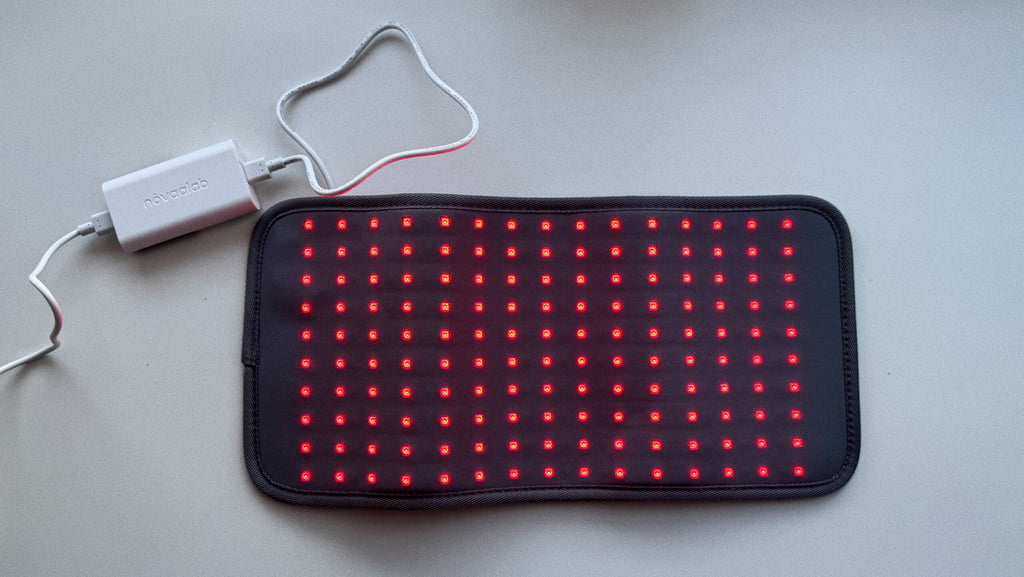
NovaaLab Light Pad is a lightweight, versatile device that easily molds to target joints or larger areas like your lower back or hips. It comes with a stretchy strap to keep the pad securely in place.
Even though it weighs only 0.6lbs, it features 450 light chips that deliver an irradiance of up to 150mW/cm² at direct skin contact, proving you don’t need a bulky device to house dense LEDs and powerful light.
On top of that, we found its controls to be very straightforward. Customizations like the timer, static versus pulsing light, and light type (red only, infrared only, or combined) are easily adjustable via a controller connected to the pad.
Unfortunately, it isn’t wireless by default, but you can buy a battery pack separately so you can use it on the go. The battery provides around 3 hours of use time on a single charge and costs an additional $99.90.
Overall, NovaaLab Light Pad is best suited for users seeking an ergonomic and versatile red light therapy device and those who are willing to invest extra for portability.
- Powerful
- Portable
- Straightforward
- Battery is sold separately
Compare the best red light therapy devices for joint pain
Take a quick look at this product comparison to find the right fit in no time.
| Product | Type | Red wavelength | NIR wavelength | Irradiance | Treatment area | Session length | Portable | Price | Best for |
| Kineon MOVE+ LED & Laser | Modular strap | 660nm | 808nm | 25mW/cm² | Joints and larger areas | 5–15 mins | Yes | $499 | On-the-go targeted sessions |
| Recharge Health FlexBeam | Modular strap | 610–650nm | 800–850nm | 110mW/cm² | Joints and larger areas | 20–30 mins | Yes | $479 | Powerful and versatile sessions |
| Mito Red Light MitoQUAD™ Wavelength Belt | Belt | 630nm, 660nm | 810nm, 850nm | 18mW/cm² | Joints and other larger areas | 15–20 mins | No | $349 | Stationary sessions |
| Megelin JointLux Laser+LED Light Therapy Wrap | Wrap | 660nm | 850nm, 1064nm | Up to 150mW/cm² | Knees, elbows, ankles | 15 mins | Yes | $169 | Joints-only sessions |
| NovaaLab Light Pad | Pad | 660nm | 850nm | Up to 150mW/cm² | Joints and other larger areas | 20 mins | Yes | $349.90 | Everyday comfort |
How to use red light therapy for joint pain?
Since protocols vary widely between products, there is no single right way to use red light therapy devices for joint pain. For specific instructions, it’s best to check your user manual first.
Following the instructions, expose the joint area and position the device at the recommended distance. The user manual should also outline the session duration and frequency. Be sure to stick to it, as more time won’t necessarily deliver more benefits.
Is red light therapy safe for joint pain?
Red light therapy is deemed generally safe to use, as long as you follow the manufacturer’s instructions. That said, there are still a few precautions you should be aware of before using these devices.
For instance, during a session, you might feel mild, temporary warmth over your joint. If it ever feels hot, you should stop immediately. Additionally, while rare, one of the most common side effects of using red light therapy devices is mild skin irritation.
Lastly, in case the red light gets too bright, or you have sensitive eyes, make sure to protect them by wearing the provided safety glasses.
Always consult a healthcare professional before starting treatment if you have any of these concerns or an underlying medical condition, take certain medications, or are photosensitive.
How to choose the best red light therapy device for joint pain?
Here are the key factors to consider when choosing a red light therapy device for joint pain, along with what you shouldn't compromise on:
- Target joint and coverage. Match the device type to the area you are targeting. Smaller joints (wrists, ankles) require straps or small pads, while larger joints (knees, hips, back) require flexible belts or wider straps and pads.
- Red vs. near-infrared wavelengths. Make sure that both of these wavelengths are featured in your device. Combined together, they target surface and deeper tissues to help with joint discomfort.
- Irradiance and treatment time. The higher the irradiance (light intensity) number, the shorter your sessions usually are. So if you prefer quick sessions, look for a higher irradiance number.
- Portability. If you want to take your red light therapy device on the go, make sure it’s compact and lightweight.
- Ease of use. Set up and controls shouldn’t be complicated if you want your red light therapy device to stick to your routine.
- Power source. For red light therapy sessions on the go, make sure your device has a wireless, battery-operated design. If you don’t mind being stationary during your sessions, a corded device should be sufficient.
- Build quality. Pay attention to the materials the device is made from. Especially for joints, the materials should be flexible, yet durable and resilient.
- Warranty and support. These ensure you'll get help in case your device malfunctions or you run into any issues using it.
- Evidence. Flashy marketing claims can be tempting, but if a device isn't backed by scientific research, you are better off looking elsewhere.
- Price. Keep in mind that expensive devices aren't automatically better. Always weigh the features against the cost while staying within your budget.
Other recovery and wellness reviews
Best red light therapy devices for pain relief: What actually works?
Best red light therapy belts: Tested picks for pain relief and recovery
Best red light therapy for back pain: What actually helps?
Best red light therapy devices for scars: Top picks tested
Final verdict: Which red light therapy device should you buy for joint pain?
Our tests showed that the strongest red light therapy option for joint pain is Kineon MOVE+ LED & Laser. While it is an investment, its built-in lasers deliver highly concentrated light for fast, five-minute sessions, and the device remains incredibly comfortable and portable on the go.
However, if you’re looking for wider coverage, we recommend considering Recharge Health FlexBeam. It operates similarly to our top choice but can cover larger areas much more easily. Meanwhile, for those on a tighter budget, Megelin JointLux Laser+LED Light Therapy Wrap is a solid, joint-specific option that remains one of the most powerful contenders on our list.
FAQ
The research on red light therapy’s effect on joint pain is quite limited and ongoing, so there’s still no concrete answer whether it really helps. That said, some users report improvements after consistently using red light therapy devices on their joints.
How often you should use red light therapy for joint pain depends on the device you use. Manufacturers typically provide guidelines for session length and frequency, so it is best to follow the instructions for your specific product.
Since responses to red light therapy vary, scientific research hasn’t established a single timeline for when it starts easing joint pain. To get the most benefit, it’s advised to use the device as consistently as possible.
Using both red and near-infrared light is typically the best approach for joint pain. Together, they target the surface and deeper tissue layers, supporting muscle recovery and pain management.
-
Lasers in Surgery and Medicine.
Effect of Pulsing in Low-Level Light Therapy
-
Journal of the American Academy of Dermatology
Photobiomodulation CME Part I: Overview and Mechanism of Action