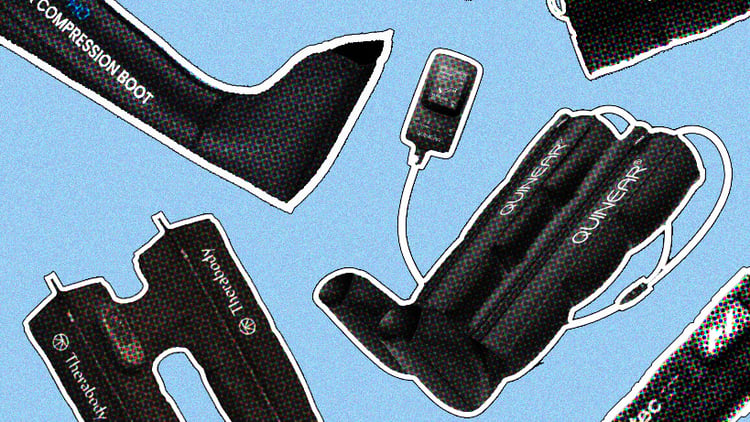
We tested the best compression boots—here are the ones that we’d recommend
Compression boots are devices that, in a way, give you a massage (inflate and deflate) to boost blood flow. This way, it may help with soreness, improve circulation, reduce leg fatigue, and support post-workout recovery. As a result, it’s one of the most popular gadgets amongst athletes, runners, and people who are always on their feet.
While such devices may support faster recovery and relaxation after intense activity, you shouldn’t expect miracles. Using compression boots might only slightly help you, and the results highly depend on your training intensity and overall health.
Since there are quite a few options available, we decided to test some and see which are worth investing in. In this article, you’ll find our top compression boots, each tailored to your needs and budget.
Quick summary: The best compression boots
- Normatec 3 Legs: Best overall leg compression boots
- Normatec Elite Legs: Best compression boots for circulation with a wireless design
- RENPHO Aeria Boot: Best compression boot for a budget-friendly price
- Therabody JetBoots Prime: Best compression boot for recovery, suitable for beginners
- QUINEAR Leg Recovery Compression System: Best compression boots for edema and professional athletes
How we tested compression boots
To find which compression boots deserve your attention, we tested them for almost a month. Each device was evaluated considering the compression quality and overall performance. We were also interested in whether they’re comfortable and easy to use on a regular basis.
We also looked at the extra features and customization options these compression boots offer to see whether they’re suitable for everyone or focus more on specific use cases. It was also necessary to consider technical aspects, such as portability and battery life, as well as price, to determine whether it offers good value for money.
Normatec 3 Legs: Overall best compression boots
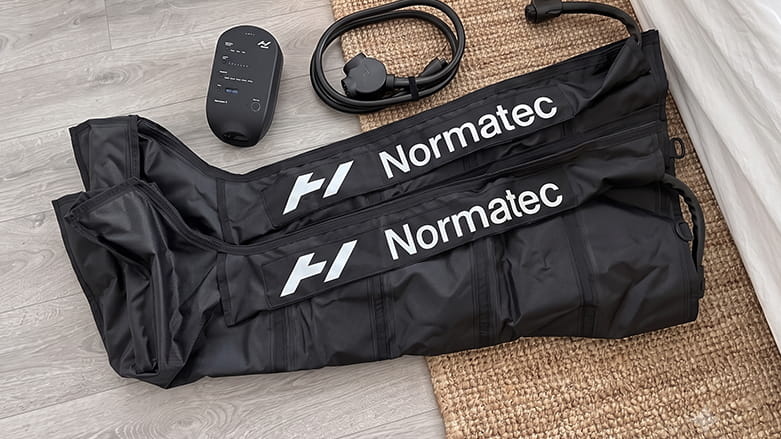
- Weight: 3.2 pounds
- Connectivity: Bluetooth
- App support: Hyperice app
- Price range: Premium
After reviewing Normatec 3 Legs, we believe that it’s a solid, premium, and very portable device that might help with recovery. Due to its dynamic air compression and massage-like pattern, it could potentially reduce stiffness and improve circulation.
It also offers seven compression levels, allowing you to perform sessions of 40–110mmHg. This is why we think it may be suitable for both simple relaxation and post-workout recovery. Using the ZoneBoost feature, you’ll also be able to focus more on specific areas if you have one that you want to target more.
Compared to other compression boots, Normatec 3 is very lightweight, weighing only around 3.2 pounds. Of course, you’ll find no small compression boots, but if you’re looking for a gadget that you could travel with, Normatec 3 Legs is one of the best options due to its weight.
Overall, it is quite straightforward, so you shouldn’t have much trouble using it. It also has a companion app, Hyperice, where you can adjust the zones and intensity levels.
The only drawback of Normatec 3 is its price. It’s definitely one of the more expensive devices, so if you’re looking for something simple, you can find cheaper alternatives. On the other hand, we believe that Normatec 3 is definitely worth considering if you’re an active person looking for customizable recovery tools.
- 7 compression levels
- Lightweight, easy to travel with
- 3-hour battery life
- Higher pricing
- An app is required for additional customization
Normatec Elite Legs: Best premium quality compression boots
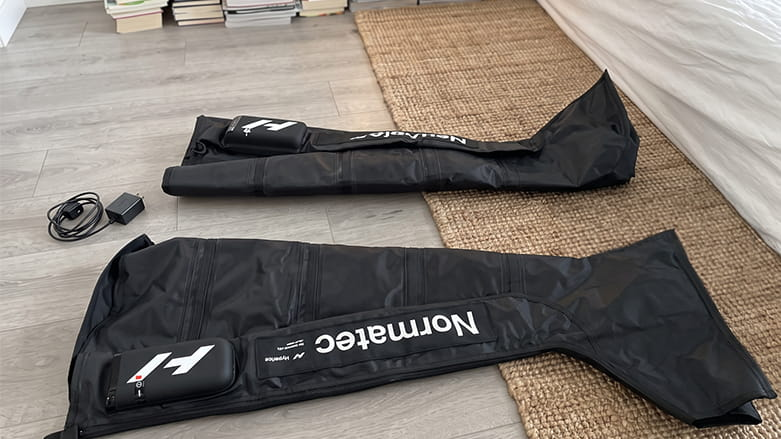
- Weight: 6.4 pounds
- Connectivity: Bluetooth
- App support: Hyperice app
- Price range: Premium
Normatec Elite Legs is one of the most advanced and modern compression boots, taking a completely wireless approach. Even the controller is not wired, as each boot has its own controller.
Overall, the technology is quite similar to Normatec 3 Legs, as it uses dynamic air compression and its patented Pulse technology, which delivers sequential compression. It also offers seven compression levels ranging from 40–110mmHg. However, we see Normatec Elite Legs as an upgrade, as it has a longer battery life (four hours) and a more sturdy design.
We personally liked the modern look of Normatec Elite Legs. It feels like a firm and very professional device to use at home. However, it weighs twice as much as Normatec 3 Legs, which is something you should consider if you’re thinking of traveling with it.
If you’re looking for an advanced and customizable compression boot with a more clinical feel, Normate Elite Legs is definitely for you. We believe that it’s suitable for professional athletes or very active people who may want help with post-workout recovery.
However, if battery life, wireless design, and extra features like ZoneBoost and HyperSync are not key factors for you, we suggest other alternatives. Unfortunately, Normatec Elite Legs is definitely one of the most expensive compression boots out there.
- Completely wireless
- 4-hour battery life
- Modern and sturdy design
- Expensive compared to competitors
- Quite heavy
RENPHO Aeria Boot: Best budget-friendly compression boot
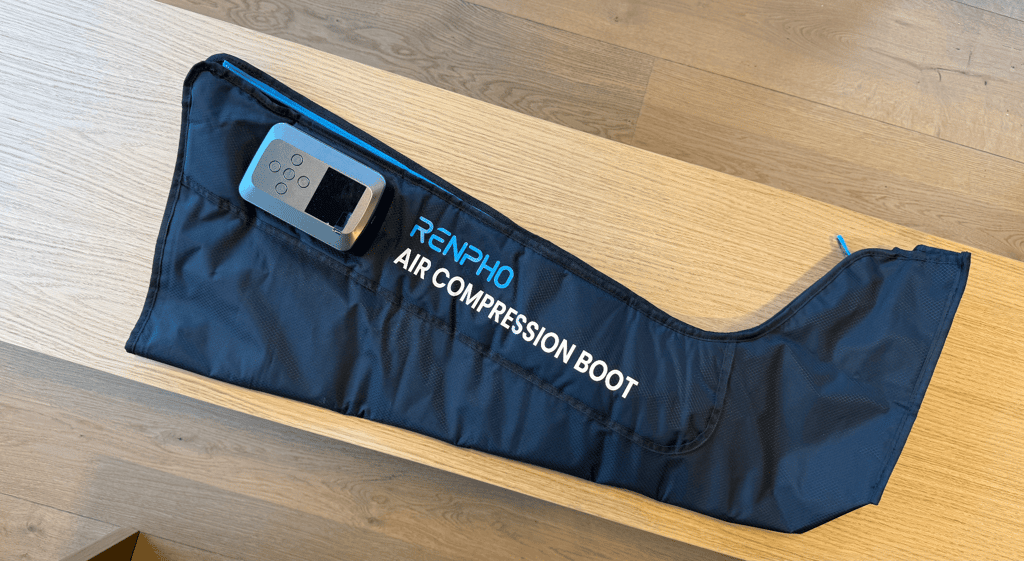
- Weight: 4.01 pounds
- Connectivity: Bluetooth
- App support: Renpho Health
- Price range: Low
Compared to other compression boots, RENPHO Aeria Boot is one of the cheapest devices out there, especially if you choose the single boot option. While it’s very affordable, it still offers solid performance with extra modes and massage intensities.
It has full 360° air compression, which may be perfect for anyone with stiff, tired legs. There are 16 intensity levels (ranging from 50–200mmHg), potentially making it suitable for both simple relaxation and recovery after intense workouts. It also offers three modes: Restore Mode, Soothe Mode, and Nourish Mode, so you’ll be able to customize your sessions according to your needs that day.
Just like Normatec Elite Legs, it’s completely wireless, but it’s much lighter. This makes us believe that RENPHO Aeria Boot is quite portable.
On the other hand, RENPHO Aeria Boot’s battery life is not as long as its competitors'. It takes about 2.5 hours to charge. Battery life is only 60 minutes, meaning it will last only one or two sessions before needing to be charged again.
If you’re looking for a budget-friendly yet still quality option, RENPHO Aeria Boot is a great choice. However, if you’re interested in more efficient sessions, we recommend choosing a pair of boots so you can relax both legs at once, which will be more expensive.
- Wireless design
- 360° air compression
- Three different modes for different use cases
- 1-hour battery life
- You’ll need to purchase a pair of boots for both leg sessions, which costs much more
Therabody JetBoots Prime: Best user-friendly compression boots
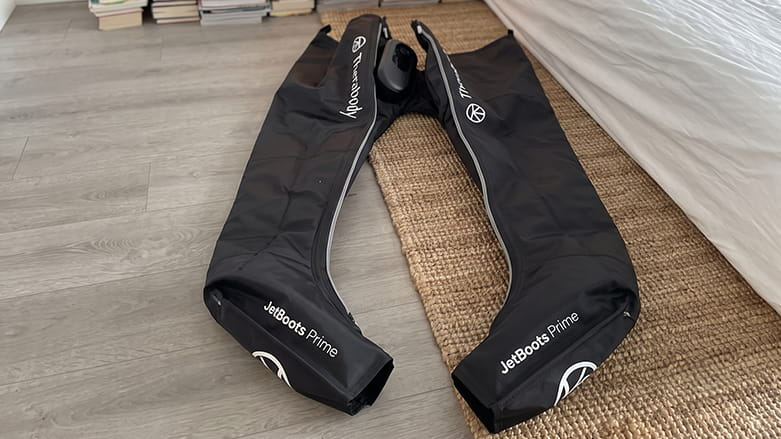
- Weight: 6 pounds
- Connectivity: Bluetooth
- App support: Therabody
- Price range: Mid-range
We found Therabody JetBoots Prime to be a simple-to-use device, making it a perfect choice for beginners who want to potentially improve blood circulation or recover after intense activities. With a 3-hour battery life, you’ll be able to enjoy efficient sessions without much effort.
These compression boots feature four air chambers for gapless compression. The pressure is between 25–100mmHg, and you can adjust the compression time to 20, 40, or 60 minutes. It also has a built-in touch screen, making it easy to control your sessions.
While it’s a bit heavier than some other devices, we found it quite compact. If you want to travel with it, you can easily fold it and put it in the drawstring backpack you get with your purchase. It’s also completely wireless, so it’s more hassle-free as well.
Overall, it’s a much simpler version of Therabody JetBoots Pro Plus. We believe that Therabody JetBoots Prime would be a good addition to your recovery routine, but it definitely has fewer features and modes than its competitors.
If you’re new to compression boots and want something simple for relaxation and post-workouts, JetBoots Prime is the way to go. However, it might not be ideal for professional athletes or users who want more targeted compression or greater customization.
- Includes a drawstring backpack for traveling
- Easy to use built-in touch screen
- Wireless design
- Lower maximum pressure compared to competitors
- Not many extra modes and features
QUINEAR Leg Recovery Compression System: Best professional compression boots
- Weight: 6.61 pounds
- Connectivity: None
- App support: None
- Price range: Mid-range
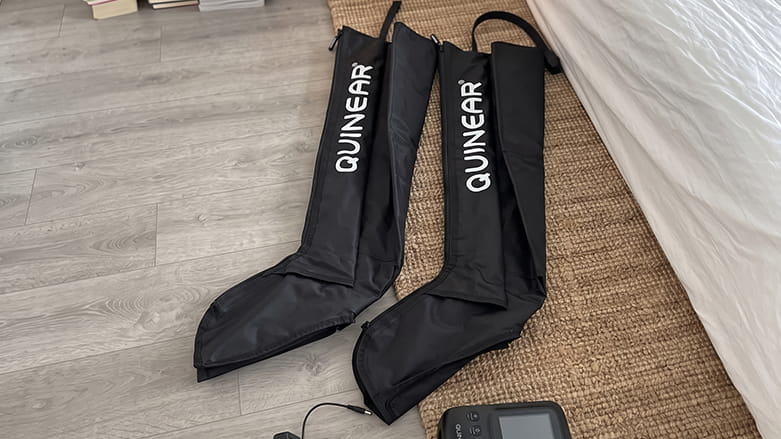
After reviewing QUINEAR Leg Recovery Compression System, we believe that it’s a very customizable device suitable for multiple use cases. Since it has quite a few different modes and offers extra features, it almost feels like a more professional gadget.
It has four air chambers that will cover your feet, lower and upper calves, and thighs, and eight pressure levels (50–120mmHg). QUINERA Leg Recovery Compression System even has a built-in pressure sensor, which automatically adjusts inflation according to your leg size. There are also three massage modes (Sequence, Circulation, and Combination).
The brand also includes a portable storage bag, which should come in handy when storing the compression boots. However, we found it not the best option for traveling. The device is heavier compared to other alternatives, and the overall design is quite bulky.
If you’re someone who's looking for an advanced, professional-style gadget with different modes and features, QUINEAR Leg Recovery Compression System might be perfect for you. However, if it’s your first time using such devices, you might consider something simpler.
- 8 pressure levels
- 3 massage modes
- Built-in pressure sensor
- Bulky design and not completely wireless
- Heavier compared to competitors
Best compression boots compared
Here’s a quick overview of the top compression boots and their key specifications to help you make a well-informed decision:
| Compression boots | Compression chambers | Pressure levels | Battery life | Weight | App support | Price range |
| Normatec 3 Legs | 5 chambers | 7 levels (40–110mmHg) | 3 hours | 3.2 pounds | Hyperice app | Premium |
| Normatec Elite Legs | 5 chambers | 7 levels (40–110mmHg) | 4 hours | 6.4 pounds | Hyperice app | Premium |
| RENPHO Aeria Boot | 5 chambers | 16 levels (50–200mmHg) | 1 hour | 4.01 pounds | Renpho Health | Low |
| Therabody JetBoots Prime | 4 chambers | 4 levels (25–100mmHg) | 3 hours | 6 pounds | Therabody | Mid-range |
| QUINEAR Leg Recovery Compression System | 4 chambers | 8 levels (50–120mmHg) | 4 hours | 6.61 pounds | None | Mid-range |
What are compression boots?
Compression boots are devices you wear on your legs. Such gadgets use pneumatic compression technology, which basically applies pressure to your legs by inflating and deflating the boot, giving you a sort of rhythmic massage.
Applying this massage to your legs might support relaxation, post-workout recovery, stiffness, or swelling. Some compression boots even offer different pressure levels and fully customizable sessions, which may work well for both relaxation and recovery.
Compression boots are a great addition to your post-workout routine, but they're only effective when paired with a balanced lifestyle. You still need to rest, hydrate, move, and stretch regularly. Compression boots may support recovery, but they won’t solve more severe issues.
How do compression boots work?
Usually, compression boots have multiple air chambers inside them. These chambers inflate and deflate in a specific order, creating compression. During sessions, you feel a sort of squeezing sensation that turns into pressure on your legs. We found that it almost feels like a massage.
Such compression on your legs may potentially improve blood circulation, resulting in faster recovery. Using compression boots is very popular among runners, athletes, and other fitness enthusiasts. We also believe it could be beneficial for workers who stand a lot on their feet, or for those with seated jobs who want to improve blood circulation after a long day of work.
If you use it correctly and regularly, the pressure that the boots provide might help your legs feel less tired, less stiff, and less sore.
How to choose compression boots
There are numerous brands offering compression boots, making it harder to find the one that suits you best. For the best possible experience, consider a few factors before investing in one.
Different brands offer different compression levels, a crucial feature of such boots. If you’re looking for something simple and relaxing after work, a gentle 20–50mmHg pressure might be enough. However, for more professional athletes, we recommend something between 100–200mmHg.
Talking about technical things, you should also consider how many air chambers the device has. Simpler compression boots usually offer only four chambers, which is why they’re often way cheaper. While it’s not bad and still offers solid sessions, you should choose a gadget with five or eight chambers for more targeted and gradual compression on your legs.
What’s more, you should also consider the battery life and portability of compression boots. If you travel a lot and don’t want to skip your recovery sessions, choose a more compact device.
Of course, price is a key factor in decision-making. There are quite a few solid budget-friendly options. However, if you need something to use for a long time and you’re looking for a professional device with an advanced companion app, you should expect the price to be a bit higher.
Other health tech reviews:
Normatec vs. Therabody: Which recovery system is right for you in 2026?
Best red light therapy pods in 2026: Options for recovery and relaxation
Withings Body+ vs. Body Smart: Which smart scale should you choose?
Final verdict
We put multiple brands to the test and reviewed their chambers, compression range, portability, battery life, and different modes. All top five compression boots are worthy of attention, but Normatec 3 Legs remains our top choice. It offers the perfect balance between excellent compression, quality build, and simplicity.
However, if you’re looking for something more budget-friendly, RENPHO Aeria Boot is one of the best choices. While it’s a cheaper device, we found it quite advanced considering its price. For professional athletes or users who want the most premium experience, we recommend Normatec Elite Legs.
Best compression boots: FAQs
Yes, compression boots might work in some cases, but it depends on your expectations. Compression boots might help boost blood circulation, potentially reducing soreness and swelling, or improving overall recovery. However, keep in mind that it is a support tool—it won’t solve any serious physical problems.
How often you should use your compression boots basically depends on your needs and lifestyle. If you’re someone who simply wants to relieve leg fatigue after work, you can use them 3–4 times a week. If you’re more active, you can also use the device daily, which is quite common for athletes.
Yes, compression boots are generally safe to use if used correctly. However, some people might experience side effects. If you’re pregnant, have recently had an injury or an infection, or have any vascular conditions or blood clots, we recommend consulting your doctor first before using compression boots at home.
Yes, compression boots may improve circulation. Since the boot inflates and deflates, giving you a massage, it helps to pump blood to your heart. This might lead to less swelling, less fatigue, and less stiffness.
The best compression boots for athletes are Normatec 3 Legs, Normatec Elite Legs, and QUINEAR Leg Recovery Compression System. All devices offer five chambers, multiple pressure levels, and different modes for different use cases. Since they’re all quite customizable, it’s a perfect choice for more professional use at home.
-
Journal of Bodywork and Movement Therapies.
-
International Journal of Sports Physiology and Performance.
-
Biology of Sport.