The next Ultrahuman smart ring could become a controller for smart glasses

Exclusive: New USPTO filing explores 3D spatial tracking and gesture controls for augmented reality
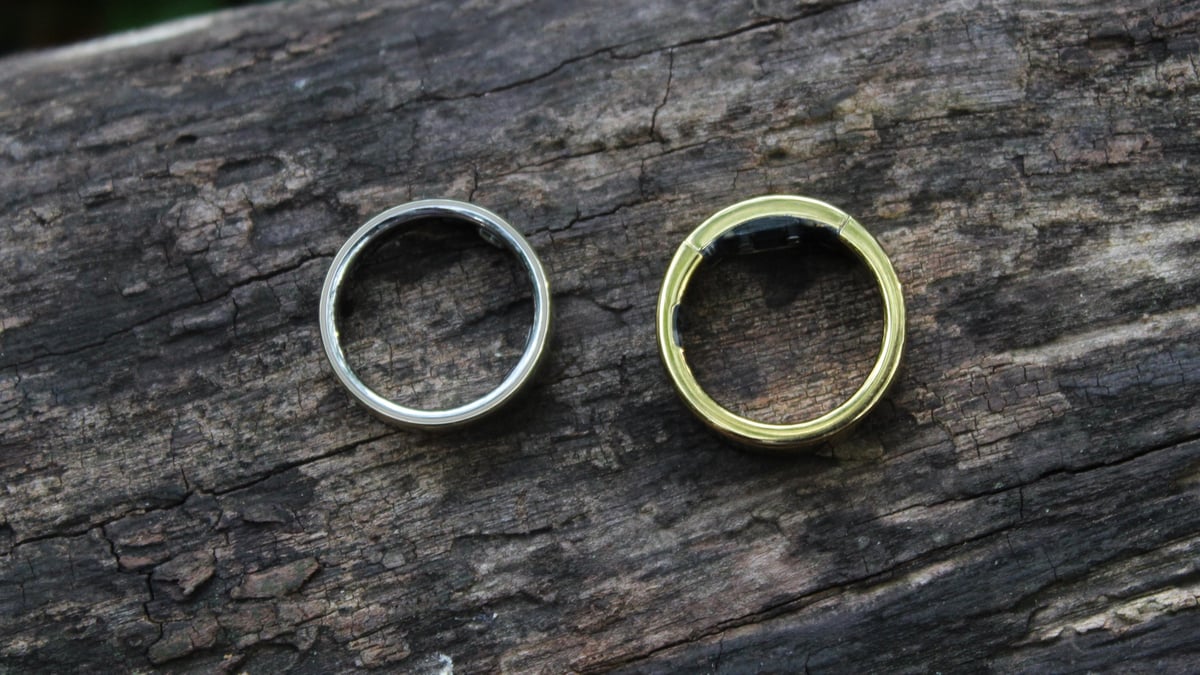
Ultrahuman is exploring new technology that would let smart rings be tracked in 3D space. A new patent filing hints at a future where the company’s products could be used for gesture control of augmented reality (AR) smart glasses.
Right now, smart rings are a bit like wedding rings—you only need to wear one at a time. However, judging by a new patent filing by the maker of the Ring Pro and Ring AIR, there could eventually be an option to double down.
The USPTO filing, spotted by Wareable, describes using two smart rings—one on each hand—for “3D positional tracking and gesture recognition”.
The system sends movement data back to augmented reality environments via Bluetooth to control a digital interface, and the patent also describes a touch-sensitive component as an input method.
Expanding beyond wristwear
While a third-party integration or partnership is always possible, the filing signals that Ultrahuman is at least considering expanding its portfolio into AR smart glasses.
The sector is expected to be a major growth area over the next decade and presents a huge opportunity for Ultrahuman to expand. A search of the USPTO shows no other similar patents for AR glass gesture tracking, though the company already offers its blue-light-blocking Faraday eyewear designed to protect circadian rhythms.
Given that the shift toward smart glasses is partially about reducing the bulky form factor of traditional headsets, making the controllers equally minimal makes practical sense. That's what we've seen with the Even Realities G2, which pairs with the brand's R1 smart ring.
“Traditional systems often rely on external cameras, sensors, or markers to track movement and gestures. However, these systems can be limited by environmental factors, such as lighting conditions or occlusion. Moreover, the requirement for external equipment can restrict the user's mobility and limit the applicability of the technology in different settings," the patent reads.
“Thus, there is a need for a wearable device that overcomes these limitations by providing precise 3D positional tracking and gesture recognition capability. Such a device would offer greater freedom of movement and versatility, enabling users to interact with digital content in a more natural and intuitive manner.”
Hardware and latency demands
Would dual smart rings still offer the same health and wellness benefits? There's very little reason why not.
Ultrahuman products already contain a six-axis motion sensor to map activity and sleep. The company claims the sensor “captures the intricacies of your body's movements with unmatched precision” – a claim supported by our extensive testing.
The current product lineup may meet the motion-tracking goals described in the filing, but a new model would be required for touch-sensitive inputs.
Real-time communication may also introduce latency, requiring hardware optimizations. Currently, captured data takes a few seconds to sync with the companion app, whereas AR applications demand millisecond precision and real-time spatial processing.
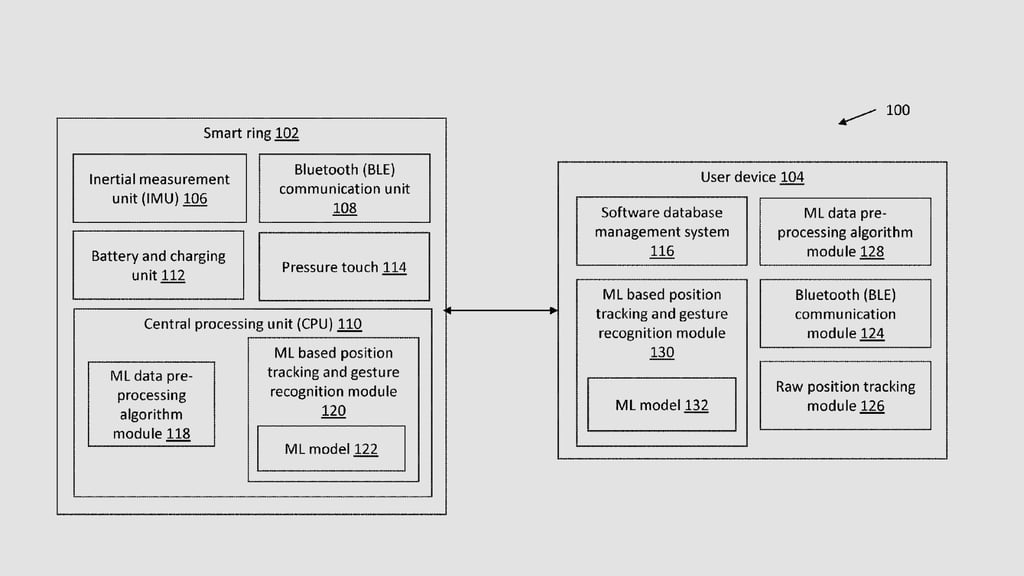
“The user wears one smart ring on each hand to increase the flexibility and range of motion of the gestures. Each of the smart rings includes an Inertial Measurement Unit that may be used for continuously recording 6-axis motion data and providing the motion data to the CPU...
“The motion data may include accelerometer data (ax, ay, az)... gyroscope data (gx, gy, gz)... and timestamps (t)... Further, both the smart rings are connected to each other via the BLE communication unit... such that they can monitor the motion data collectively or independently...
“The smart ring transmits the motion data to the user device in real-time or in a pre-defined frequency... Further, the raw position tracking module may determine a position of the user in a 3D environment based on the 6-axis motion data measured by the IMU.”
Of course, a patent filing is never a surefire indication that a commercial product is imminent. However, it highlights a sensible and natural direction for Ultrahuman to consider as it expands its product portfolio.
Wareable has requested comment from Ultrahuman and will update this post when it responds.