The company is still pushing toward one of wearables’ toughest goals: meaningful blood pressure tracking without a cuff
Oura may soon estimate blood pressure metrics by analyzing the subtle wave shapes of multi-wavelength optical sensors.
That’s if a newly granted patent—“Techniques for determining blood pressure based on morphological features of pulses”—is anything to go by, at least.
While Oura already uses optical sensing in the ring, this patent describes a more advanced approach that would use multiple wavelengths and pulse-wave analysis to estimate blood pressure.
Put simply, Oura wants to look beyond simple pulse rate and study the detailed rise and fall of each pulse wave.
This is one of the clearest signs so far that Oura is moving toward more advanced blood pressure tracking.
More than just a general blood pressure signal
Tracking blood pressure without invasive methods remains one of wearable technology's toughest challenges, which is why only a few brands have tried.
Huawei’s Watch D3 is a good example of a blood pressure-focused device, while Samsung’s Galaxy Watch series has used cuff-based calibration for its readings for some time.
Oura’s new patent suggests a different approach. It uses several wavelengths of light, such as infrared and red, to measure pulse waveforms at different tissue depths.
By closely analyzing the shape of these pulses—including features like systolic and diastolic peaks, delays, derivatives, curvature, amplitudes, and timing differences—the device may estimate various blood pressure metrics.
Oura could also consider factors like movement, posture, hydration, temperature, and fit when analyzing the readings.
The patent also explains that the system may create a baseline PPG profile for the user, learn what is normal, and compare future readings to that standard over time.
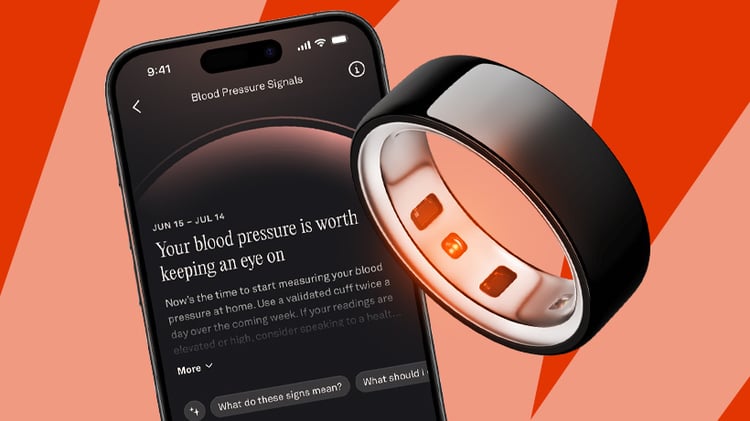
This seems more ambitious than Oura’s current Blood Pressure Signals feature.
Currently, Oura provides broader wellness insights instead of direct blood pressure readings. It tracks nighttime PPG trends over 30-day periods and highlights patterns that could suggest reduced nighttime dipping or signs of cardiovascular strain, but it does not give systolic and diastolic numbers in mmHg.
In contrast, the patent describes a system that seems much closer to true cuffless blood pressure estimation.
And while the patent abstract refers to a generic wearable device, the ring shape fits best here since Oura only makes rings, and the finger is usually better than the wrist for picking up clear vascular signals.
This could hint at the direction of future Oura Ring models, but as with all patents, there’s no way to know if or when this idea will actually see the light of day.