We put these two standout scales against each other to help you decide which is the better buy
Tracking your weight alone is generally not enough for long-term health and fitness. That’s why many people turn to smart scales that measure body fat percentage, muscle mass, water weight, and so much more. While the numbers you get are rough estimates, they help provide a clearer picture of your overall body composition.
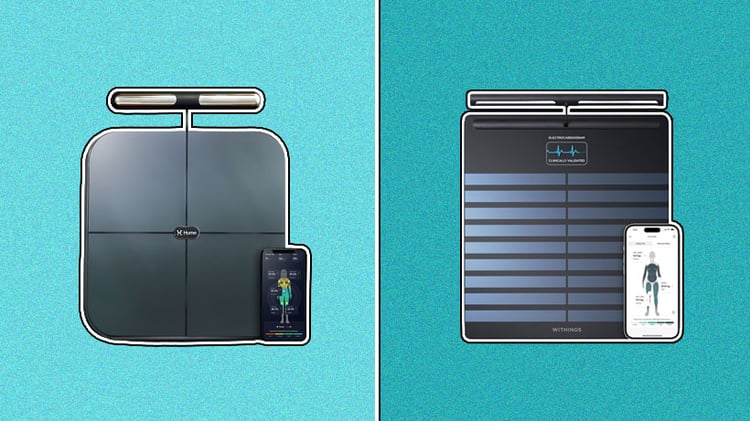
If you’re looking to upgrade your bathroom scale, two standout options on the market are Hume Health Body Pod and Withings Body Scan.
| Feature | Hume Health Body Pod | Withings Body Scan |
| Price | $183.04 | $499.95 |
| Body composition metrics | 45, including fat percentage, overall muscle mass, and bone mass | 40+, including fat percentage, overall muscle mass, and bone mass |
| Segmental analysis | Yes | Yes |
| ECG support | No | Yes |
| App support | Hume Health app (syncs with Apple Health, Google Fit, Fitbit) | Withings app (syncs with Apple Health, Google Fit, Strava, etc.) |
| Connectivity | Bluetooth | Wi-Fi and Bluetooth |
| User Profiles | Up to 24 users | Up to 8 users |
| Subscription requirements | Free app + optional Hume Plus subscription for $8.33 | Free app + optional Withings+ subscription for $9.95 |
| Warranty | 1-year | 2-year |
| Official Website | Visit Hume Health | Visit Withings |
Withings Body Scan is designed for users who want advanced heart and nerve-related insights and segmental body composition analysis.
Meanwhile, Hume Health Body Pod focuses on body composition tracking, AI-powered health insights, and fitness-oriented coaching at a lower price point.
Read on for their detailed comparison below, covering everything you need to know to choose between the two.
Design and everyday use
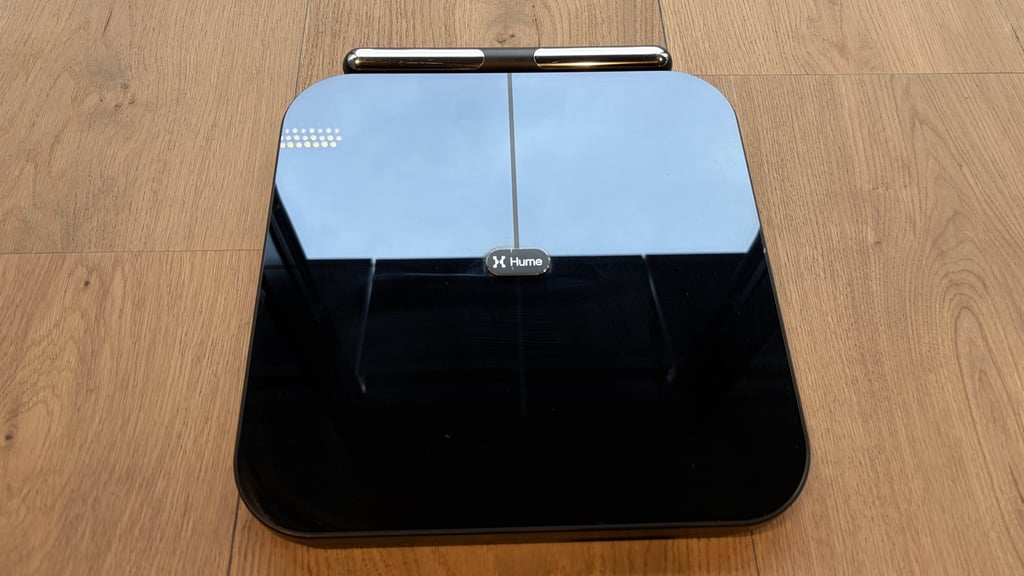
Out of the box, we noticed that both scales have a sleek, modern look. It’s just that Withings Body Scan is slightly larger and heavier than Hume Body Pod. While the larger surface area may be great for larger feet, we noticed that Hume Body Pod feels lighter to pick up or slide out with one hand.
Both devices sport a tempered glass surface and a retractable handle, but you’ll notice a difference when you go to grab them. While you simply grip the handle on Hume Body Pod, Withings Body Scan requires a more precise grip, asking you to position your thumbs over dedicated sensors. It’s really not a problem, just takes a bit more conscious effort to get used to.
When it comes to their screens, their approach again differs slightly. Hume keeps it simple by showing your weight and saving the rest of the data for your phone. Meanwhile, Withings cycles through several metrics directly on its colorful display. While this means you don’t need your phone to see the key health metrics, we found that staring down at your feet for a full scan isn’t exactly comfortable. On the bright side, if you don’t want to see the metrics displayed, you can turn them off using Eyes Closed mode in the app.
In terms of setup, the two smart scales require an app to get started, both of which easily guided us through the whole process. During daily weigh-ins, both scales also recognized who was stepping on them based on their weight and previous data. Hume supports up to 24 user profiles, while Withings caps out at 8. When it detects a user, it routes the data strictly to that person’s profile.
One thing to note with Withings is that daily weigh-ins take a bit longer since it gathers more information about your body than Hume. ECG alone takes 30 seconds. This isn’t necessarily a bad thing, but it’s something to have in mind.
As for keeping them powered, both feature rechargeable batteries that last roughly a year on a single charge, making them low-maintenance.
Since Hume Body Pod is lighter, supports more user profiles, and completes daily weigh-ins faster, we feel like it’s slightly better in the design and everyday use department, though not by a lot.

Health and body composition tracking
In total, Hume Health Body Pod measures 45 health metrics, while Withings is marketed to collect over 40 biomarkers. They overlap in key body composition markers like overall body fat, visceral fat, muscle mass, water weight, and bone mass.
They also measure your Basal Metabolic Rate, the number of calories your body burns to sustain life at complete rest. This is highly useful when trying to figure out how many calories you should consume for your individual situation.
Both additionally offer full-body segmental scan coverage for the arms, torso, and legs. This means that the scales will break down fat percentages and muscle mass for the right arm, left arm, torso, right leg, and left leg to help you notice any inconsistencies and asymmetries in your body.
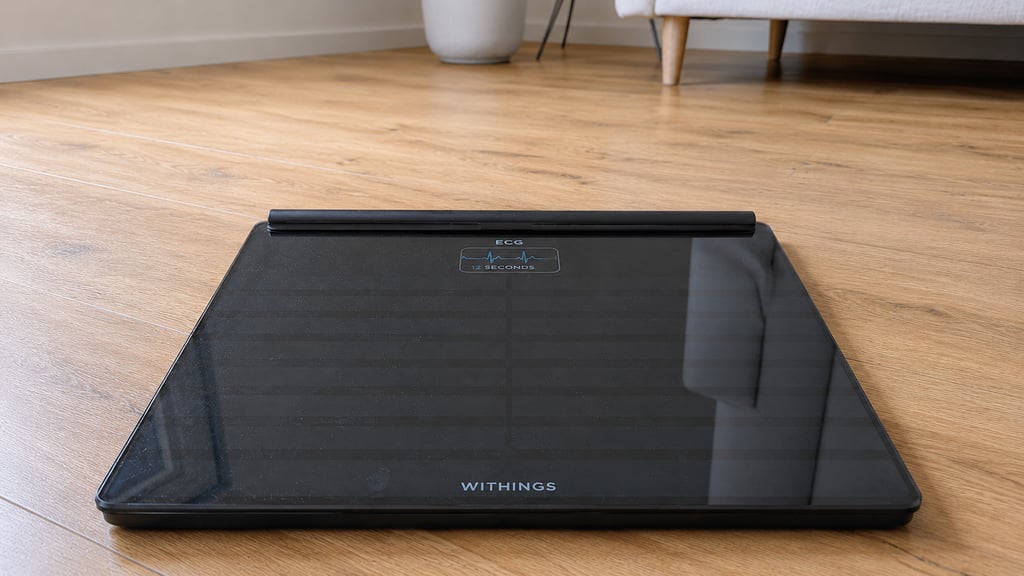
What sets Withings apart and partially justifies its premium price is its advanced heart and nerve-related insights. While Hume includes a general heart health metric, Withings features specialized hardware to perform a 6-lead ECG, calculate Vascular Age, and measure Pulse Wave Velocity.
Withings also uses Electrodermal Activity (EDA) to provide a Nerve Health Score, which Hume lacks. This metric may help you find out how your body is potentially reacting to stress and recovering from it over time.
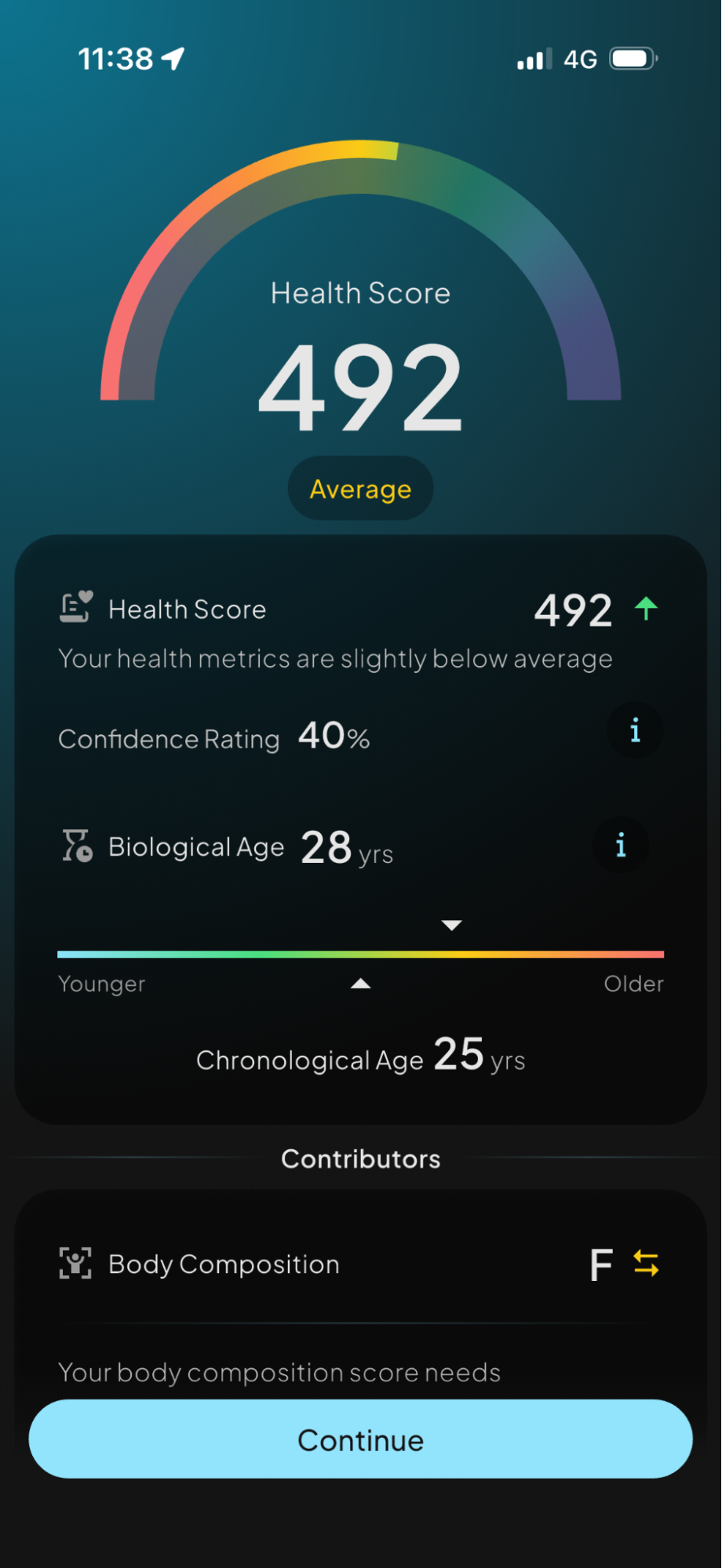
Hume Body collects standout biomarkers that Withings is missing too, like protein levels and advanced hydration metrics (intracellular water and extracellular water), and has its own proprietary scores that offer useful insights such as Overall Health Score, Body Composition Grade, and Activity Grade.
Which of these metrics is the most useful ultimately comes down to personal preference. Some people might be more interested in Hume’s hydration stats, while others might be far more invested in the advanced heart data provided by Withings.
For us, Withings seems to have a slight advantage over Hume in health and body composition tracking, as it offers advanced heart and nerve-related insights that provide a more comprehensive view of your overall well-being.

Accuracy and measurement technology
Both Hume Body Pod and Withings Body Scan use BIA technology to perform full body scans. In simple terms, this technology estimates your body composition by sending low-level electrical current through the body.
To make these estimates more accurate, both scales feature a retractable handle. This gives them more contact points, allowing the current to travel through not only the lower but also the upper part of your body, possibly improving biomarker accuracy.
When compared to DEXA scans—the clinical standard that uses low-intensity X-rays to measure lean mass, fat mass, and bone mass—Withings claims 99% accuracy correlation, while Hume claims 98%. However, take these marketing claims with a grain of salt. Since BIA technology is highly sensitive to daily variables, long-term trends matter more than daily fluctuations.
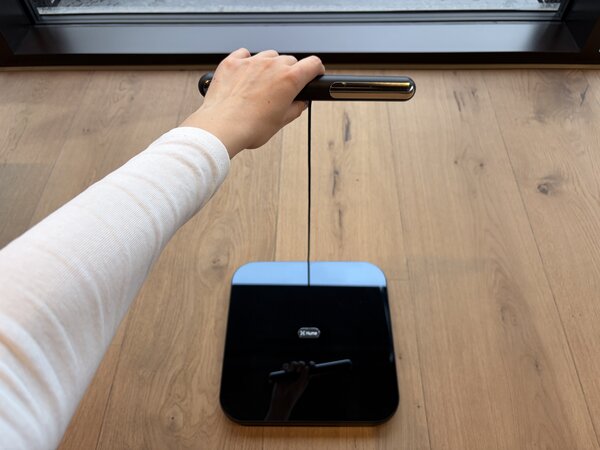
Accuracy also depends on consistency and how you measure yourself. For maximum accuracy, place the scale on a hard, flat surface, wear minimal clothing with bare feet, and keep still with an upright posture. It is highly recommended to weigh yourself at the same time every day, ideally in the morning, before drinking or eating.
Since Withings reports an accuracy of 99% vs. Hume’s 98%, we have to give in to Withings in terms of accuracy and measurement technology. However, for everyday use, it’s a really close call.
App experience and insights
Withings’ and Hume’s app experiences and insights differ quite a bit. Withings takes a more wellness-oriented approach, while Hume feels more like a personal fitness coach supporting you to set and reach your goals.
Both apps are also powered by AI. However, Withings uses it primarily to find long-term wellness patterns, while Hume goes further and converts those patterns into actionable, daily recommendations.
While they visualize data similarly and both allow for progress tracking, Withings lets you go into more detailed data, whereas Hume focuses more on the big picture, using a health score to keep you motivated.
Both devices connect with platforms like Apple Health, Google Health Connect, Fitbit, Garmin, and Strava so you can keep your health data in one place. It is also worth noting that Withings integrates with most of these directly, while Hume pulls their data through your phone’s native app. In our experience, they both sync seamlessly with third-party apps, and if a data transfer was ever delayed, a simple app refresh usually fixed it for us.
Since Hume goes the extra mile to provide actionable recommendations rather than just giving you raw data and patterns, we have to give it more points for a better overall app experience.
Price and value
We have to warn you that the price gap between Withings and Hume is quite big. Hume retails for $183.04, while Withings is selling for more than double the price—$499.95.
Without paying additional costs, with both, you get access to your weight, segmental body composition breakdown, multi-user tracking, and syncing with other apps like Apple Health and Google Fit. The premium price you pay for Withings also gets you extra heart and nerve-related data like 6-lead ECG, Vascular Age, and Nerve Health assessments.
However, for deeper insights, you can subscribe to the Hume Plus and Withings+ subscriptions. The Hume Plus plan costs $8.33/month (with a yearly subscription), while Withings+ comes to roughly $9.95/month. However, beyond that, neither scale requires any further maintenance costs.
Everything considered, for us, Hume Body Pod is easier to justify financially—not only because it’s more affordable, but also because it holds up to Withings nicely, offering similar core functions and adding its fitness coach insights to help reach your goals. Of course, it lacks advanced heart and nerve-related insights, but those are functions that not everyone may need.
Verdict: Which should you choose?
• Choose Hume Health Body Pod if you prefer an app that focuses on actionable, daily recommendations to reach your goals rather than just presenting you with a list of raw medical data.
• Choose Withings Body Scan if you want to track more advanced health data like vascular age, nerve health, and ECGs.
Our bottom line: In our eyes, Hume Health Body Pod takes the win. It’s more affordable than Withings Body Scan, yet still delivers in-depth insights and motivational coaching most people need to reach their health goals.