
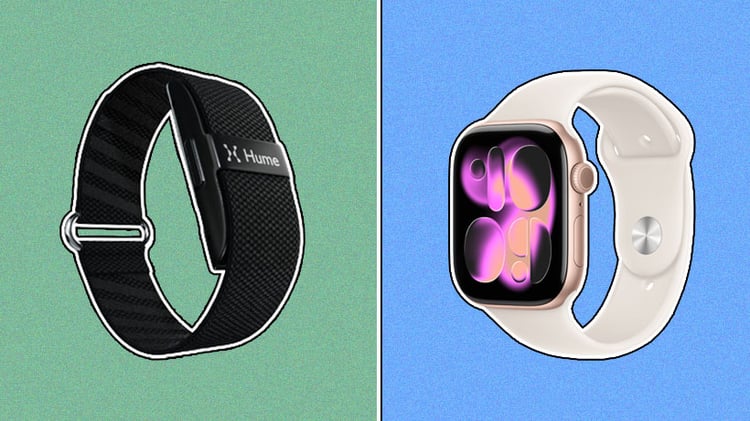
We compare two screen-free approaches to health tracking: Fitbit’s budget-friendly tracker and Hume’s longevity-focused band
There is clearly growing demand for minimalistic wearables that track your health without turning into another screen on your body.
That is exactly what Fitbit Air and Hume Band 2.0 are. Both are designed to stay out of the way, collect health data in the background, and feed it into companion apps that interpret it for you.
But despite that shared screen-free approach, these devices are aimed at different users. Fitbit Air appears to be a lower-cost entry point into overall wellness tracking, while Hume Band 2.0 is built more explicitly around longevity, recovery, and metabolic wellness.
Not sure which one to choose? This comparison draws on hands-on testing and official specifications to weigh up how these two wearables stack up—so you can figure out which one actually fits you.
Hume Band vs. Fitbit Air at a glance
| Product | Hume Band 2.0 | Fitbit Air |
| Display | None | None |
| Battery life | Up to 14 days (claimed) | Up to 7 days (claimed) |
| Water resistance | Up to 1 meter | Up to 50 meters |
| Sensors | 5 LED sensors, 4 photodiodes | Heart rate monitor, accelerometer with gyroscope, SpO2 sensor, temperature sensor |
| Sleep tracking | Yes | Yes |
| GPS | No | No |
Warranty | 1-year warranty, can be extended to 10 years | 1-year warranty, can be extended to 2 years |
| Price | $249.06 | Starting at $99.99 |
| Subscription | None for core features; optional Hume Health Premium | None for core features, optional Google Health Premium |
| Official retailer | Visit Hume Health | Visit Fitbit Air |
Hume Band vs. Fitbit: Key differences
The differences come down to what kind of insights you will be receiving from the collected metrics.
Hume Band 2.0 is unique in the market for its longevity-focused approach. While the tracking is passive, you’ll not be left with a bunch of metrics without any interpretation. The goal is to convert your passively collected data into easy-to-understand insights on sleep, recovery, and metabolic health—all tied to the overall longevity goal.
Fitbit Air takes a more mainstream route and doesn’t have any particular goal for its users. Instead of centering the product on longevity language, Fitbit positions Air as a discreet tracker that integrates with Google Health Coach and Gemini-powered analysis.
In other words, Hume Band 2.0 seems to be more specialized, while Fitbit Air feels more general-purpose.
Design, comfort, and everyday wear
Both are quite similar.
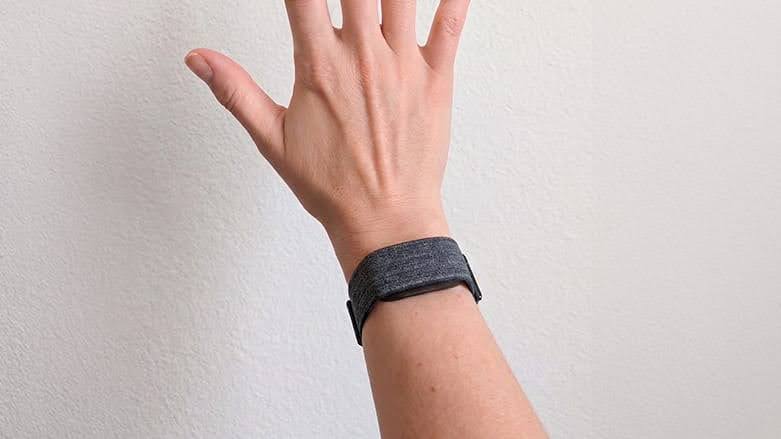
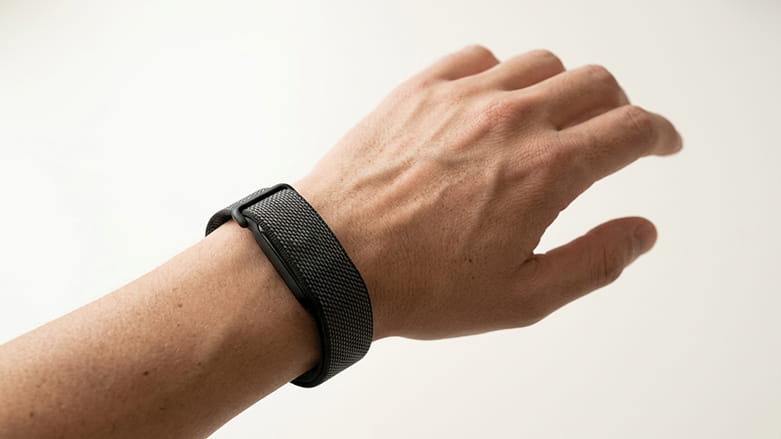
Hume Band 2.0 is a soft, screen-free band designed for continuous wear. It is lightweight, easy to forget, making it suitable for anyone looking to track discreetly. For our testers, it stood out for comfort and low-friction all-day use.
Fitbit Air is described as a pebble-like module that can be swapped between different bands, giving it some style versatility. While buying it initially, you can choose from 5 different band colors—but we already have other band options available from Google. As with other Fitbit devices, we can expect third-party bands to be released soon.
Compared to WHOOP, both Fitbit Air and Hume Band 2.0 feel less bulky, so they are a good choice if that’s what you are looking for. But our team found Hume Band 2.0 to be softer—but in the end, we couldn’t pick a winner in this category.
Health tracking and daily wellness
Both Hume Band 2.0 and Fitbit Air monitor similar metrics, including heart rate, sleep, activity, and recovery-related metrics. Neither has a screen, so the experience revolves around checking your data in the app rather than on your wrist.
Hume Band 2.0 leans heavily into long-term health optimization. Beyond basic tracking, it presents metrics such as biological age, recovery, heart rate variability (HRV), resting heart rate, stress, and metabolic health in a dashboard designed to show how your daily habits may influence your long-term wellbeing. Rather than focusing on individual workouts, the app encourages users to spot trends over time.
Fitbit Air offers a similar experience, except it does not lean into longevity—it is tailored for overall wellness instead.
Both platforms also highlight recovery and readiness, which is completely lacking if you use devices such as Apple Watch. These are meant to help users make decisions on whether to train harder or take a break based on factors such as sleep, HRV, and stress levels.
Where they differ is in how that information is framed: Hume Band 2.0 ties recovery back to longevity and aging, whereas Fitbit Air presents it as a guide for managing your energy and effort throughout the week.

For longevity, Fitbit Air for general wellness
Fitness tracking and exercise features
We will not sugarcoat here: one is clearly superior for those who work out—and it is not Hume Band 2.0.
As noted by our reviewers, Hume Band 2.0 didn’t appear to be designed for workouts. Of course, it tracks the basics, such as steps, calories, and heart rate during activity, but it doesn't offer structured workout modes, pace tracking, or detailed breakdowns.
Automatic workout detections didn’t work all of the time, so for those who like to monitor their progress, Hume Band 2.0 might not suit them well. Hume’s value lies in how your body recovers from exercise, not in how the exercise itself is performed.
We liked Fitbit Air more for workouts. While it also lacks GPS, it supports a wider range of activity modes and provides more granular workout summaries, including active zone minutes.
But even so, Fitbit Air won’t replace a dedicated sports watch, such as Garmin, if you are more serious about workout tracking—after all, both of these lack GPS, so it is expected.

Mobile app and software experience
Both devices are entirely app-dependent, so the software experience matters.
The Hume Health app is intuitive. It presents your data within a longevity-focused dashboard. The free tier covers enough metrics: steps, sleep, heart rate, HRV, stress levels, body temperature, and estimated blood oxygen saturation levels.
The longevity insights come from unique metrics such as metabolic momentum, capacity, strain, and recovery—each calculated from the aforementioned data. These numbers present your biometrics into more tangible insights, so you won’t be just tracking for the sake of tracking.
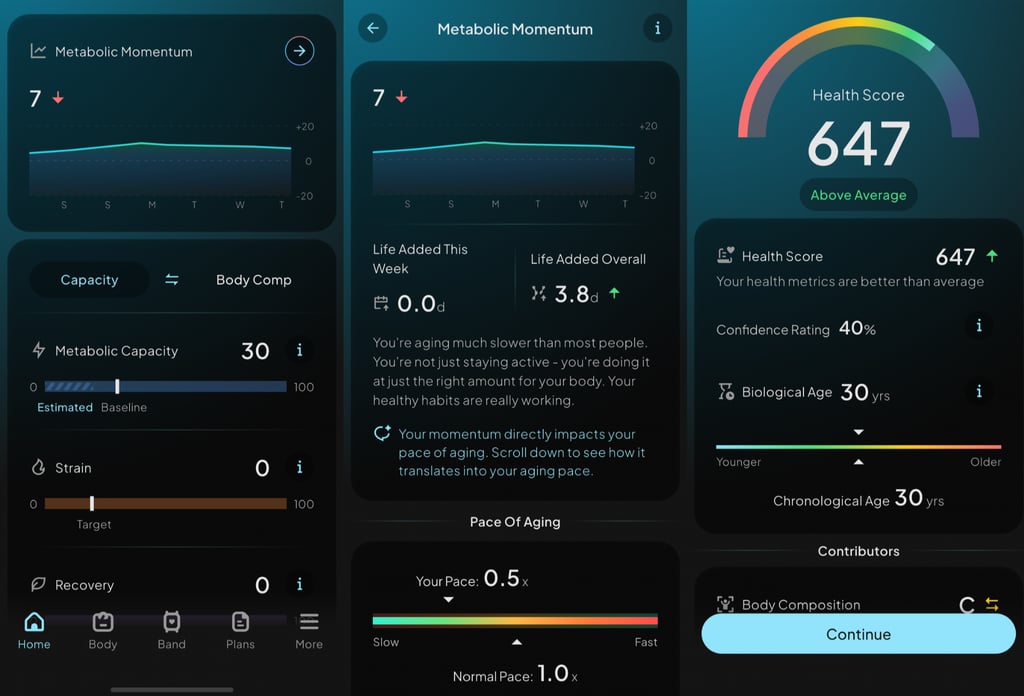
Compared to competitors that gate basic insights behind a paywall, this all seemed reasonable for our team. The premium tier adds an AI coach that offers deeper explanations of your data.
Fitbit's app (Google Health) is polished, benefiting from years of development. It is more similar to Apple’s Health app if you have any experience with it: a hub for your data rather than a tool. It surfaces your numbers clearly, but the interpretation and guidance largely sit behind the Premium paywall—meaning the app feels complete on the surface but intentionally shallow until you subscribe.
Battery life and charging
When it comes to battery life, both devices performed practically the same.
While Hume Band 2.0 advertises up to 14 days, constant tracking brought that figure closer to 7 days in our testing. This is still a solid result and a notable improvement over the original band's 5–7 day ceiling.
When the battery does run low, a recharge takes around 20-80 minutes. For a device designed for continuous all-day monitoring, a combination of long battery life and fast charging is practical.
Fitbit Air lands in the 6–7 day range under similar conditions, with comparable charging times (up to 90 minutes). It's a respectable result, but it doesn't pull ahead of Hume Band 2.0.
Pricing, premium, and long-term value
At first glance, Air seems to be the winner in this category: with the starting price of $99.99, it is not only cheap, it is one of the most budget-friendly bands out there.
While any Fitbit user can use Google Health app for free, access to the Health Coach requires an additional $10 monthly subscription. We are talking about features such as in-depth sleep analysis, proactive insights, AI coach, and more: many of this comes for free for Hume Band 2.0 users.
Hume Band 2.0 is, however, more expensive than Fitbit upfront. At $249.06, it is more than twice the price of Air but offers many “premium” features for free—including actionable insights.
But Hume also offers a premium subscription for $8.99 per month. During our testing, we didn’t find it essential to upgrade.
Lastly, if you are the sort of individual who prefers investing in a single device for the long run rather than upgrading to the latest model every single year, Hume Band 2.0 would be our recommendation.
While the band is covered by a one-year warranty by default, for $35.00 you can extend it to 10 years—which is quite a lot, considering that most fitness trackers are not even meant to survive for more than a couple of years.
Fitbit Air is also covered by a 1-year warranty (or 2-year if you are based in Europe). With Pixel Care+ for $19.00, you will be covered for 2-years in total. This can not be extended further.
To sum up: if you are looking for a cheaper upfront cost, go with Air, but if you are looking for more long-term value, go with Hume Band 2.0.
More Wareable reviews
Best budget-friendly fitness trackers: Discover your other options if you don’t want to splurge
Best fitness trackers: Our overall top picks
Hume Band vs. WHOOP: Is the premium WHOOP worth the extra cost?
Hume Band vs. Apple Watch: Learn what the Apple users had to say after comparing the two
Final verdict
Hume Band and Fitbit Air are close in concept. With no smart features, GPS, or display, they are designed for background tracking. This is similar to WHOOP—but both Hume Band and Fitbit Air do not require any subscription for core features and can be considered to be budget-friendly.
Both can be great tools if you want to improve your fitness—but what we would recommend will depend on your expectations.
Hume Band 2.0 is clearly a winner if one of your goals is working towards longevity. The insights are tailored for it, and the app translates your metrics based on long-term goals rather than everyday general wellness. We also found that the Hume ecosystem could be more beneficial if you are just starting out on your wellness journey—it is more guided.
Fitbit Air wins in workout tracking—it gives more data points from exercise than Hume Band 2.0. Design-wise, both bands are similar (lightweight, screenless), but Fitbit Air offers several band colors to choose from—so if you want something more eye-catching, you have your winner.
But if you are looking for something more heavy-duty, a sports watch to map your marathons or a smartwatch with plenty of apps to play around with, none of these devices will be enough. With no screen, they are intentionally designed to stay in the background—and will suit those who are tired of distractions.
FAQs
Is Hume Band better than Fitbit?
In some ways, yes. It leans into more metabolic health, longevity, and actively improving your health. Hume may be better suited for those who are starting on their fitness journey and want more guidance.
Does Hume Band require a subscription?
No, you can use all the core features without ever getting a premium subscription.
Is Fitbit Premium necessary?
No, but users wanting more insights might want to upgrade to Google Health premium.
Which device has better battery life?
Both have the same battery life according to our testing. Full recharging takes about the same time—80 minutes for the Hume Band 2.0 and 90 minutes for the Fitbit Air.
Is Hume Band a good Fitbit alternative?
Yes, for people who are looking for longevity-focused insights.