Apple’s next safety upgrade could make Fall Detection far better at judging when a wearer really needs help.
A recent patent filing suggests Apple is refining Fall Detection by analyzing how a user moves before and after a suspected fall
Although all the focus has been on the recent Apple Watch Series 12 announcement and its improved optical and electrical heart sensors, Apple may also be preparing upgrades to one of its key safety tools.
Last week, a published USPTO patent outlined a fall-detection system that tracks how someone moves before, during, and after a possible fall.
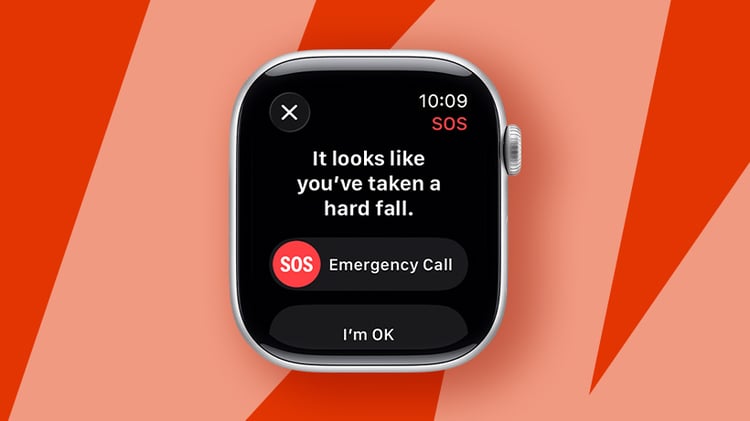
Fall Detection has been one of the Apple Watch’s key safety features for years. Since the Series 4, it has used motion sensors to detect hard falls and, if the wearer does not respond, call emergency services.
Apple has been working to improve this feature for some time. Back in 2024, we reported on a patent filing showing the company was exploring a more context-aware version of Fall Detection.
That patent described a system that could consider location, elevation, weather, heart rate, and even fitness history to better decide if a fall is serious.
The latest patent goes even further. Rather than focusing on the fall itself, it suggests Apple may also check what happens before and after, such as how the wearer moves leading up to it and whether the wearer gets up, stays still, or shows signs of recovery.
How Apple could judge the severity of a fall
To do this, Apple seems to use more than basic motion data. The patent explains that the system can use “acceleration data, gyroscopic data, location data, altitude data, and/or heart rate data” to decide if a fall happened and what type it was.
Simply put, the watch could check how fast you were moving, whether your body twisted, where you were, and whether your heart reacted in a way that suggests something serious may have happened.
This could be helpful in everyday situations. For example, if someone slips on wet steps or falls while hiking, the watch might get a clearer idea of what happened rather than just detecting a single hard impact.
Let’s say you were hiking downhill and fell. A future version of Fall Detection might use your location and altitude to figure out whether you had a bigger slip on uneven ground or just a small stumble on flat terrain.
And if you tripped on the stairs, it could notice a sharper change in your body angle before you fell, then pick up on movements that show you were tumbling instead of just dropping once.
If you slipped backward on ice, it might detect a different movement pattern that shows you lost your balance, not that you tripped forward.
As Apple says, “These characteristics can be used to distinguish tripping falls from slipping falls.”
As with all patents, though, we simply don't know whether the potential improvements outlined in the patent are actually in the roadmap for the Apple Watch, and it's unlikely that any of these features will appear in watchOS 27.
This feels more like the kind of upgrade Apple could hold for a future Apple Watch release, perhaps in 2027, with watchOS 28. Stay tuned for more.