Why You Can Trust Wareable
Founded in 2014, Wareable brings together journalists and experts who have reviewed over 1,000 products, including smartwatches, fitness trackers, smart rings, smart home gadgets, and health tech devices.
Our team combines hands-on testing, in-depth research, and expert insights to evaluate product performance, assess manufacturer claims, and help readers make informed decisions.
Apple explores conversational health AI with new 200,000-user research study

Working with the clinical platform OpenEvidence, the virtual study app may lay the groundwork for future Health ecosystem tools
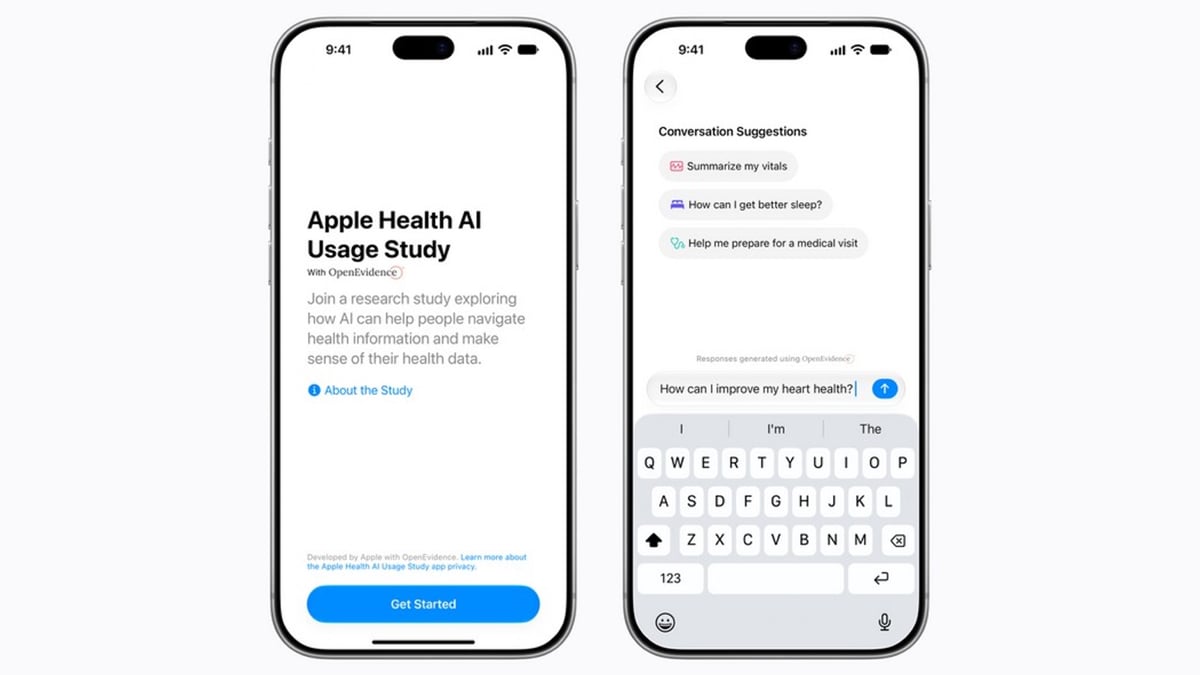
Apple has launched the 'Apple Health AI Usage Study' in the United States, introducing a dedicated research app to investigate how users engage with conversational AI for health and wellness.
Developed in collaboration with OpenEvidence—a clinical AI platform for healthcare professionals—the study aims to examine user trust, response comprehension, and everyday health actions.
The study app lets participants ask everyday health questions and translates complex medical information into approachable language, backed by linked, peer-reviewed clinical citations from authoritative sources such as The New England Journal of Medicine and JAMA.
To give the AI meaningful context, participants can optionally share HealthKit metrics from their Apple Watch or other wearable—such as resting heart rate, activity, sleep, and lab results—so they can explore how integrating personal data affects AI relevance and how it might help patients prepare for clinical visits with their doctors.
Apple also emphasizes the study's strict privacy safeguards, noting that data will not be used to train AI models and that participants retain full control over which HealthKit metrics or survey responses they share.
The study is open to up to 200,000 U.S. participants aged 21 and older. To enroll, users must download the study app on an Apple Intelligence-enabled iPhone (iPhone 15 Pro or later) running iOS 26 or later.
A step toward full native integration?
While the study's data won't be used to actively train AI models, it's natural to imagine the initiative's outcomes will be crucial in shaping how Apple eventually brings conversational AI into its broader digital health ecosystem for the masses.
While the new study app operates primarily on the iPhone, hardware devices like the Apple Watch and AirPods remain the main conduits through which Apple captures personal health and biometric data.
And while it remains to be seen, of course, how long it will take for the insights from this study to be integrated with data to deliver conversational, plain-English dialogues between users and Apple Intelligence, we'll certainly be keeping an eye on this one over the coming months.