
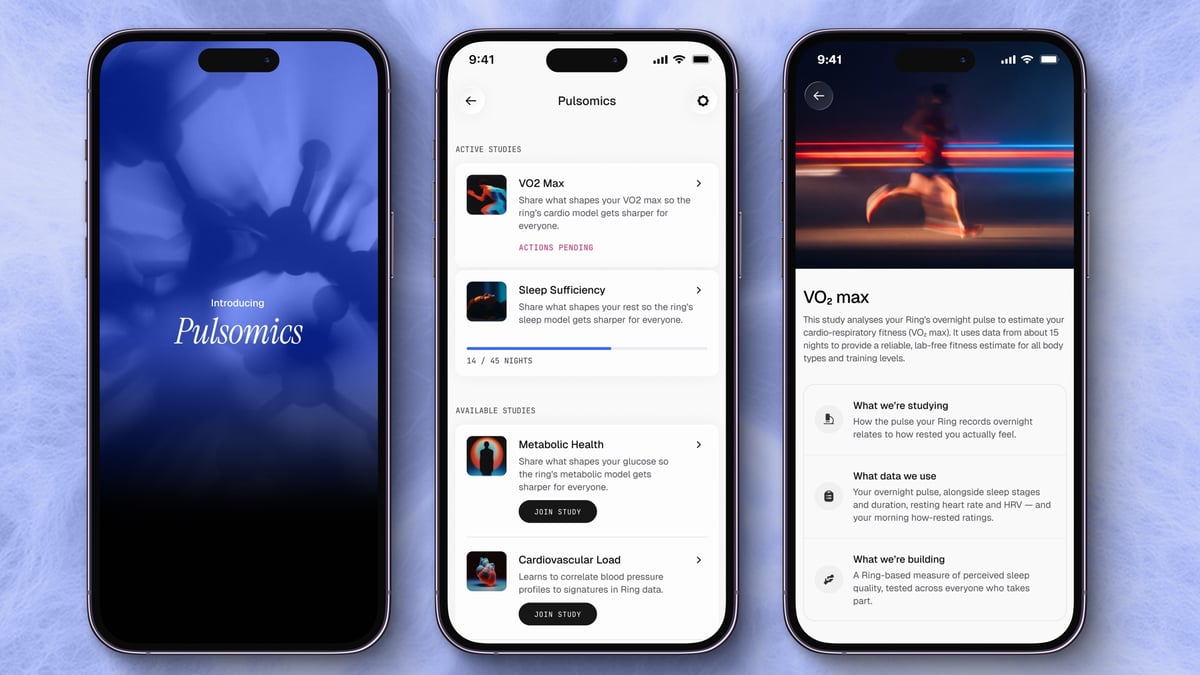
The new initiative will use smart ring biometrics to help build personalized sleep and metabolic health features
Ultrahuman has launched Pulsomics, a new opt-in research initiative embedded directly inside the Ultrahuman app, designed to collect real-world biometric data from smart ring wearers across more than 100 countries.
Announced as the tech industry gathers in Berlin for IFA 2026—where the Indian startup will be on the ground showing its Ring Pro and Ring Air—the program aims to overcome a long-standing bottleneck in health features: algorithms trained on small, homogeneous clinical study cohorts.
By allowing users to log raw overnight pulse data alongside demographic markers—such as age, sex, ethnicity, skin tone, height, and weight—Ultrahuman says it plans to build multimodal datasets that reflect everyday living across diverse populations.
Pulsomics opens with three initial clinical studies. One is a 'Sleep Sufficiency Study', which pairs daily sleep journaling with raw pulse signals to calculate personalized sleep requirements rather than relying on population-wide averages.

Another is the 'Glucose Metabolism Study,' which combines ring data with recent blood panels to deliver metabolic insights without requiring continuous lab tests. Meanwhile, the 'VO2 Max Study' correlates pulse signals with lab references to improve the accuracy of cardiovascular fitness estimates across a broader range of body types.
The programme is available immediately via the Ultrahuman app for all Ring AIR and Ring PRO users aged 18 and over.
Ultrahuman's overhaul continues
Pulsomics is the latest in a string of updates from the brand in 2026—headlined, of course, by the Ring Pro launch back in March.
From a software perspective, the most notable update came in July, when the companion app was redesigned to place greater emphasis on its 'Ultrasphere' actionable AI insights. This also arrived alongside an improved VO2 max calculation and a shift to on-device processing.
Earlier this month, Wareable also uncovered a patent filing that showed the company is considering incorporating color-changing LEDs to display heart rate zones, stress levels, blood oxygen saturation, and progress toward daily movement targets.
At least at first glance, Pulsomics presents something quite different; it has the potential to alter and improve all of the underpinning algorithms that power the brand's smart rings.
Still, as you would expect, the brand has also emphasized that Pulsomics functions as a wellness research project rather than a diagnostic tool. Participant data, it says, is also de-identified prior to analysis.
The programme is available immediately now via the Ultrahuman app for all Ring Air and Ring Pro users.