Muse S Athena review: Is it worth the extra price tag?

- Adds fNIRS mental strength training
- Softer headband for longer sessions and comfort during sleep
- Sleep tracking with 10-hour battery life
- Smart Wakeup and Sleep Assist features to improve sleep
- Unique gamification elements
- May be too confusing for some users
- Black-colored strap contains polyester
In the past, I have tested Muse 2, a biofeedback device that aims to deepen meditation. Even during that time, I was curious about Muse S Athena as well—it seemed to offer way more than what you can find in Muse 2.
The addition of fNIRS-based brain training and sleep tracking are the main reasons I was so eager to get my hands on it. Of course, more features don't automatically mean a better device—so I put the Muse S Athena to the test myself.
After a month of using it day and night, this is what I found out.
| Product | Muse S Athena |
|---|---|
| Product type | Biofeedback headband for meditation, mental training, and sleep tracking |
| Price | $403.74 |
| Subscription | Optional; $12.99 per month or $49.99 per year. Some features, including Smart Wakeup, require a membership |
| Key features | Mental strength training, sleep assist, smart wakeup, and guided meditation |
| Battery life | Up to 10 hours |
What is the Muse S Athena and how does it work?
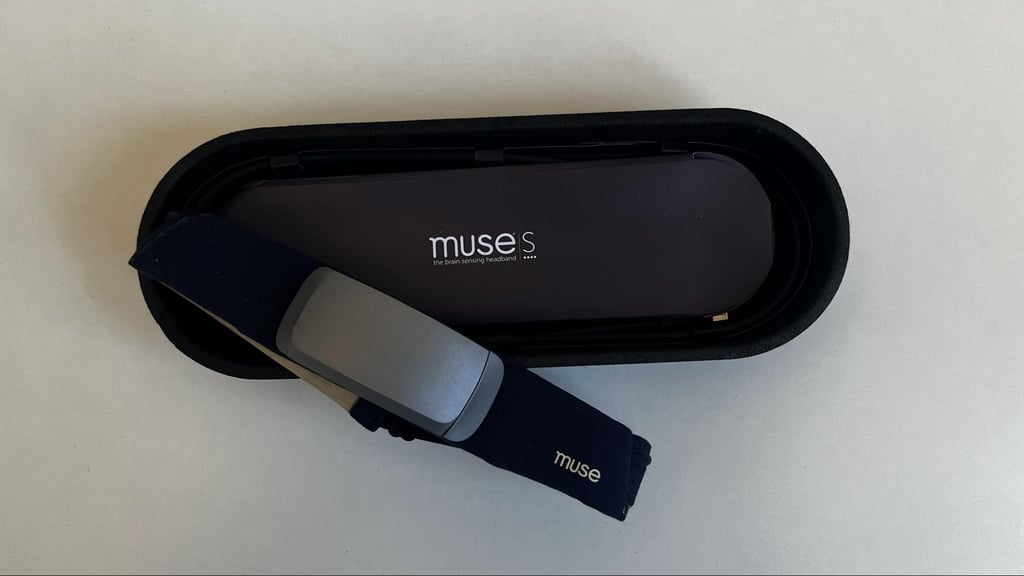
Normally, describing a health tech device is quite easy these days: most people already know what a smartwatch or a scale does. With Muse S Athena, I must be more cautious: it is so unique that missing even small details might give you the wrong impression.
Most health tech is built to track. Muse S Athena is built to train, using biofeedback to help improve your mental wellness.
Muse 2 was a bit less complicated: it is a biofeedback meditation tool, mainly focused on tracking brain activity during meditation and turning that into real-time audio feedback. If your mind wanders, the soundscape shifts. If you stay calm and focused, the sounds soften. The whole idea is to make meditation feel more measurable.
Muse S Athena keeps that same basic idea, but expands it. It still supports meditation, yet it also adds sleep features and a new Mental Strength Training mode powered by fNIRS. Instead of only reacting to patterns the app interprets as calm or distraction during meditation, the headband can also estimate changes in blood oxygenation in your prefrontal cortex while you deliberately exert mental effort.
In the app’s Strength mode, you first go through a calibration phase. From there, the session asks you to sustain mental effort, and the app turns that into live feedback.
Muse S Athena also covers sleep, with overnight tracking, Deep Sleep Insights, and Sleep Assist designed to help cue your brain toward sleep.
Designed for sleep, great for long wear
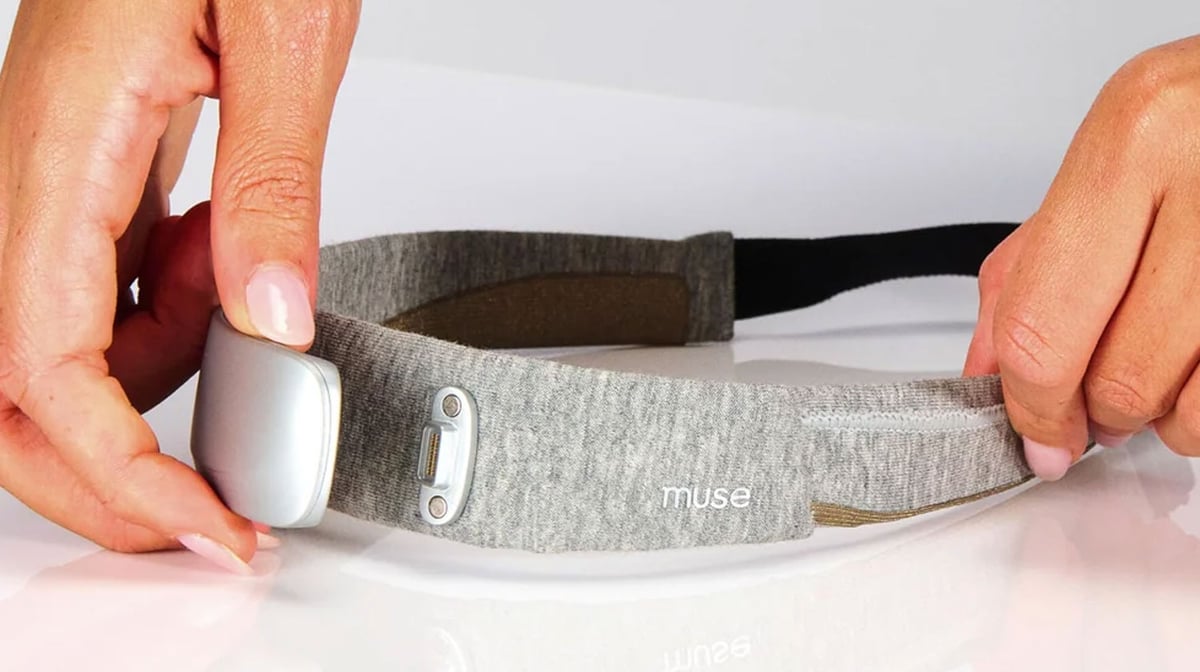
I wasn’t a hater when it came to Muse 2 design: it is sleek, extremely lightweight, and totally fine for longer sessions. However, it would occasionally lose contact, most likely because it doesn’t wrap the head as securely as Athena does.
Muse S Athena replaces the more gadget-like feel of Muse 2 with a softer headband design. This doesn’t surprise, as a device meant to stay on your head overnight has to feel secure without being intrusive.
There may also be a practical upside to fit. If the headband sits more evenly and maintains better contact with the skin, there is a fair chance it could improve sensor consistency, too. In practice, I haven’t noticed any hiccups or lost contact during my testing.
However, I was surprised to learn that the carbon strap (the one I tested) is mostly made of polyester, while the opal strap option is mostly made of cotton. They are both priced the same, so I wouldn’t make the mistake of choosing the black strap again, although it could be argued that polyester might be better if you sweat a lot. Whatever your preference, I wish this had been highlighted somewhere on the website, as some of us are trying to avoid polyester whenever possible.
What is the Muse S Athena like for sleep tracking?
I will not lie, I was extremely excited to try out Muse S Athena for sleep—I am a big fan of getting a good night’s sleep, and my sleep protocol is constantly being updated, upgraded, and revised.
Unlike Muse 2, which was really just about meditation, Athena is actually built with overnight use in mind. The softer headband makes more sense here straight away, because if a device is meant to stay on your head all night, comfort is not a bonus feature—it is the whole point.
More importantly, the Sleep Assist feature was one of those rare wellness additions that actually made me stop and think, okay, this is kind of cool.
Sleep Assist is a responsive sleep experience that fades audio out as you fall asleep and can bring it back if you wake during the night. In theory, that sounds a little gimmicky. In practice, I think it was quite helpful for me—at least it seemed so.
Now, the Smart Wakeup function was probably my favorite feature of the Muse S Athena. Waking up groggy because an alarm went off at the “wrong time” is an issue I had never addressed before. This is what Smart Wakeup is for: instead of waking you at a fixed time, Athena can try to wake you within a chosen window when it detects you are already close to waking. During that one-month testing period, I noticed that my mornings were indeed easier.
Meditation features and brain activity insights
If you are already familiar with Muse 2, the core meditation side of Athena may feel broadly familiar.
The day-to-day meditation flow remains the same: you wear the headband, follow the audio cues, and receive post-session data showing how your brain activity shifted during the session.
This structure remains one of the main reasons people purchase Muse products—it makes meditation feel more concrete and can help beginners who are unsure how to start.
Athena’s added layer is that it appears to broaden brain insight beyond simple calm-versus-active meditation states. With fNIRS and brain blood oxygenation feedback, the device leans harder into mental effort, mental load, and training rather than just plain mindfulness.
The trade-off is the same one I felt with Muse 2. When meditation becomes measurable, it can become more engaging. But it can also become something you perform for the numbers, especially with several gamification elements added to the app. It can be useful for some, distracting or too confusing for others.
How accurate is Muse S Athena?
With a device like Muse S Athena, “accuracy” is not a single question. It is really a mix of smaller ones: does the headband keep stable contact, does it produce consistent signals, do the readings change when the fit changes, are the results reasonably repeatable, and do the app’s sleep or meditation insights feel believable rather than random?
During my testing month, I was quite impressed with Muse S Athena: the headband kept contact and the results felt repeatable enough from session to session. I didn’t notice any weird anomalies in the data—which was reassuring.
The technology behind Muse devices has already been used in studies to detect meaningful changes in brain activity. One study used Muse headband to classify stressed versus non-stressed mental states and reported 93.17% accuracy.
Still, I would keep expectations in check. Muse S Athena gives you estimates, not clinical-grade measurements. But as a wellness device, it felt more reliable than I expected.
Using the Muse app day to day
Like Muse 2, Muse S Athena requires an app. While the headband is the one responsible for collecting data, the app shapes a significant part of the day-to-day experience.
Compared to Muse 2, I did not run into the same level of frustration with Muse S Athena. For some reason, Muse 2 sometimes wouldn’t pair with the app immediately—this was no longer the case with Muse S Athena.
Once connected, the app was easy to navigate. The basic structure is straightforward: you pick the type of session you want, go through the signal check if needed, and start.
Afterward, the app gives you a breakdown of your session, whether that is meditation feedback, sleep data, or Strength results.
What still stands out about Muse is how well it makes inner states feel trackable. The app takes something vague—calm, focus, mental effort, sleep quality—and turns it into graphs, percentages, scores, and trends. If you like feedback loops, you may love that. If you want a more stripped-back relationship with meditation or sleep, you may find yourself pushing back against it.
Is the Muse S Athena worth the price?
I would say Muse S Athena is easier to justify than Muse 2—after all, it goes beyond just a meditation device. However, it is also more expensive ($403.74 vs. $212.49 at the moment).
If you plan to use all the features, including brain training, meditation, sleep tracking, Sleep Assist, Muse S Athena is an interesting tool to have in your mental wellness toolkit. But if you are looking at it for one feature only, for instance, sleep tracking, I would say this might be an overkill device. There are cheaper ways to track sleep.
Besides that, while you can use Muse S Athena without an additional subscription, some features will not be available. Smart Wakeup, my favorite feature, for example—so it is definitely worth factoring the membership into the cost. Right now, the monthly subscription is $12.99, while the annual package is $49.99.
To sum up, yes, for some people, Muse S Athena may be worth the hefty price tag—but only for those who do actually plan to use all the features.
Other health and sleep tech reviews:
Pulsetto FIT X review: Can non-invasive vagus nerve stimulation support wellness?
Sensate review: Can it help with stress?
Muse 2 review: Can it deepen meditation?
Best noise machines for sleep: Here’s what we would recommend for better rest
Best sleep trackers: Discover products we trust
Final verdict: should you buy the Muse S Athena?
Muse S Athena is more feature-rich than the Muse 2—and I also liked its design more. That said, it is still expensive, and the value really depends on how many of those features you will actually use.
If you want one device for meditation, sleep, and mental training, Muse S Athena is an interesting option. I would recommend it for those who are planning to use all these features, not just some—you can find cheaper alternatives for single-use needs.
FAQ
Yes. Muse headbands provide biofeedback for meditation, sleep, and mental training, but the results are estimates based on sensor data and app interpretation, not clinical-grade measurements.
Muse S Athena is softer, more comfortable, built for overnight wear, and adds sleep tracking, Sleep Assist, Smart Wakeup, and fNIRS-based Mental Strength Training. Muse 2 is mainly a meditation-focused EEG biofeedback device.
No, but some features and content are likely tied to Muse’s premium subscription. The headband works without it, though the overall experience may feel more limited if you skip the paid plan.
No. Muse S Athena is a consumer wellness device, not a medical one. It can provide useful feedback and estimates, but it is not designed to diagnose, treat, or monitor medical conditions.
-
Computational Intelligence and Neuroscience. Stress Classification Using Brain Signals Based on LSTM Network.