FlexBeam red light therapy review: What makes it different?

- Easy to use
- Quick sessions
- Close contact with the skin
- Premium build quality
- Long warranty
- Steep price
- Battery life could be better
I have been testing red light therapy (RLT) devices for a while now. However, my focus was almost always on skin health—although, of course, I was aware of other potential benefits. So when I started experiencing shoulder pain, I was curious to try out a device for that—this is how I ended up trialing FlexBeam for a couple of months.
In this article, I share everything I learned from that experience.
| Product | FlexBeam |
| Manufacturer | Recharge Health |
| Price | $479 |
| Wavelengths | Near-infrared (800–850nm) and red (610–650nm) |
| Treatment time | 10 minutes |
| Irradiance | 110mW/cm² |
| Nice to have | FDA-cleared, active cooling system, auto shutdown, 5 year warranty |
What is FlexBeam and how does it work?
Before diving into my testing, it is helpful to become familiar with the device itself and its intended purpose.
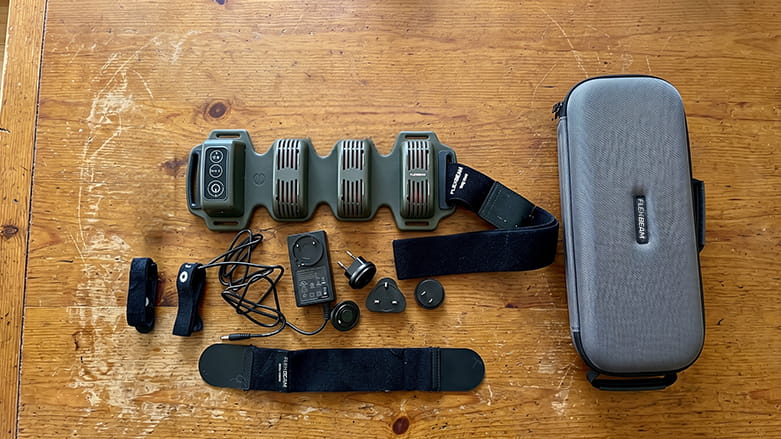
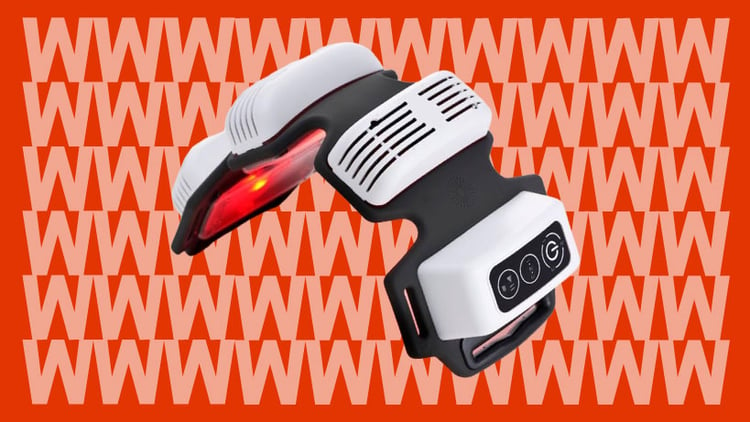
FlexBeam is a wearable red and near-infrared light therapy device built for targeted treatment rather than full-body coverage—that’s why I chose it for the shoulder pain.
Its biggest differentiator is the three-pod flexible design, which lets you position light directly over problem areas like knees without having to hold the device in place.
The device uses three light pods. Across those pods, it delivers both near-infrared light and red light:
- 800–850nm LEDs, peaking at 814nm
- 610–650nm LEDs, peaking at 622nm
The core idea behind this combination is that red and near-infrared light are absorbed by the body at different depths. Red light is generally believed to support more superficial tissue, while near-infrared light is used for deeper penetration.
FlexBeam’s design is intended to bring both into a single wearable unit that can be strapped directly onto the treatment area. It comes with several velcro bands, so you can definitely use it for other body parts, including knees, back, and hips.
The brand positions FlexBeam as a product for recovery—think of muscle soreness after a workout—but they also mention benefits such as pain management, circadian rhythm and gut health support.
Is the price justified?
There is no denying that FlexBeam is a premium-priced red light therapy device. Here, however, you are not paying for maximum treatment area per session but for portability, wearable convenience, and the ability to place light directly where you need it.
With the current discount, you can get FlexBeam for $479. Buyers comparing it with cheaper generic RLT devices may initially see the price gap as steep, but the trade-off is that FlexBeam aims to offer a more body-specific experience with better wearability and more structured dosing.
If your goal is whole-body sessions, we recommend skipping this device. If your goal is to treat one problem area consistently while staying mobile, the pricing makes more sense.
The device is also covered by a 5-year warranty—way longer than most RLT devices out there that offer the standard 1-year coverage only. This makes the device more compelling to those who are in it long-term.
Why is FlexBeam’s design different?
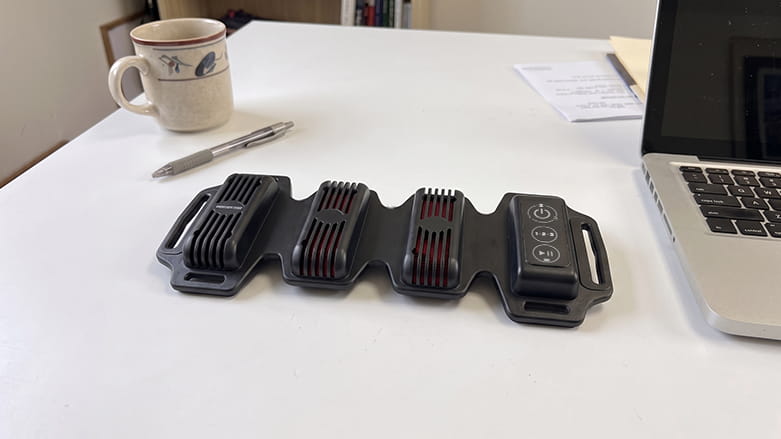
The design is one of FlexBeam’s biggest selling points. Instead of a rigid panel or a simple rectangular wrap, it uses a three-module flexible layout connected by a silicone strap, allowing it to contour around different parts of the body more naturally.
FlexBeam build feels especially durable and sturdy. On paper, the device's weight of 0.775kg is definitely manageable for wearable use, though it didn’t feel light in my testing. But since the recommended session time is only 10 minutes, you’re unlikely to run into issues here.
The separate battery pod helps maintain portability, but it also adds another component to manage during setup and wear.
FlexBeam includes multiple straps and accessories, such as a mini band, body band, and duo band, to improve fit across different body areas. Overall, the design sounds thoughtfully executed for medium and larger treatment zones. While the flexible format should help, some users may still find positioning a little bulky around tighter areas where a smaller single-point device would sit more neatly.
FlexBeam in action
I have been testing FlexBeam for a couple of months to see how easy it is to incorporate into my routine.
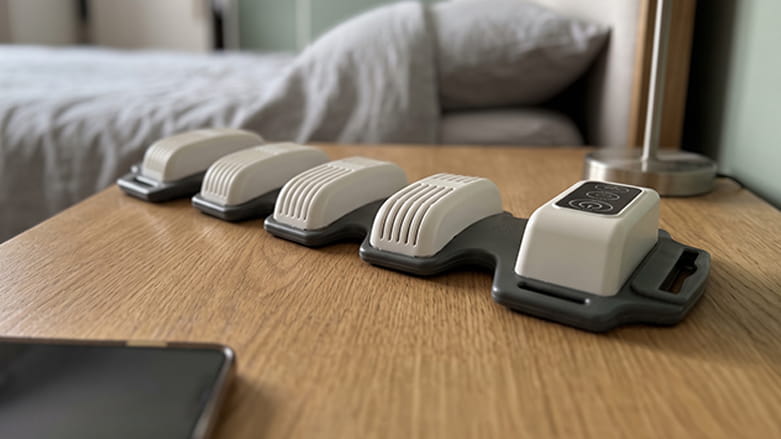
My conclusion: it is a practical red light therapy device for those who want a hands-free experience. Instead of standing in front of a panel or holding a device against my skin, I could strap it on and get on with my day—and with only 10 minutes needed to complete the session, FlexBeam won’t be a burden.
The three-pod design conforms surprisingly well to larger areas like my shoulder and lower back, and the app added a layer of structure, which can be especially useful if you tend to forget things.
The battery life, however, could be better. The official website says it should last 5–8 sessions on a single charge, which matches what I experienced, but that means that I had to charge it every week.
Does FlexBeam actually work?
Yes, in the sense that it uses established red and near-infrared light therapy principles in a targeted wearable format.
To test the device for this review, I used FlexBeam to address mild shoulder pain that had been bothering me for a few months.
I strapped it on most evenings for the full 10-minute session and stuck with it fairly consistently. After a couple of weeks, the pain actually went away, but, of course, it's hard to say whether that was down to FlexBeam or just my body's natural healing process running its course.
That's the honest caveat with pretty much any RLT device: without a control, I can't say for certain it was the light therapy and not just time doing its thing.
But looking into studies on RLT and shoulder pain, there is some reason to think the light itself may have played a role. For instance, a 2024 review of 36 clinical studies on photobiomodulation (PBM) for shoulder and neck conditions found promising evidence for pain relief and functional improvements, although the authors also pointed out that treatment protocols varied considerably between studies.
There are more studies like that. What they suggest is that the basic idea behind FlexBeam is scientifically plausible: red and near-infrared light may have biological effects on tissues, and appropriately dosed may help reduce pain and support recovery in some shoulder conditions.
For me, the takeaway is fairly simple: I can’t claim FlexBeam cured my shoulder pain, but my experience is consistent with a growing body of research suggesting that photobiomodulation may help with certain types of shoulder pain.
FlexBeam vs. other red light therapy devices
While I think FlexBeam is a great RLT device, I can’t deny that it is the only one of its kind. In fact, our team has tested a bunch of similar products. These two appear as the closest running competitors for FlexBeam:
FlexBeam vs. Kineon MOVE+ Pro
Both of these devices are extremely similar—especially due to their form, a wearable system, instead of a more common pad or belt style.
When we tested Kineon MOVE+ Pro, our team also noted similar things. It stayed put on the knee even during movement and the benefits built gradually rather than overnight. As a drawback, the battery issue comes up with Kineon as well.
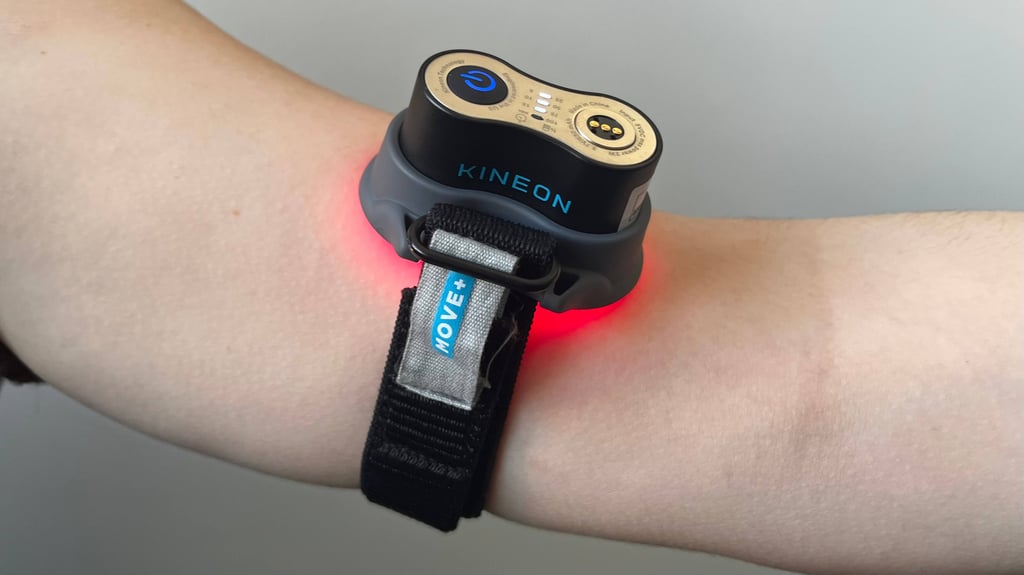
The main difference between them is that Kineon's is better built for pinpoint treatment of a single joint, while FlexBeam's flexible three-pod design is made to wrap around larger areas like the back, shoulders, or hips. So if your priority is targeted knee or joint pain specifically, I would suggest Kineon, but if you want one hands-free device that adapts across multiple body parts, FlexBeam is the more versatile pick.
FlexBeam vs. LifePro
While LifePro offers a wide range of products, its red light therapy pad is probably the closest equivalent to FlexBeam. While it is a belt, making it especially easy to use on the back, you can put it on other body parts, including the shoulders. That close contact with the skin is what makes FlexBeam and LifePro appear similar.
I prefer FlexBeam, although it is more expensive. The sessions with FlexBeam are faster and cordless—having the freedom to move around during my RLT sessions made it much easier for me to stick with the treatment. Of these two, only FlexBeam is FDA-cleared, which is another point in its favor.
However, LifePro offers a lifetime warranty, while FlexBeam comes with 5-year coverage. Don’t get me wrong, here I wouldn’t say only 5 years, since most brands stick to the standard 1-year warranty only, but buy-it-for-life shoppers will surely appreciate LifePro’s approach more.
Other red light therapy reviews:
Best red light therapy for back pain: Discover our hands-on tested devices
Best FDA-cleared red light therapy devices: For those who prioritize regulatory transparency and want extra reassurance
Red light therapy for hair loss: Find out more on how RLT may support scalp health and what products we recommend in this category
Final verdict: Is FlexBeam worth it?
FlexBeam is worth considering if you want a premium, targeted red light therapy device that is easy to wear, easy to position on larger joints and muscle groups, and easy to use consistently.
Its main strengths are not raw size or budget value. They are convenience, portability and focused treatment. That makes it a strong option for people who do not want a bulky panel setup and do not want to hold a device in place for every session.
But if you are looking for a more versatile product, something you may use for skin health, for example, FlexBeam is not the best choice. It is designed to support recovery, and it is obvious in its unique style.
If you are interested in RLT for pain management, however, it may be worth consulting your healthcare provider before jumping into the purchase.
Yes, FlexBeam is an FDA-cleared device as per the official manufacturer’s website. When we emailed the company, they also confirmed this information.
The best approach is to use it consistently, as red light therapy devices work best with regular, repeated sessions rather than occasional use.
A default FlexBeam session lasts 10 minutes. Always follow the manufacturer’s instructions for the best results.
-
Lasers in Medical Science.
Photobiomodulation on shoulder and neck pain and disability: A comprehensive review.