
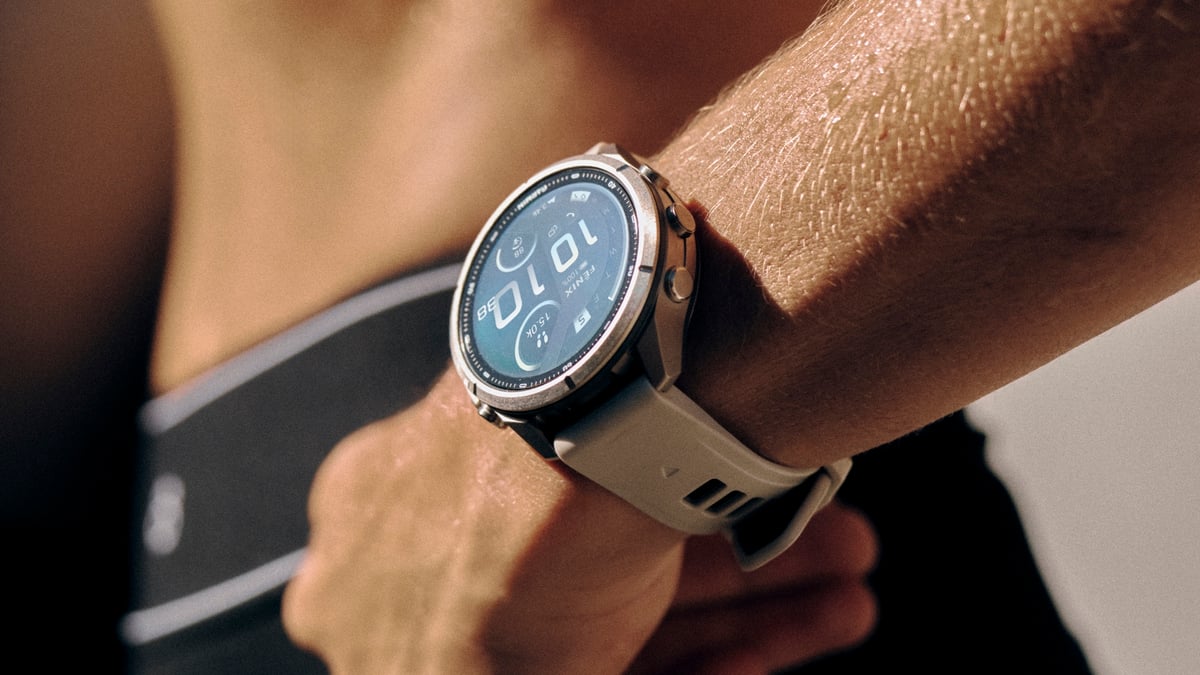
The latest series aligns standard and Pro launch cycle, debuts 'Epic' shareable stories, and drops MicroLED
Garmin has pulled back the curtain on the Fenix 9 and Fenix 9 Pro, with the new-generation flagship outdoor watch series featuring an all-titanium case, reduced thickness, LTE support across all three sizes, and a 3,000-nit AMOLED display.
The new series marks a dramatic departure from the brand's typical launch cycle, too, with the standard and 'Pro' editions announced simultaneously. Until now, the brand has rolled out each new generation every other year, with the in-between year filled by the Pro version.
All new versions of the multisport smartwatch will be available from 28 August, with the standard Fenix 9 starting at $999.99 / £859.99 and the Fenix 9 Pro—which also features a Solar edition with a memory-in-pixel display—starting at $1,099.99 / £949.99.
That Pro pricing is a welcome surprise: at $1,099.99, it undercuts last year's Fenix 8 Pro launch price of $1,199.99 by $100. And despite that price snip, the Fenix 9 Pro will debut the line’s first-ever full titanium watch case.
Garmin says it's built using a molecular nano-molding process to trim case thickness while preserving durability, and it features a 3,000-nit AMOLED screen and inReach satellite/LTE connectivity across its 43mm, 47mm, and 51mm models (not just the latter two, as in the previous edition).
MicroLED held back for this generation
Also notable is what's absent. The Fenix 8 Pro launched with an optional MicroLED display—then the brightest screen ever fitted to a smartwatch.
There's no MicroLED option here; instead, Garmin has pushed the Fenix 9 Pro's AMOLED brightness to 3,000 nits and given the 51mm model its largest-ever Fenix screen, at 1.5 inches.
All watches, mind you, share the same headline software: a new Garmin Epic feature for turning multi-day activities into shareable stories, expanded stamina and rucking tools, and a considerably upgraded mapping engine.
We'll be putting the Fenix 9 generation's new hardware and software smarts through our usual testing wringer over the coming weeks—but, for now, let's run through the specific editions in a bit more detail.
Fenix 9 adds new software smarts and design tweaks
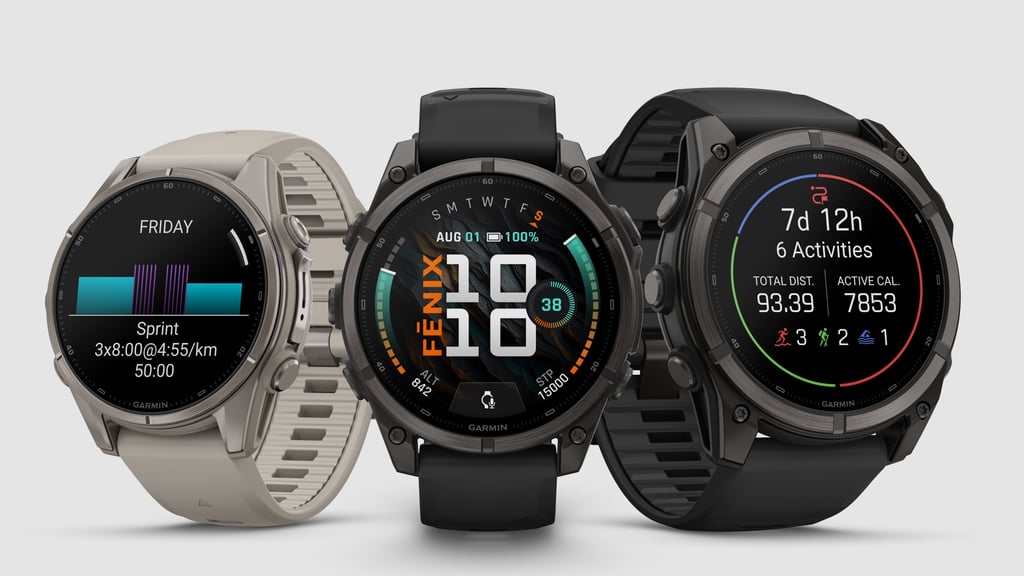
While the standard Fenix 9 doesn't get all the bells and whistles of the Pro models, it does still land with an AMOLED display twice as bright as the Fenix 8, a sapphire lens, leakproof buttons, and a 40m dive rating.
In addition to Garmin Epic support, it debuts new stamina zones and a stamina curve that aim to show how endurance shifts over time. Indoor rowing also offers tailored VO2 max and power curve tracking (power meter-equipped machines only), and rucking adds adjustable pack weight mid-activity (plus GORUCK workouts).
Internally, Garmin also notes that the Fenix 9 has 50% more RAM than the Fenix 8—and up to 30% faster panning. Meanwhile, 64GB of storage doubles offline map capacity and holds around 7,000 songs.
Battery life tops out at 29 days in smartwatch mode on the largest size.
Fenix 9 Pro gets the premium, all-titanium case
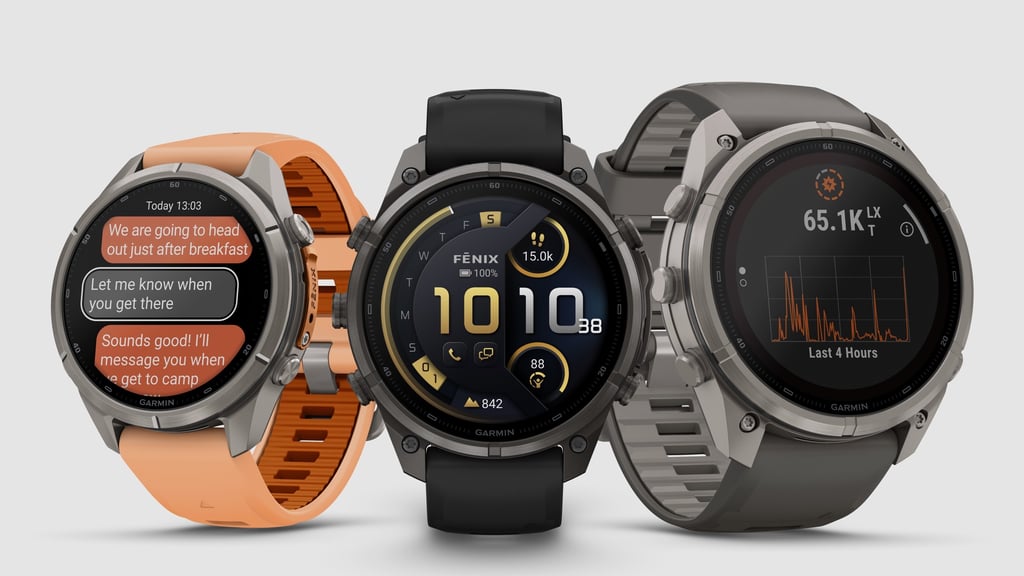
Beyond the titanium case, Fenix 9 Pro's biggest changes are about connectivity.
For the first time, Garmin's satellite-and-LTE inReach connectivity is available across all three case sizes—the Fenix 8 Pro dropped its 43mm option entirely due to antenna constraints.
As before, an active plan unlocks voice calls, texting, and SOS, plus a new Garmin Locate feature that lets contacts track a wearer's position through the Garmin Messenger app over LTE, and satellite-delivered weather forecasts alongside the existing LTE ones. LiveTrack notifications also now arrive via Garmin Messenger.
Select models add solar charging, extending battery life to a claimed 57 days versus 31 days for the largest non-solar AMOLED version, while a revised LED flashlight adds a green light mode to preserve night vision.