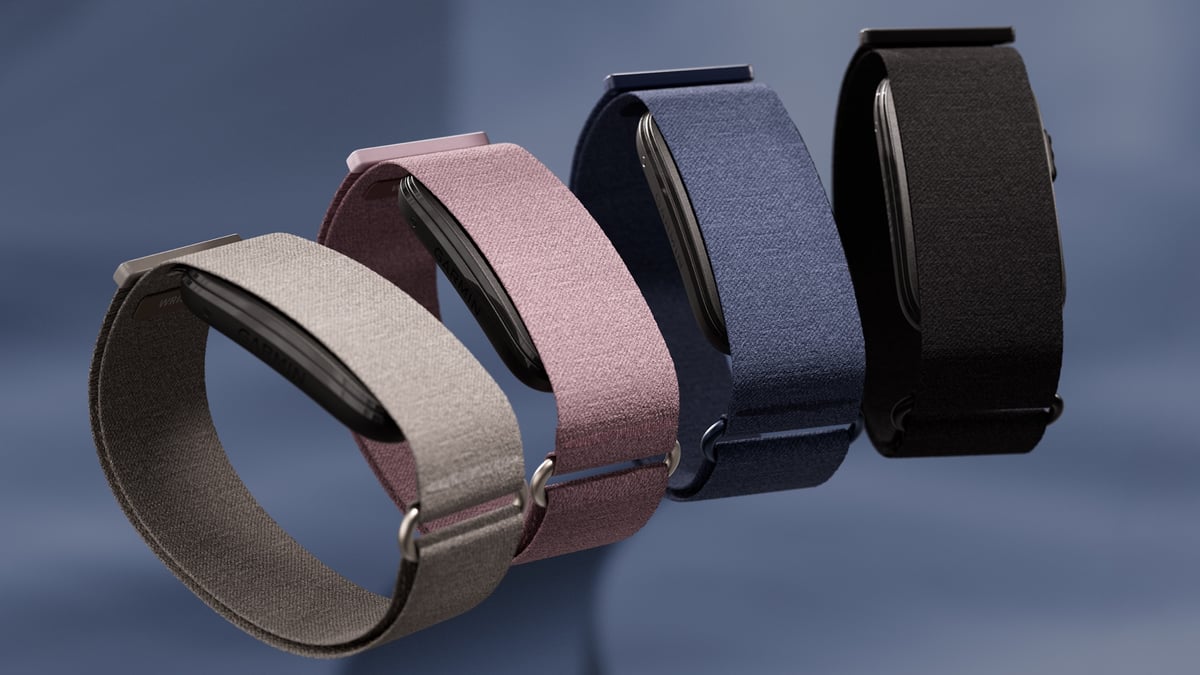
After months of leaks and rumors, Garmin has officially broken into the screenless tracker category with the announcement of the CIRQA Smart Band.
The screen-free band arrives as a significant departure from the brand's GPS sports watches, built to track advanced performance and wellness metrics without commanding a user's visual attention.
The CIRQA module integrates Garmin's (last-gen) Elevate 4 sensor into a versatile, fabric-loop design that can be worn on either the wrist or the upper arm.
It launches globally on July 24 for $199.99 / £179.99 and is free of the recurring subscription fee charged by the leader in this pocket of the wearables market, Whoop.
A supplementary powerhouse
The CIRQA monitors continuous heart rate, stress levels, respiration, Pulse Ox, and skin temperature, while providing comprehensive sleep-stage tracking and automatic nap detection.
All recorded vitals are backfilled directly into the Garmin Connect app, where the data populates Garmin's holistic tools. it unlocks access to Training Readiness scores, HRV Status trends, VO2 max estimates, and tailored recovery guidance.
And for workout tracking, a single physical side button lets users manually launch more than 80 activity types, supplemented by an adaptive algorithm that learns to classify regular routines more accurately over time as activities are edited in the app.
Alongside the major launch, Garmin also introduced the Approach Z10 compact laser rangefinder for golfers.
Priced at $299.99 / £259.99, the device weighs under 180g and offers precise distance tracking to the pin up to 350 yards away with 6x magnification.
It also features a built-in Range Relay system that automatically beams ranged distances to compatible Garmin watches (or the Garmin Golf app) to overlay a live laser range arc on the digital course map.
The Wareable take: Can Connect back it up?
At this price, the CIRQA is undeniably expensive. After all, it is—for all intents and purposes—just a heart rate monitor. And unlike the current best wearables without a screen, which are backed by leading companion apps and platform integrations, Garmin Connect is far from as polished when it comes to holistic overviews.
Connect remains excellent for deep-dive athletic analysis, but—even with Connect+ AI summaries—it lacks the intuitive, recovery-first presentation that makes screenless rivals like Whoop and Oura really sing.
We saw brands like Polar (and to a lesser extent, Amazfit) miss the mark with their own Whoop competitors because their software platforms couldn't support a screenless experience. The same may prove true with CIRQA; the lack of a 'live' dashboard could be frustrating without a watch display to back it up.
Also, while it's a huge plus that Garmin built in armband versatility, charging an extra $49.99/£49.99 for the bicep strap (where HR is traditionally much more accurate) also feels frustrating for a brand whose ecosystem is built on workout heart rate tracking. It feels like a missed opportunity to offset some of the lofty price concerns by not bundling it in the box.
All that to say, as well, that the CIRQA may also prove to be less of a Whoop killer and more of a premium supplementary tool for the Fenix or Forerunner power user who wants data continuity but doesn't want to sleep with something bulky on their wrist.
In that sense, CIRQA feels like a direct evolution of last year's Index Sleep Monitor, which we loved for its upper-arm comfort despite its middling battery life and steep price. This time, Garmin is pitching a 10-day, 24/7 device that finally fills the gaps for screenless purists.
Stay tuned for our full review coming soon.