- Game-changing battery life
- Refined, premium cushion design
- Rock-solid tracking performance
- Some health features require Samsung phone
- No physical rotating bezel or digital crown
- Single case size
When Samsung unveiled the original Galaxy Watch Ultra two years ago, it marked a decisive shift in the Android smartwatch hierarchy. For years, the Wear OS ecosystem lacked a true, uncompromising 'Ultra' contender capable of standing toe-to-toe with the endurance and rugged durability of the Apple Watch Ultra series, or specialized multi-sport watches from Garmin.
Two years later, the premium smartwatch landscape has evolved significantly. We’ve seen the arrival of the Apple Watch Ultra 3, the Huawei Watch Ultimate 2, and increasingly sophisticated sports watches bridging the gap between hardcore performance and daily intelligence. Yet, a bit curiously, no other Wear OS brand has attempted to challenge Samsung in this specific, high-powered domain. Samsung essentially commands the premium Android space entirely unopposed.
Launching alongside the standard Galaxy Watch 9 series at Samsung's Unpacked event in London, the Galaxy Watch Ultra 2 follows the brand's established two-year flagship cadence. If history is our guide, this Ultra 2 will serve as the brand’s rugged offering for the next 24 months, with next year’s hardware cycle likely seeing a return of the 'Classic' line—with its physical rotating bezel.
Waiting two full years for a hardware refresh inevitably sets high expectations. In an industry conditioned by annual iterative bumps, consumers (and reviewers like myself) expect two years' worth of hardware evolution when a successor finally lands.
While the Galaxy Watch Ultra 2 might initially appear visually familiar, the internal engineering shifts are significant. By partnering with Qualcomm for the Snapdragon Wear Elite platform, Samsung has managed to fit a vastly enlarged 800mAh battery inside a body that is actually thinner than the original.
Add to that a suite of thoughtful health intelligence tools, expanded sport profiles for diving and trail running, and you have a smartwatch that elevates the Wear OS experience to new heights. Below is our full review.
Price, value, and the competition
At $699.99 / £649, the Galaxy Watch Ultra 2 arrives with a modest $50 / £50 price increase compared to the original Watch Ultra ($649 / £599).
While any price jump is unwelcome, this uptick aligns with a broader industry trend driven by rising component costs—and possibly the premium associated with moving to Qualcomm's advanced 3nm Wear Elite architecture, alongside the larger 800mAh battery.
Despite the cost increase, the Ultra 2 remains neatly positioned in the premium end of the smartwatch market. It continues to undercut its most direct competitors, comfortably sitting below the Apple Watch Ultra series ($799 / £749) and dedicated multi-sport options from Garmin's top-tier range, which routinely breach the $1,000 threshold.
For Android users seeking flagship rugged hardware, titanium construction, and rich smartwatch features, the Ultra 2—like the OG model—represents solid value. It occupies the sweet spot between everyday Wear OS watches and the far pricier sports flagships.
Design & display: Slimming down
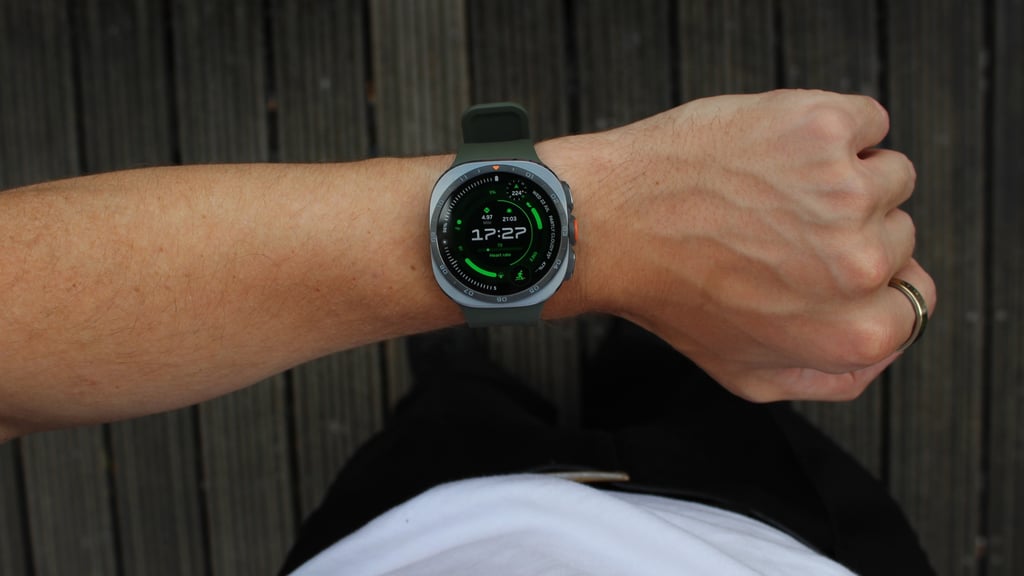
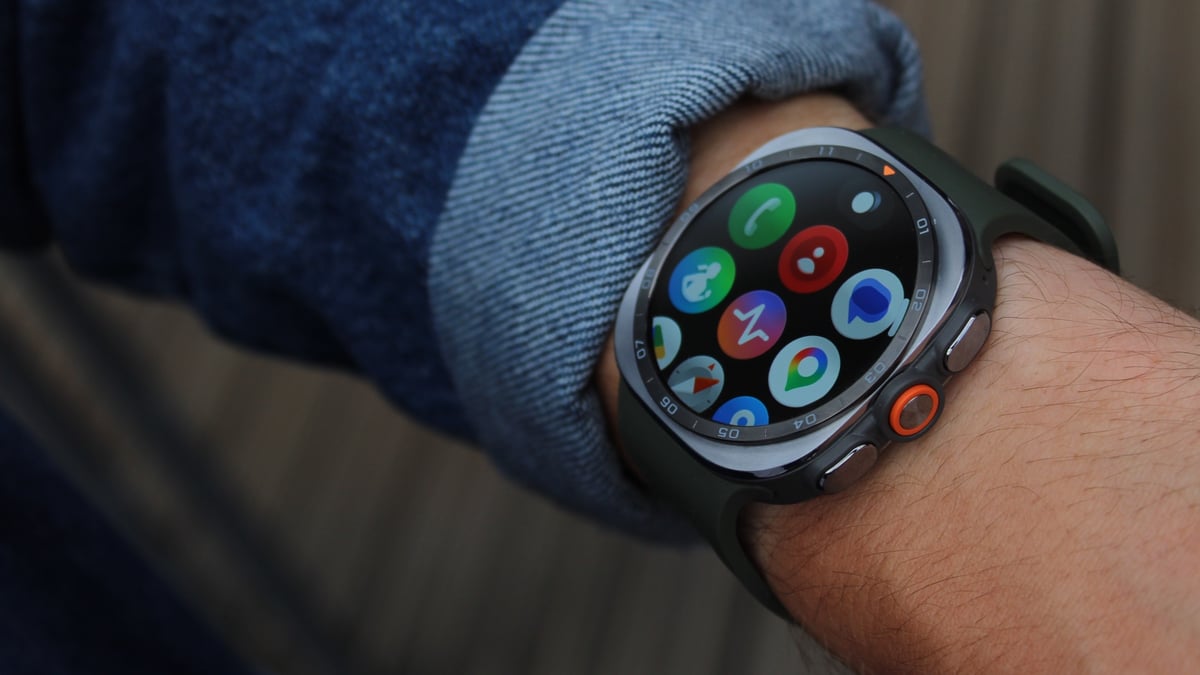
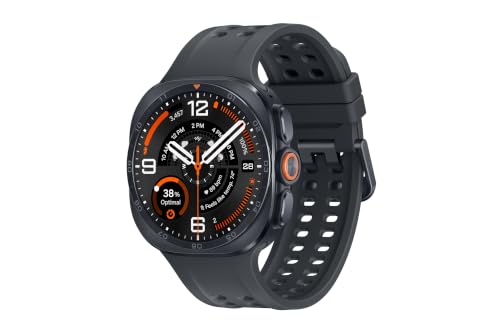
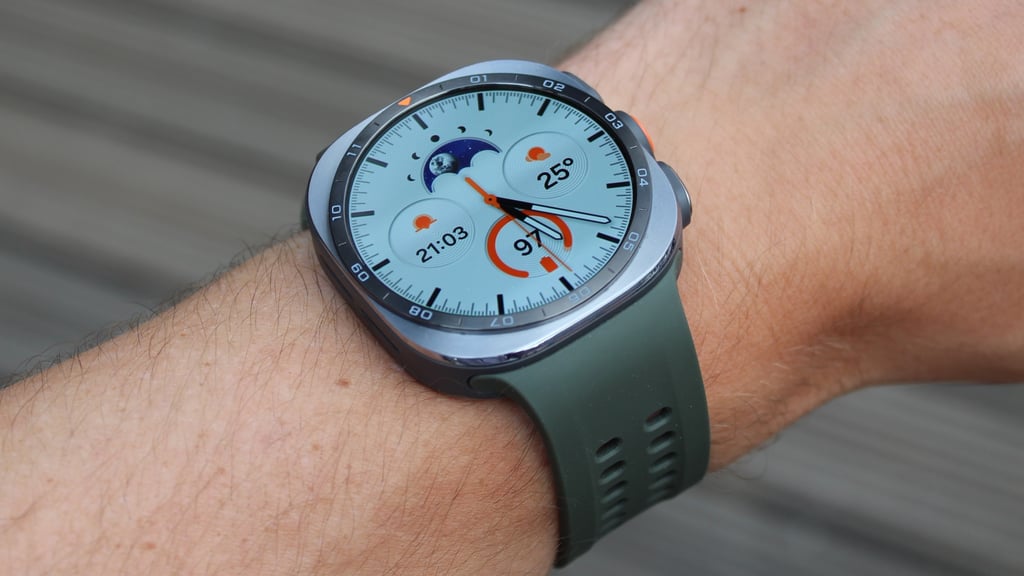
The original Galaxy Watch Ultra divided opinion with its bold 'squircle' case—a traditional circular display embedded within a cushioned square titanium chassis. With the Ultra 2, Samsung has refined the silhouette into a more elegant, cohesive shape. The cushion edges blend seamlessly into the bezel, creating a watch that feels distinctly inspired by high-end horology rather than looking like an oversized piece of tech.
Samsung has also tweaked the dial details. The indices of the first-gen Ultra have been replaced by cleaner hour markers along the inner bezel ring, giving the watch face a sharper, more premium aesthetic. Available in refined Titanium Gray and Titanium Silver finishes, it's one of the few rugged smartwatches that can pass in a smart-casual setting even with the fluoroelastomer sport band.
More importantly, the wearability improvements are immediate on the wrist. Samsung has managed to shave the case thickness down from 12.1mm to just 10.7mm. A 1.3mm reduction might be hard to grasp when you see it written down, but, on the wrist, it's a noticeable difference. The watch sits lower against the arm, slips more easily under jacket cuffs, and the weight doesn't feel as unbalanced during high-motion activities, like running.
Screen quality and navigation friction
The 1.5-inch Super AMOLED panel also remains an absolute triumph. Samsung has bumped peak brightness to a staggering 5,000 nits for this generation, the highest ever on a smartwatch.
While the jump from 3,000 nits on the original model to 5,000 nits on the Ultra 2 isn't a night-and-day visual shock the spec sheet would suggest—and, let's be honest, you don't necessarily want your watch taking people's eyeballs out anyway—it's exceptional in harsh, outdoor environments. In the last week or so of glare-heavy summer sunlight, the display delivers complete readability without a hint of washed-out text or data screens.
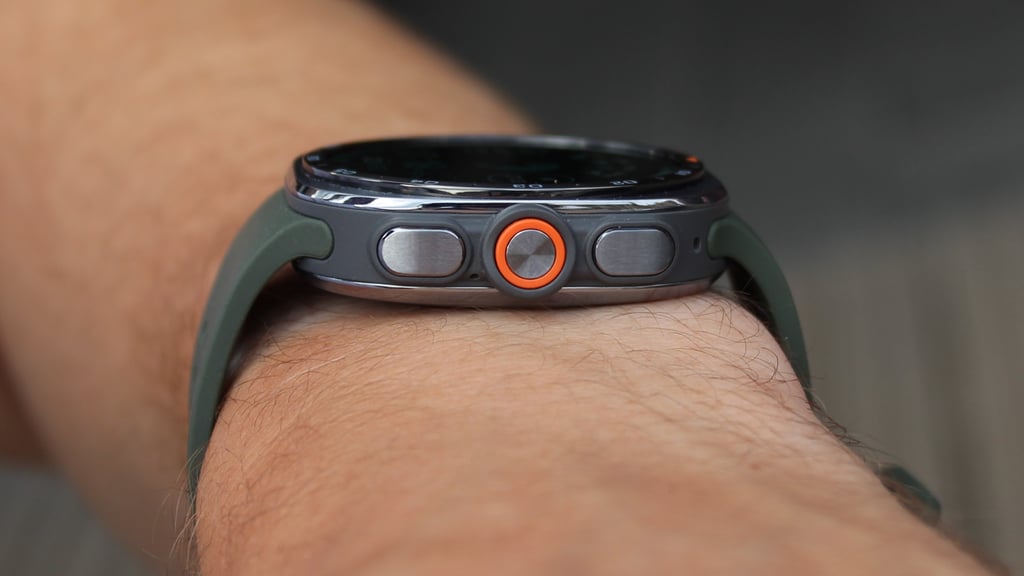
On the original Ultra, one minor criticism I had concerned smudge reflections across the flat sapphire crystal glass.
Because Wear OS relies heavily on touch swipes to navigate its horizontally scrolling Tiles, build-up could create annoying reflections under direct sunlight. Thanks to the Ultra 2's display's sheer raw backlight output, though, that glare issue is effectively neutralized. The panel punches straight through all that.
Still, though I rate it among the very best smartwatches in pure design terms, our primary navigational critique of the Ultra platform remains largely unaddressed.
Simply, the Ultra 2 is crying out for another physical input. While the customizable orange 'Quick Button' sits on the right side for starting workouts or dropping lap markers, Samsung has again opted against incorporating a functional physical rotating bezel or converting the home/back buttons into a digital crown.
Swiping through dozens of widget Tiles on a bare touchscreen while running at high pace remains a somewhat clunky affair. A rotating bezel—a hallmark of Samsung's best historical designs—would have elevated this cushion-cased chassis to absolute perfection. But, hey, you can't have it all—maybe in the third generation.
New software features: Bridging the gap
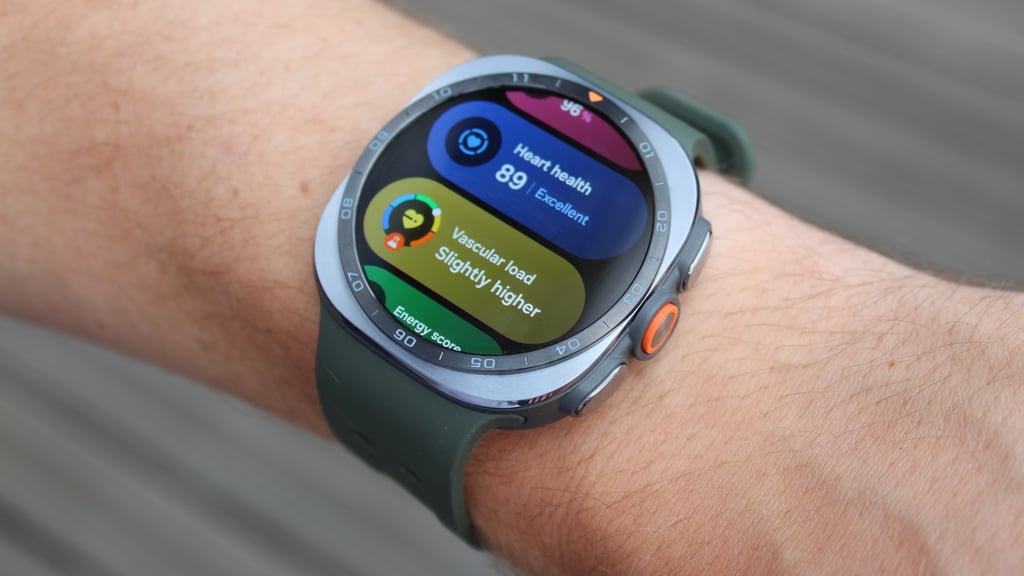
While hardware upgrades dictate the day-to-day wearability, Samsung continues to refine how the watch's health data is processed and presented via One UI Watch. The Ultra 2 (and the Galaxy Watch 9) is being used to debut a number of shiny new features—and while there are a couple of novel additions, this year's software upgrades mostly just bring the Samsung Health experience on par with rivals.
1. Vitals
The new Vitals feature, as you'll see on the Apple Watch Ultra and similar models, serves as an early-warning recovery baseline. By monitoring five key overnight bio-signals—resting heart rate, heart rate variability (HRV), respiratory rate, skin temperature, and blood oxygen saturation—the watch establishes a rolling personal baseline over seven nights of wear.
Rather than potentially overwhelming the user with raw data spikes, Vitals selectively issues alerts only when meaningful deviations occur from the established baseline. In our testing alongside readings from Whoop MG, Oura Ring 5, and Garmin's Fenix 8 Pro, the Ultra 2's interpretation of these core metrics is within a reasonable range—no real surprises there.
Vitals takes a week of calibration before it's ready to begin flagging jumps outside your usual levels—but, as with many baseline-related features, it's a long-term feature that will rely heavily on analysis in Samsung Health, and whether it can do so before you would otherwise feel an onset of symptoms, or know the reason behind them.
So, one to keep an eye on—and see whether Galaxy AI ends up being heavily integrated. Either way, its existence here fills a previously noticeable gap in Samsung's recovery tracking suite.
2. Heart Health Score
Combining sleep metrics, stress trends, active strain, and on-wrist body composition data, the Heart Health Score synthesizes physiological markers into, essentially, a health snapshot. It's a relatively novel feature—especially in a copycat industry of brands blending the same biomarkers together and spitting out a new insight.
What makes this feature genuinely different is its inclusion of the BIA's body composition data. I'm still not necessarily convinced that measuring body composition from the wrist is really accurate enough to play this much of a leading role, since it requires notoriously strict consistency to avoid variance, but the core idea of tying this data into longitudinal cardiovascular scoring is one I rate.
It gives the user some crucial personalized context and a holistic perspective on how lifestyle habits actually affect heart health without sounding overly alarmist.
3. Daily Cardio Load & new exercise profiles
Finally matching up to the likes of Apple’s Training Load and Garmin's Acute Load, Samsung's Daily Cardio Load does exactly what you'd expect: it measures accumulated strain against your rolling training capacity. Like all these tools, it's essentially a guide to help prevent you from overtraining by establishing recommended target ranges for upcoming workouts. Like with the Vitals app, this is more about ticking a much-needed box than anything else, but it does work nicely—and, as ever, is presented neatly in Samsung Health.
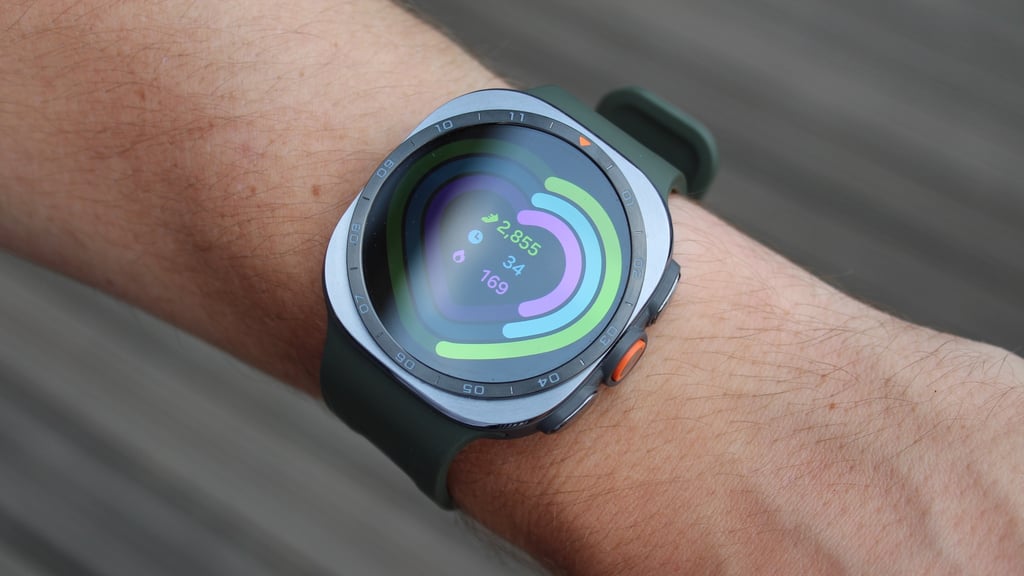
Samsung has also expanded its native workout catalog to catch up with top-tier multi-sport rivals:
- Pro-ready diving profile: Developed in partnership with dive specialist Mares, the Ultra 2 now tracks real-time depth, water temperature, ascent rates, and dive times, backed by its IP69K and 10 ATM depth ratings.
- Trail Running profile: Incorporates turn-by-turn route navigation, elevation profile mapping, real-time ascent tracking, and automated hydration loss estimations.
4. Fitness Index
The Fitness Index breaks down physical fitness into five foundational pillars:
- Cardio
- Endurance
- Strength Capacity
- Flexibility
- Body Composition
Visualized as an intuitive pentagon radar graph within Samsung Health, this benchmarks your metrics against anonymized age- and gender-matched peer groups. My scores have proved a little more generous than I'd perhaps expect from a feature this broad, but, like the Heart Health Score, it's another I think will become more refined over time—especially if it can pad things out with some Galaxy AI analysis.
For now, though, it's still a neat presentation of abstract biometric data that turns it into a clearer picture.
Workout tracking: GPS and heart rate accuracy
Core workout tracking remains the ultimate proving ground for any watch with this kind of price tag.
For this review, the Ultra 2 has gone through the same wringer I put all of the industry's most popular trackers through, evaluating the optical sensor and dual-frequency GNSS (L1+L5) performance against Wareable's gold-standard reference devices: a Garmin HRM-600 chest strap and the Garmin Fenix 8 Pro. In the graphs below, you'll also see that I tested with a Whoop MG (on the wrist) as a secondary reference.
Test 1: Indoor endurance cycling session
- The full workout session data comparison is viewable here
Indoor cycling provides a stable, motion-controlled environment—ideal for evaluating optical HR data without road vibrations or wrist-flex issues you have when lifting weights, or similar. And over a continuous 3-hour indoor spin workout, the heart rate metrics recorded across all three devices were exceptionally tight:
- Garmin HRM-600 chest strap: 134.00 bpm average
- Samsung Galaxy Watch Ultra 2: 134.36 bpm average
- Whoop MG: 132.50 bpm average
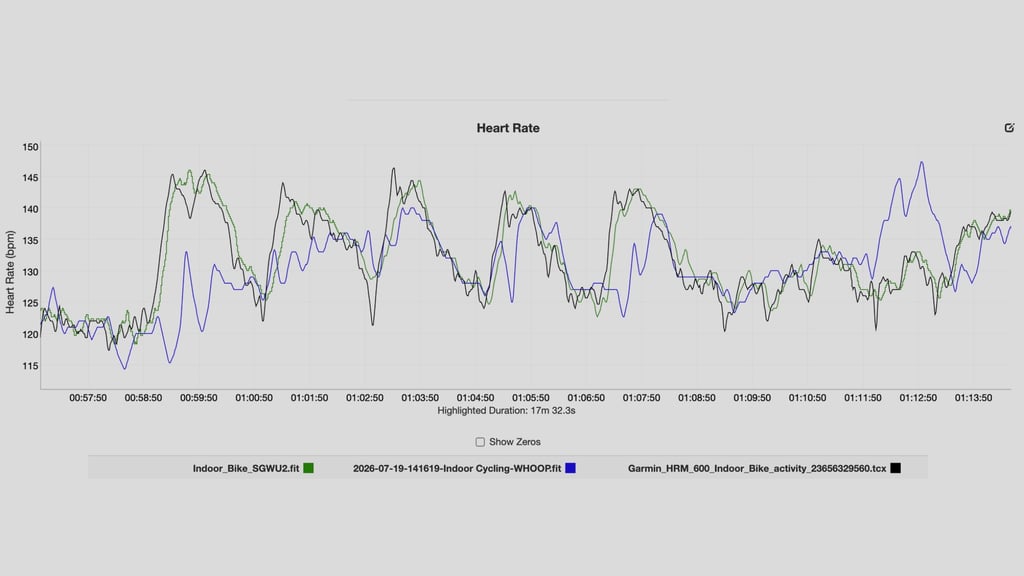
Beyond the overall averages, analyzing the below 15-minute snapshots reveals that the Ultra 2 tracked virtually beat-for-beat with the chest strap during mini interval surges and recovery drops. It's definitely more latent, which is typical for a device further away from the heart, but it's vastly outperforming the Whoop on the opposing wrist here.
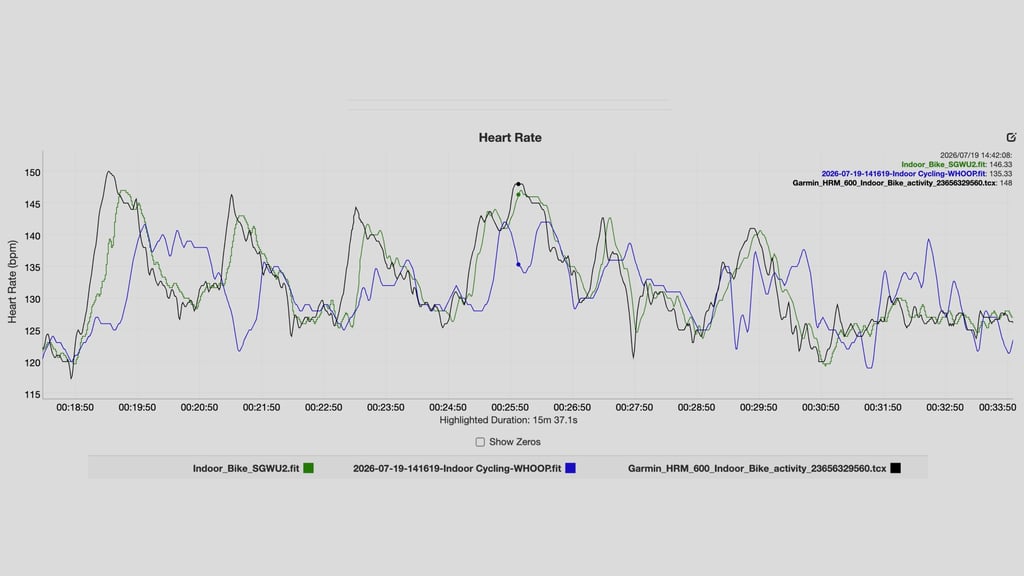
The Ultra 2 mirrored the chest strap's immediate response curve with remarkable precision—very similar to what I've come to expect from the Apple Watch line, and similarly refined to the original Ultra.
It's one thing to be within 0.5 bpm over a three-hour session, but it's another to track with the same curves as a chest strap during essentially the entire period, too.
Test 2: Outdoor running interval workout
- The full workout session data comparison is viewable here
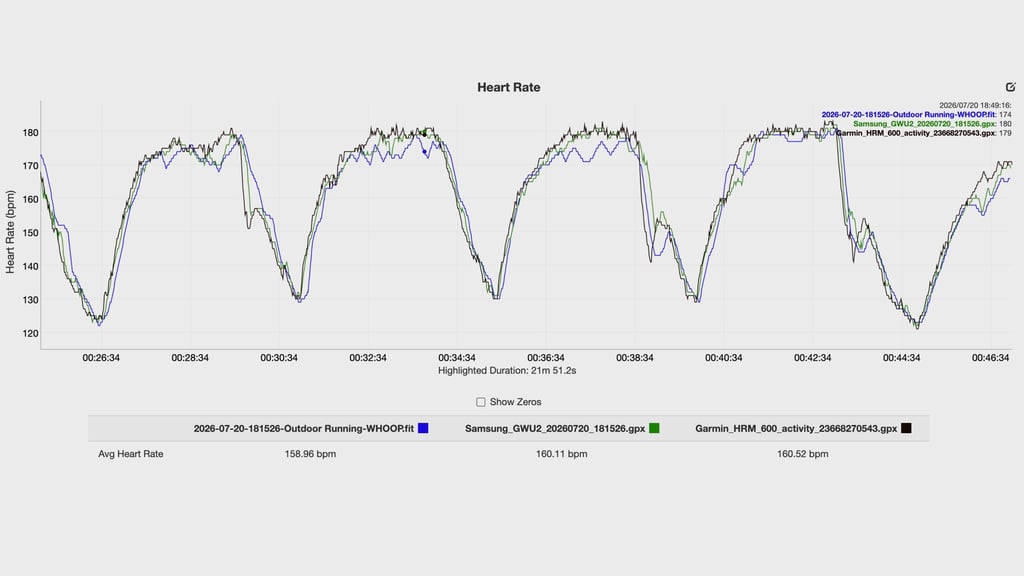
Okay, step one of the HR gauntlet cleared with aplomb. But outdoor running introduces variable wrist movement, cadence impacts, and environmental exposure. For this testing session, I ran at a steady-state pace for about 25 minutes, followed by 4 x 400m threshold intervals.
Session average heart rates were once again incredibly—remarkably, actually—tight between the Galaxy Watch Ultra 2 and the Garmin HRM 600, while the Whoop MG struggled considerably despite the overall session average not looking too out of place.
- Garmin HRM-600 chest strap: 156.44 bpm
- Samsung Galaxy Watch Ultra 2: 156.04 bpm
- Whoop MG: 157.84 bpm
As we can see from the heart rate comparison graphs below, the Ultra 2 experienced a brief 30-second settling period during the initial 25-minute steady portion before (mostly) locking cleanly onto the chest strap’s rhythm.
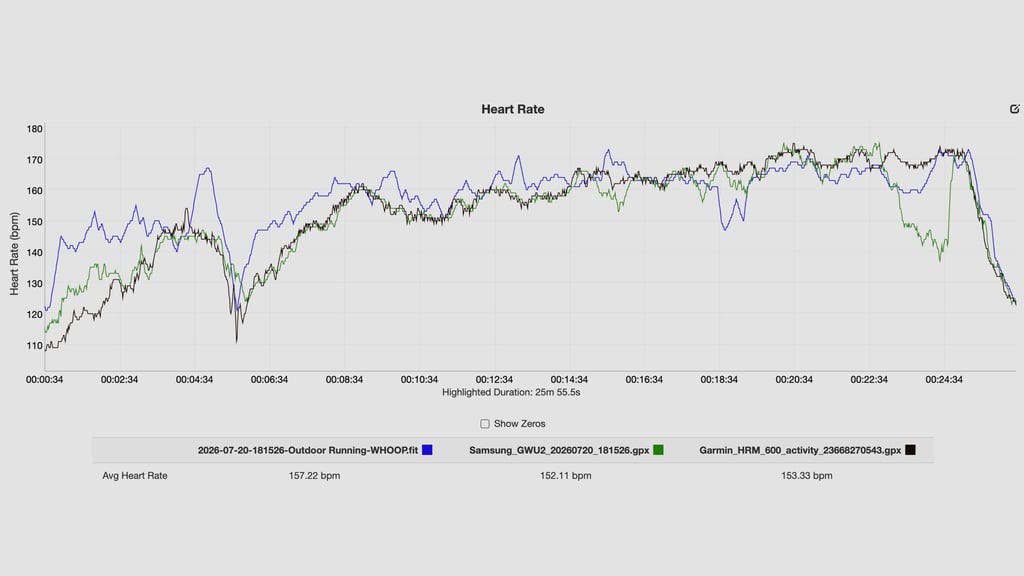
Then, during the intervals, when heart rate slowly crept toward and into zone 5 and back down during the 90-second rest periods, the Ultra 2 matched the chest strap's maximum readings without suffering from the throttling—or algorithmic tendency to underreport, really—that sometimes plagues wrist-based optical sensors.
Dual-frequency GPS performance here was similarly very strong. Trace logs through the tree-covered sections showed virtually no signal drift, accurately recording the overall five-mile distance within 50 meters compared to the dual-band Garmin benchmark.
On that note, though, I'll be testing the Ultra 2 in harsher environments than suburban streets over the coming months, so stay tuned for that.
Test 3: Resistance training
- The full workout session data comparison is viewable here
Strength training remains one of the most demanding challenges for any wrist-based optical sensor due to forearm muscle contractions, gripping forces, and rapid wrist movements.
During this full-body workout—which included single-leg deadlifts, kettlebell swings, and cable movements—the Ultra 2 did struggle much more than in the previous two tests, though I should caveat this by saying that this is the session with the most deviation out of four I've performed with the watch over the last week.
On this workout, there was a consistent underreporting on sets, although lag was actually encouragingly following the usual track of being quicker than Whoop. So, not perfect—but overall a pretty flawless performance
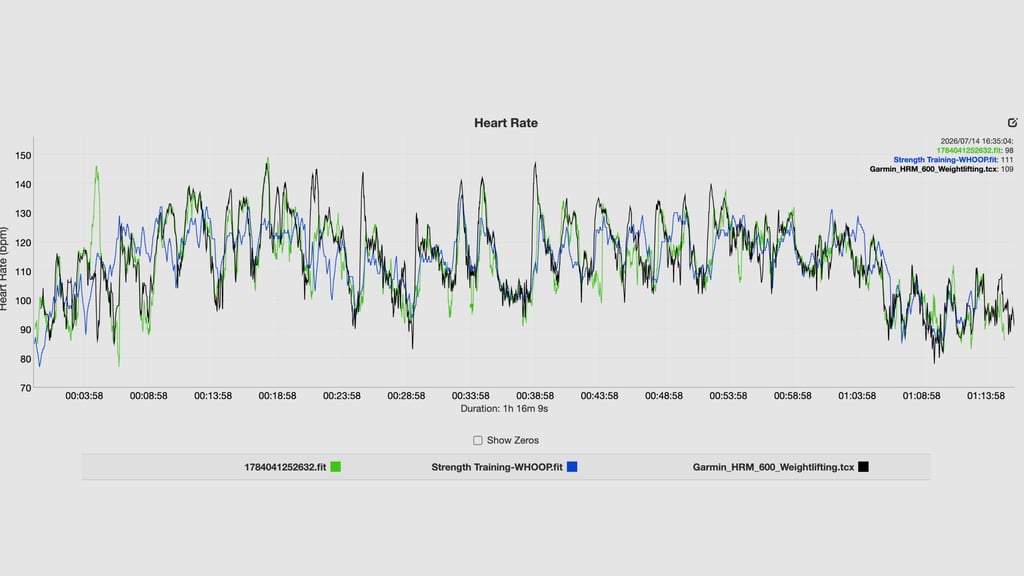
However, as the session progressed, its overall average and maximum session heart rate finished within 1 bpm of the chest strap reference. For general weightlifting and circuit training, it captures the cardiovascular strain of the workout reliably well.
Health, sleep, and stress tracking
Samsung Health continues to be one of the more visually appealing health companion platforms on the market.
Unlike some equivalents from other mass-appeal, bigger brands that cram as many tiles and graphs into a tab as possible, Samsung Health uses neat design tricks to make its cards and graphs clear and digestible. It's colorful, intuitive, and engaging, making it an app you actually don't mind opening each morning to check in on your daily scores and baselines.
Body composition analysis
As I alluded to earlier with Heart Health Score, Samsung remains one of the few mainstream manufacturers to build Bioelectrical Impedance Analysis (BIA) directly into a smartwatch. It means that placing your ring and middle fingers against the two side buttons delivers a microcurrent through your upper body to estimate body fat percentage, skeletal muscle mass, and body water volume.
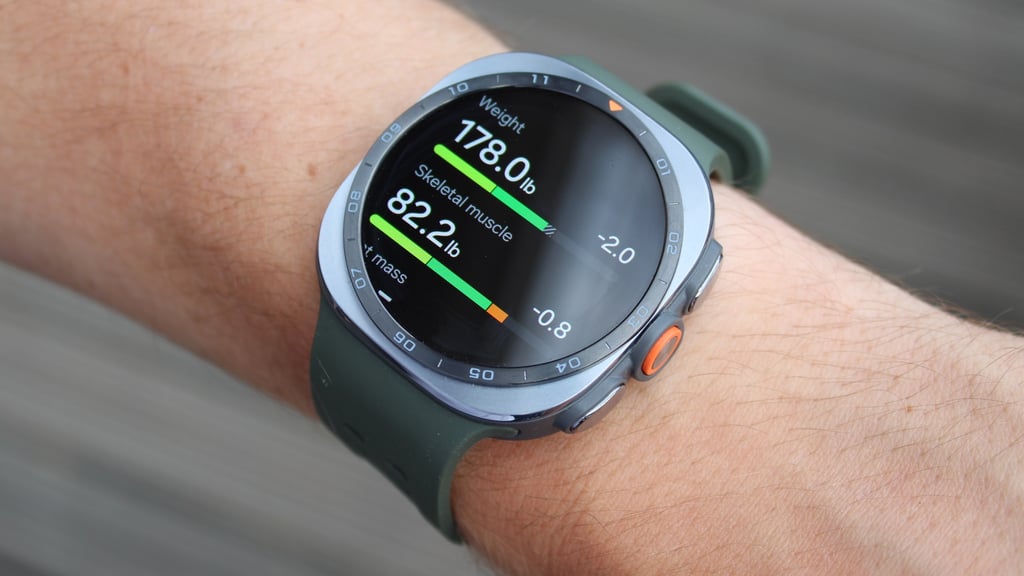
In our testing, the Ultra 2 consistently reported body fat percentages roughly 2-3% higher than our Withings reference smart scales (and the general reference points we've used to verify that baseline against DEXA scans). And, actually, the fact that the Ultra 2 has consistently over-reported at the same rate is much more helpful than erratic readings you can't put any stock into.
Absolute precision in this area also matters far less than relative tracking over time. Since body composition now feeds into the new Heart Health Score, maintaining consistent testing conditions (e.g, first thing in the morning before food or exercise) can still yield some valuable long-term trends.
Sleep tracking and coaching
Sleep detection on the Ultra 2 is much as I've come to expect from Samsung, delivering prompt, reliable results and picking up drop-off times and morning awakenings within 5-10 minutes of our reference device, the Eight Sleep Pod 5. Its night-time metric capture includes:
- Detailed sleep stage breakdowns (REM, Deep, Light)
- Continuous blood oxygen (SpO2) monitoring
- Skin temperature tracking
- Snore Detection (if you enable it via paired phone’s microphone)
The integrated Sleep Coaching program, as before, also assigns you an animal sleep persona based on a week of logged data and offers structured, multi-week behavioral targets to improve sleep regularity.
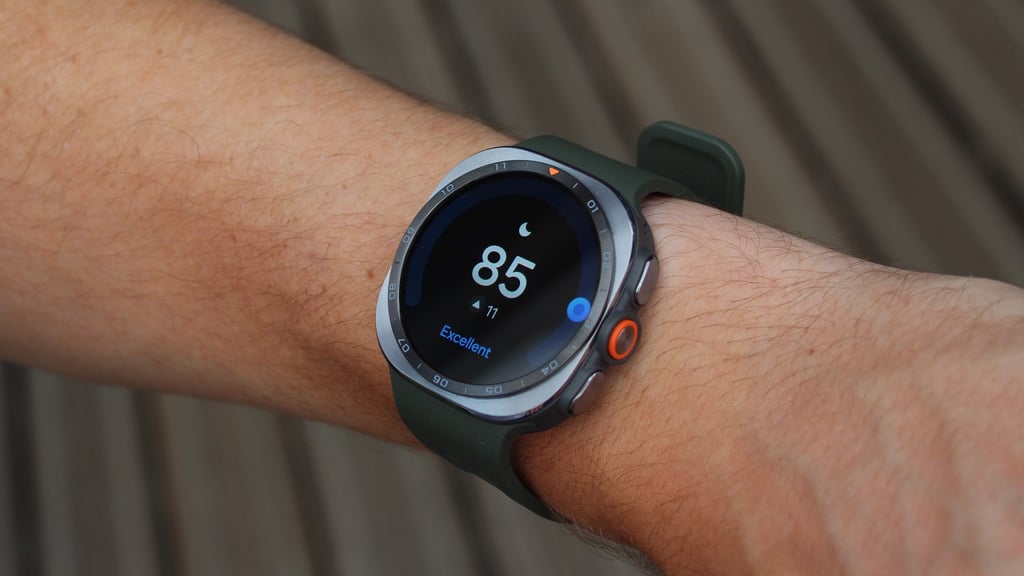
While daily sleep scores don't always align perfectly with subjective morning readiness—or at least not with the same consistency as I'd expect from Oura or Whoop—the trend data is genuinely useful for reminding you of sleep hygiene habits.
Stress monitoring
I said this when I reviewed the original Ultra, but all-day stress tracking remains an area where Samsung has a bit of room for growth.
Like pretty much every watch on the market, the Ultra 2 uses HRV to plot a color-coded stress timeline throughout the day. However, the platform still only offers minimal proactive prompts when elevated stress is detected.
Compared to the contextual AI insights offered by platforms like Whoop or Oura, Samsung's stress monitoring feels passive. Integrating contextual AI prompts—such as suggesting a guided breathing exercise during prolonged periods of elevated stress—would make this data far more actionable. Or, like those two other brands, surfacing data regarding time in different stress zones and how they compare week-on-week or month-on-month.
Battery life: The Qualcomm transformation
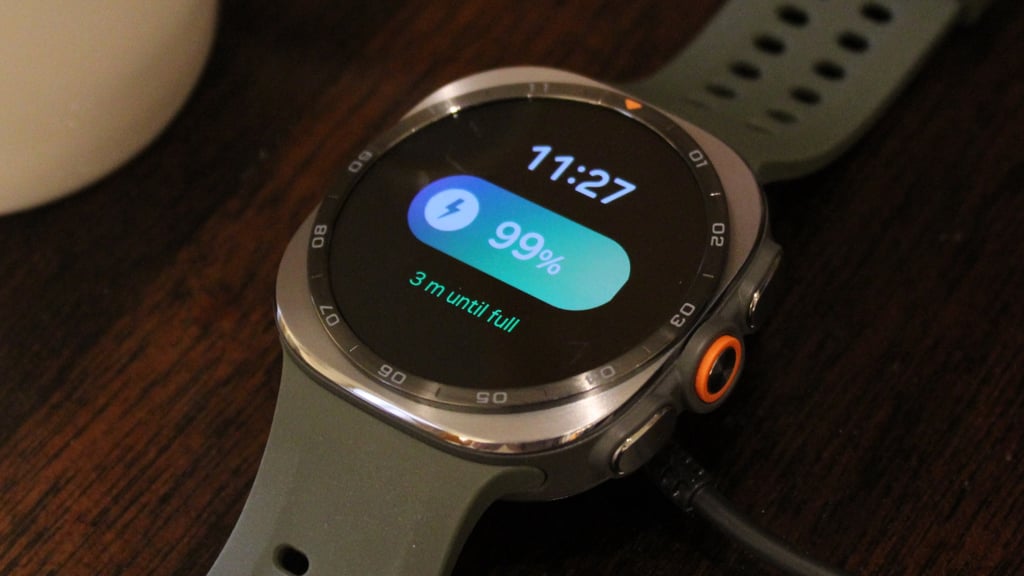
Without question, the headline triumph of the Galaxy Watch Ultra 2 is its battery endurance.
On the original Ultra, the 590mAh battery cell delivered approximately 48 hours of real-world use. That was definitely acceptable for a high-powered smartwatch in 2024, even if it was still short of a true multi-day outdoor companion.
For the Ultra 2, Samsung has engineered a massive 800mAh battery cell into the watch —a 35% increase in capacity—while, again, it's worth repeating, simultaneously slimming the titanium chassis down to 10.7mm.
This capacity increase, combined with the power efficiency of Qualcomm's 3nm Snapdragon Wear Elite chipset, fundamentally changes how you live and use the watch.
In real-world testing over the last week or so—with auto-brightness enabled, continuous heart rate sampling active, full sleep tracking recorded nightly, and 90-120 minutes of daily workout tracking—the Ultra 2 has achieved two four-day cycles.
So if you take that relatively intensive performance and consider that you could also turn off Always-On Display and tweak the background sampling frequency and other settings, eking out more than five days should be achievable with the Ultra 2. The caveat I'd add, though, is that I didn't enable the LTE function for this testing cycle—and had blood oxygen monitoring turned off, too.
It's not just battery longevity, either. Compared to the OG Ultra, the Ultra 2 has much more predictable drain rates. A full night of sleep tracking burns 5% battery; an hour of indoor workout tracking consumes roughly 5%; and an hour of outdoor running (without music streaming) tends to drain around 10%.
This leap transforms the Ultra 2 from a watch that requires strategic daily charging into a much more viable adventure companion. You can head out for a long weekend of hiking, camping, and GPS tracking without packing a charging puck—and that's a big milestone for the Wear OS platform and Samsung. Oh, and Qualcomm.
Final thoughts
The Samsung Galaxy Watch Ultra 2 represents a masterclass in targeted hardware refinement. Rather than chasing superficial gimmicks, Samsung focused its engineering efforts on solving two critical friction points of premium smartwatches: battery life and wearability.
By pairing an 800mAh battery with Qualcomm’s Snapdragon Wear Elite silicon, thinning the case to 10.7mm, and boosting display brightness to 5,000 nits, Samsung has delivered a smartwatch that feels fast, hard-wearing, and remarkably long-lasting.
While the lack of a physical rotating bezel or crown remains an ergonomic challenge—and non-Samsung phone users miss out on those more 'serious' health features—the overall package is undeniably impressive.
If you're an Android user seeking a top-tier, fully-featured premium smartwatch with genuine multi-day battery endurance, stunning display quality, and accurate workout tracking, the Samsung Galaxy Watch Ultra 2 stands comfortably at the very top of its class.