- Rechargeable, discreet receiver-in-ear designs across the range
- Strong direct-buy package with remote care, warranty, and trial
- Bluetooth, Auracast, and phone streaming support throughout
- More expensive than many basic OTC alternatives
- Best adaptive features are reserved for the costly M3
Jabra has become one of the more established names in the over-the-counter hearing-aid market, pairing online ordering with remote support rather than a traditional clinic-first buying process. In this Jabra hearing aids review, we look at the complete Enhance Select M-series (M1, M2 and M3), which are self-fitting OTC models designed as a step-by-step range rather than three unrelated products.
We tested the core experience across the lineup, including fit, controls, charging, app setup, and everyday usability, then assessed where each model earns its place. Expect a clear view of the range’s shared strengths and compromises, alongside individual guidance on whether the entry-level M1, mid-tier M2, or flagship M3 makes the most sense for your budget and priorities.
| Model | Price (per pair) | Hearing aid style | Intended hearing loss | Battery life | Bluetooth | Listening modes/programs | App | Remote support | Best for |
| Enhance Select M1 | $1,195 | Rechargeable receiver-in-ear (RIE) | Mild to moderate; self-fitting OTC | Up to 24 hours; case holds up to 96 hours total | Yes; Bluetooth LE Audio and Auracast | Four preset environments: All-Around, Restaurant, Outdoors, and Music | Jabra Enhance Select app for setup, volume, programmes, and care | Included virtual care and remote adjustments | Value-focused buyers who mainly want core controls and a discreet rechargeable design |
| Enhance Select M2 | $1,695 | Rechargeable receiver-in-ear (RIE) | Mild to moderate; self-fitting OTC | Up to 24 hours; case holds up to 96 hours total | Yes; Bluetooth LE Audio and Auracast | Four preset environments plus more adaptive sound handling than M1 | Jabra Enhance Select app | Included virtual care and remote adjustments | Buyers who want a middle ground between price and more automatic everyday adjustments |
| Enhance Select M3 | $1,995 | Rechargeable micro receiver-in-ear (RIE) | Mild to moderate; self-fitting OTC | Up to 24 hours; case holds up to 96 hours total | Yes; Bluetooth LE Audio and Auracast | Four preset environments, Auto Focus, and Advanced Adaptive Listening | Jabra Enhance Select app | Included virtual care and remote adjustments | Shoppers prioritizing the smallest design and Jabra’s most advanced automatic features |
What are Jabra Enhance hearing aids?
Jabra Enhance is a direct-to-consumer hearing-aid brand offering rechargeable, Bluetooth-enabled devices with app-based setup and remote audiology support. Its Enhance Select range includes M1, M2, and M3: three self-fitting OTC models that share the same basic idea but differ in size, sound-management features, and price. Compared with basic OTC hearing aids, Jabra adds more guided personalization, smartphone controls, wireless audio features, and ongoing help after purchase.
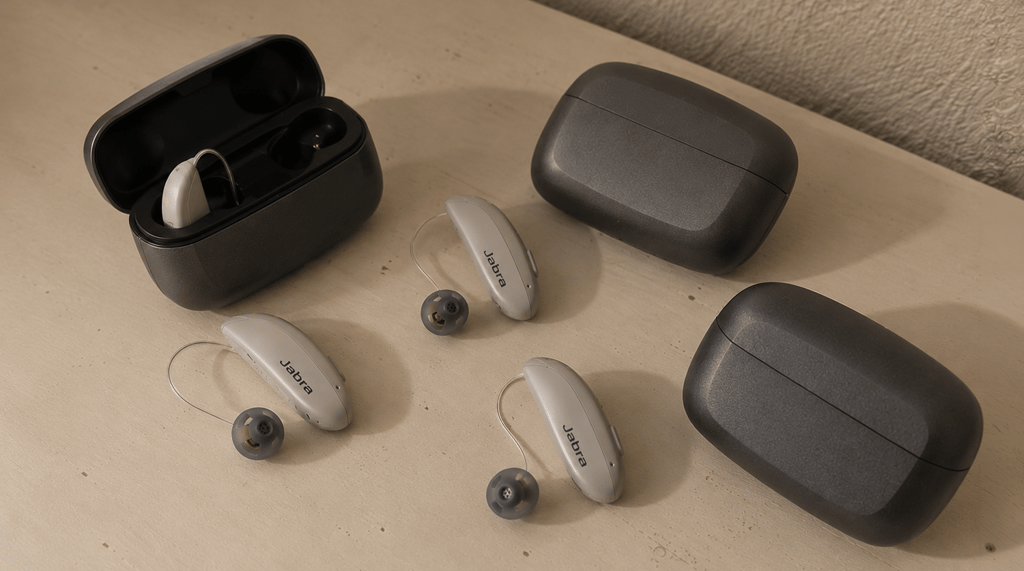
The range is intended for adults with perceived mild to moderate hearing loss, matching the FDA’s OTC category. OTC devices can be bought without a prescription or professional fitting, while prescription hearing aids are selected and programmed by a licensed hearing-care professional and can address a wider range of needs. In practice, Jabra’s approach combines an in-app hearing test, adjustable listening settings, and remote support, so we found the experience closer to a guided online service than a simple off-the-shelf amplifier.
How we tested Jabra Enhance Select
We tested the Jabra Enhance Select range hands-on, using M1, M2, and M3 across everyday indoor and outdoor situations. We compared overall sound quality, speech clarity, and how each model handled background noise, without treating those observations as medical evidence. We wore the aids for extended periods to assess comfort, fit, stability, and how easy they were to put on, remove, and store.
We also timed the setup process, checked the physical controls, and explored volume, listening-mode, and adjustment options in the app. Bluetooth testing covered pairing, audio streaming, and phone-call behavior with compatible devices. We then monitored battery performance during normal use, plus assessed charging speed, case design, and travel convenience. Finally, we used the aids during conversations, television viewing, walks, and general household tasks. This approach let us judge the complete ownership experience, including small practical details that specifications and other Jabra hearing aid reviews can miss.
Jabra Enhance Select M1 review
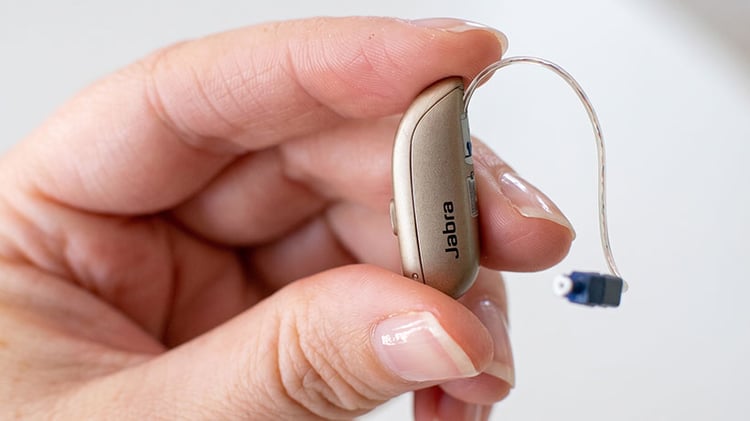
Jabra Enhance Select M1 is the entry point to the range, using a discreet rechargeable receiver-in-ear design. The main body sits behind the ear, while a thin wire runs to the receiver and soft dome in the ear canal. We found it comfortable for long sessions, although fit depends on choosing the right dome, and some visibility remains from the side. A push button handles basic programme changes, while the Jabra Enhance app adds volume, mode, and personalization controls.
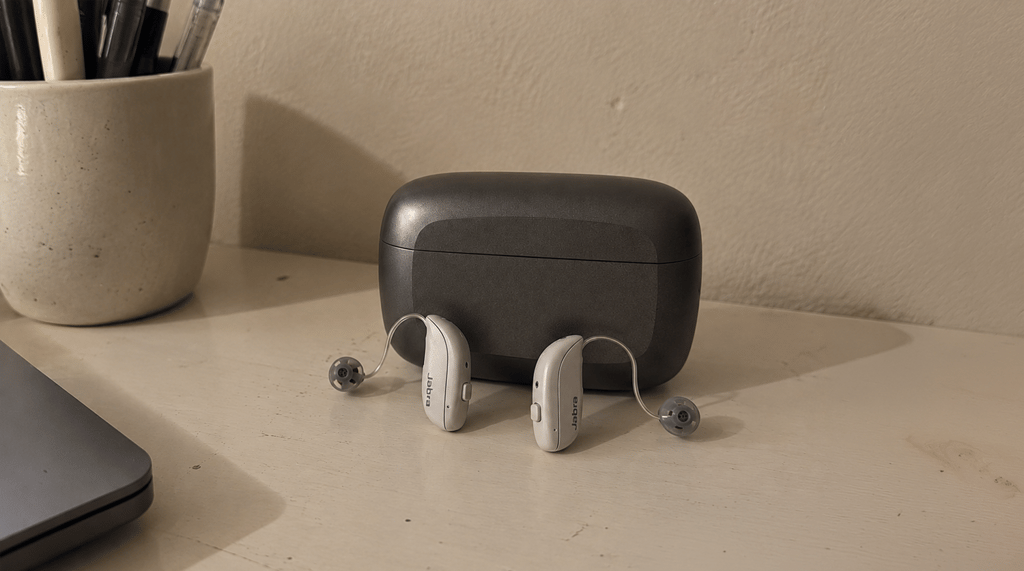
When it comes to charging, it’s very simple. The case provides overnight charging and stores up to three additional charges, with the aids offering up to 24 hours per charge. In quiet rooms, we found M1’s sound clear and balanced, with speech easy to follow. Its noise reduction helped keep everyday background sound manageable, but it was less sophisticated in busy places than M2 and M3. Four listening programmes cover common settings, including all-around, restaurant, outdoors, and music. Bluetooth supports compatible streaming, while remote audiology support adds useful guidance after purchase.
Who is Jabra Enhance Select M1 best for?
M1 suits buyers who want Jabra’s core design, rechargeable convenience, app control, and support at the lowest price. Its limitation is that it lacks M2’s stronger adaptive handling and M3’s smaller micro-RIE design and advanced automatic features. I would choose it for quieter routines, not for shoppers seeking the range’s best performance in complex environments.
Jabra Enhance Select M2 review
Jabra Enhance Select M2 is the middle choice, adding more automatic sound management to the discreet rechargeable receiver-in-ear design used by M1. We found the mini behind-the-ear body comfortable during extended wear, with a secure fit once I had chosen the right dome, although it is not completely invisible. Setup was straightforward: pairing the aids, following the in-app self-fitting test, and adjusting the initial profile without needing complicated controls.
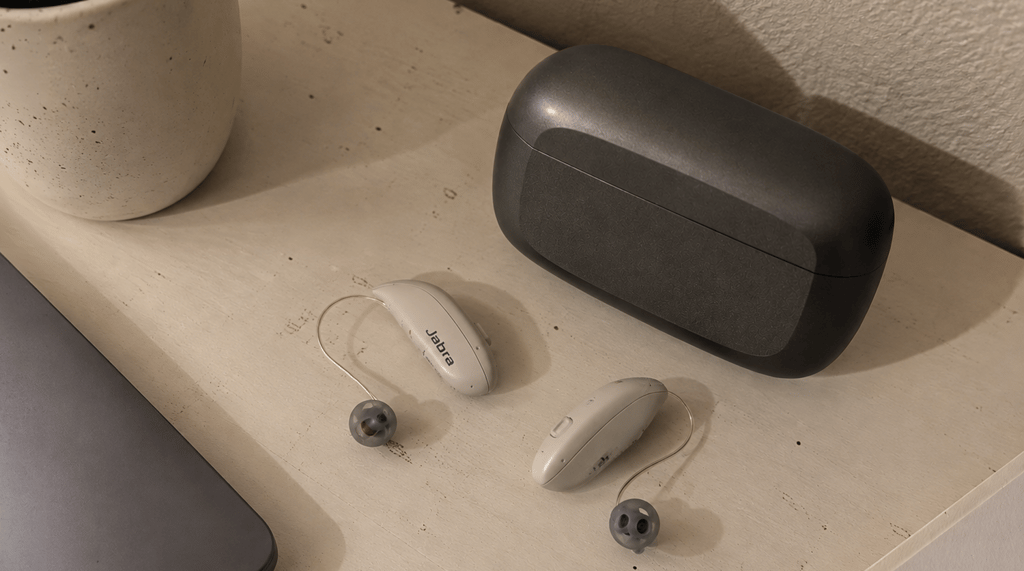
M2 sounded clean and natural in quiet rooms, with speech remaining easy to follow during conversations and television viewing. Its meaningful upgrade over M1 appeared in changing environments. Adaptive listening responded to background noise and shifting volume, reducing the need for constant manual changes, although crowded places could still sound busy. Four listening modes cover everyday situations, while Bluetooth supports compatible streaming and calls. The app handles volume, mode selection, tone adjustments, and further personalization. Battery life lasted through a typical day, and the charging case made top-ups convenient when travelling. Remote audiology care is another advantage, offering help with programming and adjustments after purchase.
Who is Jabra Enhance Select M2 best for?
M2 suits buyers who spend time in cafés, restaurants, or social settings and want more automatic help than M1 provides. Its main limitations are the higher price and the fact that its adaptive improvements may be difficult to appreciate in quiet routines. It also lacks M3’s smaller micro-RIE format and top-tier automatic features, so the upgrade makes most sense for buyers who regularly move between sound environments.
Jabra Enhance Select M3 review
Now, Jabra Enhance Select M3 is the range-topping model, and its premium appeal starts with the smallest, most discreet micro receiver-in-ear design. We found it comfortable for extended wear, although the behind-the-ear body and receiver wire remain visible from some angles. Setup is simple: the app guides you through pairing and the self-fitting test, then provides controls for volume, listening modes, tone, and personalization.
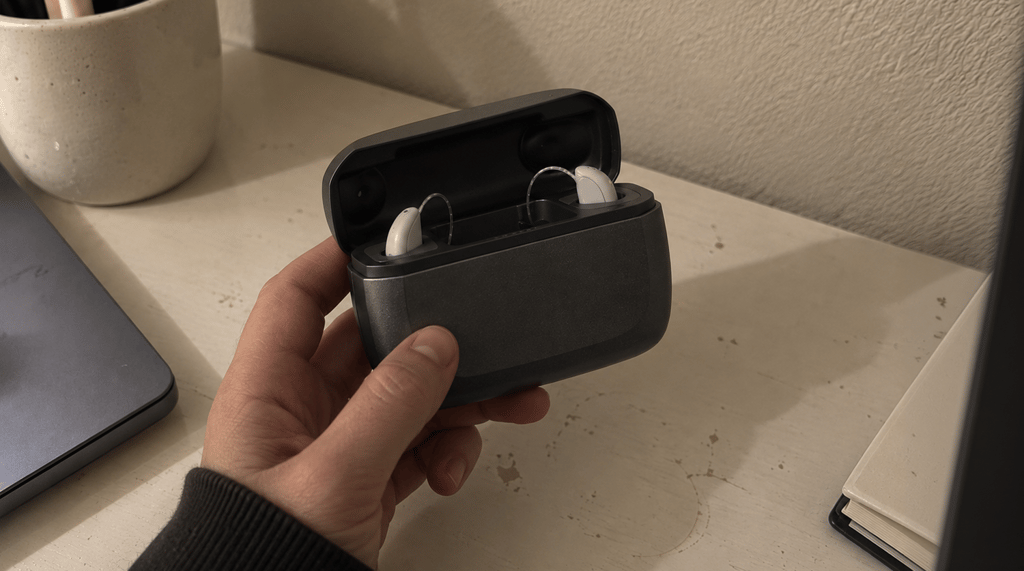
In quiet rooms, M3 delivered clean, natural sound, while its Auto Focus and Advanced Adaptive Listening made the biggest difference in changing environments. Jabra says Auto Focus tracks speech direction and reduces competing background sound. However, in practice, we found conversations easier to manage in busy settings, though no automatic mode removes every distraction. Four programmes cover common listening situations, with extra adjustments available in the app. Bluetooth LE Audio, Auracast and hands-free calls expand its usefulness beyond basic amplification, subject to phone compatibility. Battery life lasted a full day, and the travel charging case held up to three additional charges, making everyday use reassuringly simple. Remote audiology support is available for guidance and adjustments after purchase.
Who is Jabra Enhance Select M3 best for?
M3 is for buyers willing to pay $1,995 for the smallest design, stronger automatic sound processing, TapControl, and the best background-noise feature set in the lineup. It is less compelling for quiet routines, where M1 may cover the essentials, and its high price remains the main limitation. The app-led fitting also cannot replace prescription care for every user.
Jabra hearing aids value for money
Jabra Enhance Select pricing is $1,195 for M1, $1,695 for M2, and $1,995 for M3, per pair. Each package includes rechargeable hearing aids, a charging case, eartips, and access to professional remote support. Buy direct, and you get a 100-day risk-free trial, free shipping and returns, a three-year warranty, three years of loss-and-damage protection, and lifetime US-based customer support. Jabra also offers financing, with advertised monthly payments varying by model and eligibility, and accepts HSA and FSA cards.
M1 is the strongest value if you mainly want discreet rechargeable hardware and core app controls. M2’s extra cost is easier to justify if you regularly move between quiet and noisy settings, while M3 commands its premium for the smallest design and more advanced automatic sound processing. In short, the price steps can translate into useful upgrades, but quiet-environment users may not gain enough to justify moving beyond M1.
Who should consider Jabra hearing aids?
Jabra Enhance Select may suit adults aged 18 or over who perceive mild-to-moderate hearing loss and want to try an OTC device without starting with a clinic appointment. It is particularly appealing to first-time users who want rechargeable hardware, smartphone controls, Bluetooth streaming, and more sound personalization than a basic OTC model. The included remote audiology support also helps if you want guidance with setup or adjustments rather than managing everything alone.
That said, OTC devices are not suitable for every situation. An in-person hearing evaluation or prescription hearing aid may be more appropriate for people under 18, those who suspect more severe loss, or anyone with sudden or rapidly worsening hearing, a large difference between ears, ear pain, drainage, dizziness, or new one-sided tinnitus. A professional assessment is also sensible if you struggle to hear even in quiet settings or cannot get a comfortable, useful fit. These checks can identify issues that self-fitting cannot.
Other hearing aid and health tech reviews
Best hearing aids: Top picks for every budget
Best OTC hearing aids: Best options for every need
Best Bluetooth hearing aids: Top tested for Bluetooth
Best online hearing aids: Buying hearing aids online
Final verdict: Are Jabra hearing aids worth it?
Jabra’s Enhance Select range delivers a polished OTC experience, combining comfortable rechargeable hardware, clear everyday sound, app-based personalization, and unusually reassuring remote support. The main drawbacks are high prices and the need to choose carefully between features that can feel similar in quieter settings.
To recap, M1 is the best-value option for simple routines and first-time buyers; M2 is worth considering if you often move between quiet and noisy places; M3 suits shoppers who prioritize the smallest design and Jabra’s most advanced sound processing.
All three are easy to use, but the premium models do not automatically offer better value for everyone. In this review of Jabra hearing aids, our recommendation is straightforward: choose M1 for savings, M2 for flexibility, and M3 for maximum discretion and features.
FAQ
Yes, if you want rechargeable OTC hearing aids with Bluetooth, app-based personalization and included professional support. They cost more than basic alternatives, so the M1 offers the best value for simpler needs.
Yes, Enhance Select models are OTC hearing aids intended for adults with perceived mild-to-moderate hearing loss.
Yes, compatible models support Bluetooth streaming and hands-free calls, with features depending on the hearing-aid model and smartphone.
They provide up to 24 hours of use per charge, although streaming can reduce battery life. Jabra’s user guide lists an expected product and rechargeable-battery service life of five years.
Yes, the Jabra Enhance Select app is available for iOS and Android, supporting setup, volume, listening modes, sound customization, self-fitting, and battery checks.
References
-
National Center for Biotechnology Information.
-
US Food and Drug Administration.
-
National Center for Biotechnology Information.
-
US Food and Drug Administration.
-
National Center for Biotechnology Information.