We've put a wide range of OTC hearing aids through real-world testing—here are our top picks
In 2022, the FDA approved the OTC hearing aid category, meaning these devices can now be purchased without an exam or prescription. This, of course, does not imply that every hearing aid is approved by FDA—and even in the approved product list, you will find a wide range of products, some being better than others.
This is why we sat down to review OTC hearing aids. Our goal was to help our readers choose devices that suit their needs. So, in this article, you’ll find our vetted OTC hearing aids based on a wide range of criteria, such as comfort, practicality, connectivity, battery life, companion app usability, and so much more.
Quick picks: Best OTC hearing aids
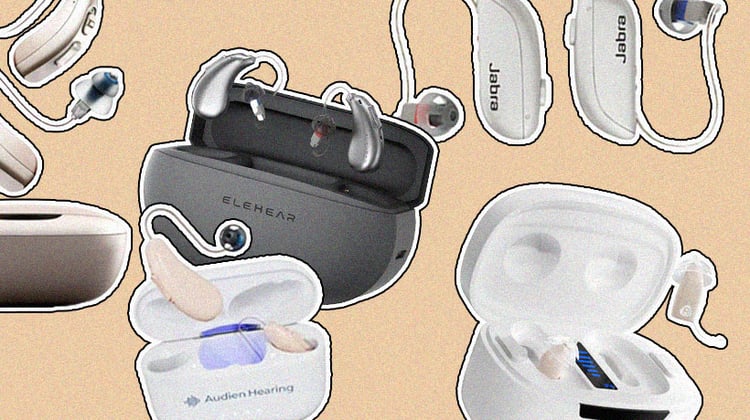
- ELEHEAR: Best value option
- Jabra: Best premium option
- Ceretone: Best discreet option
- Audien: Best with UV self-cleaning feature
- Linner: App-free option
How we evaluate OTC hearing aids
Our evaluation methodology focused on neutral, observable features rather than medical claims. Each device is assessed across these criteria:
- Setup. We looked into how intuitive the initial pairing, battery insertion, and app-guided hearing test.
- Self-fitting. Does the process require multiple attempts or feel straightforward on first use?
- Companion app. We looked at ease of use, interface, design, available controls, and how clearly the app presents settings and adjustments.
- Comfort and design. Are the devices lightweight and ergonomic for all-day wear? How do they fit in and do they feel secure even during movement?
- Battery life, case capacity, and charging. We compared the spec sheets with what we noticed during our testing.
- Customization options. Do devices offer presets for specific environments (restaurants, car, quiet rooms), or only basic volume control?
- Long-term reliability. We considered the warranty's length and coverage, as well as customer reviews and reports on reliability over time.
- Value. Finally, we considered the overall feature set and user experience relative to the price.
ELEHEAR Beyond Pro
Best for: Value shoppers seeking premium quality in a discreet device
- Battery: Up to 20 hours per charge
- Case capacity: 80 hours total (4 full charges)
- Noise reduction: Yes
- App compatibility: iOS and Android
- Warranty: 1 year
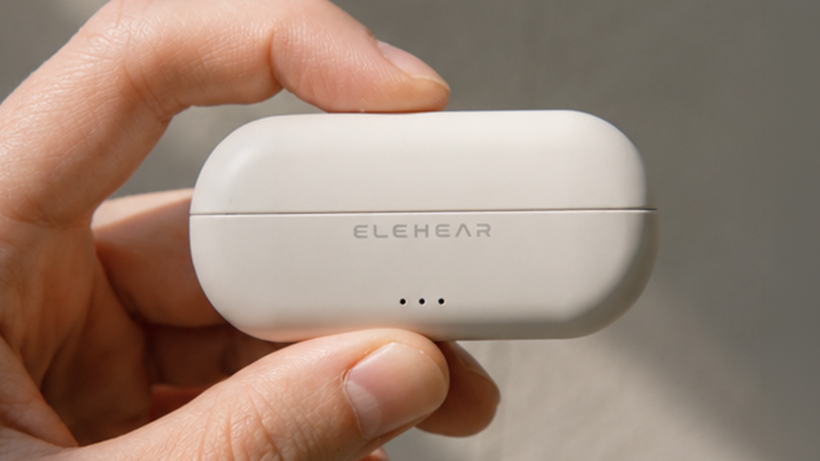
We selected ELEHEAR Beyond Pro as the best benefit-to-cost product—it ticks all the boxes while being mid-priced. From good battery life to discreet design, you’ll find all the essential features needed for a comfortable and reliable hearing experience.
ELEHEAR Beyond Pro is beginner-friendly. The app doesn't overwhelm, the self-fitting experience is smooth, and the settings are easy to get the hang of. Creating a personalized hearing profile took us around 10 minutes.
Our team also appreciated the fit. At 4.8 grams, it is not the lightest OTC hearing aid on the market, but our team found it comfortable for all-day wear. Moreover, ELEHEAR Beyond Pro stays secure on the ear even during a brisk walk.
ELEHEAR Beyond Pro delivers up to 20 hours per charge, with the charging case providing 80 hours total capacity or 4 full charges. In real-world use, this holds true for most moderate-to-heavy users, though it may vary depending on your daily usage patterns and the amount of Bluetooth streaming.
The charging case is slim, fits in a pocket, so you’ll not have to leave it behind when leaving home. A full charge takes under an hour—and that will be enough to last for a full day.
- FDA-registered
- Premium feature set at mid-tier price
- Fast charging
- Shorter warranty
Jabra Enhance Select M3
Best for: those who have a bigger budget and want the most advanced features
- Battery: Up to 24 hours per charge
- Case capacity: 72 hours total (3 full charges)
- Noise reduction: Yes
- App compatibility: iOS and Android
- Warranty: 3 years
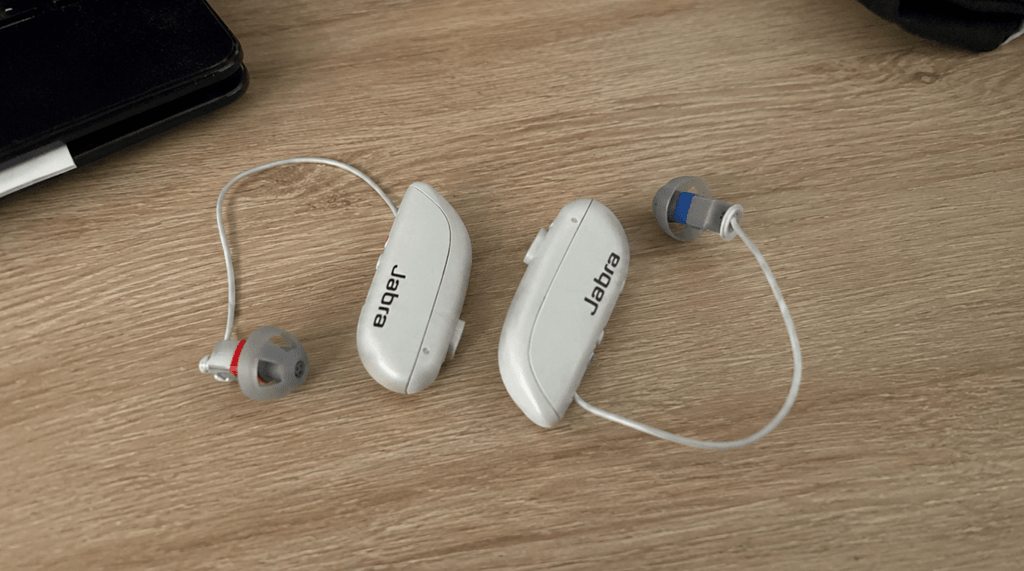
Jabra is one of the industry leaders in the hearing aid market—and Enhance Select M3 is its most capable OTC hearing aid. While it comes at a higher price point than our top recommendation, which led to its placement as our second pick, the premium cost reflects a more advanced set of features.
Jabra Enhance Select M3 is appealing to anyone who wants a more tailored hearing experience. The self-fitting process lets you fine-tune the hearing aids to suit your tastes, without being complicated.
We also gave high marks to the fit and design—the hearing aids are sophisticated enough to blend right in with your daily look and feel secure in place without looking or feeling too chunky. Plus, the controls are right where you need them, so you can make any last-minute adjustments without a fuss.
The battery life on these aids is impressive. You get a full 24 hours of use from a single charge, and the charging case gives you an additional 3 days' worth, which means you can happily go days without needing to scramble to find a power outlet—perfect for those who are always on the go.
- FDA-cleared
- Premium build quality and design
- Effective wind noise suppression
- Expensive
Ceretone Core One Pro
Best for: Budget-conscious buyers seeking an almost completely invisible design
- Battery: Up to 20 hours per charge
- Case capacity: 80 hours total (4 full charges)
- Noise reduction: Yes
- App compatibility: iOS and Android
- Warranty: 1 year
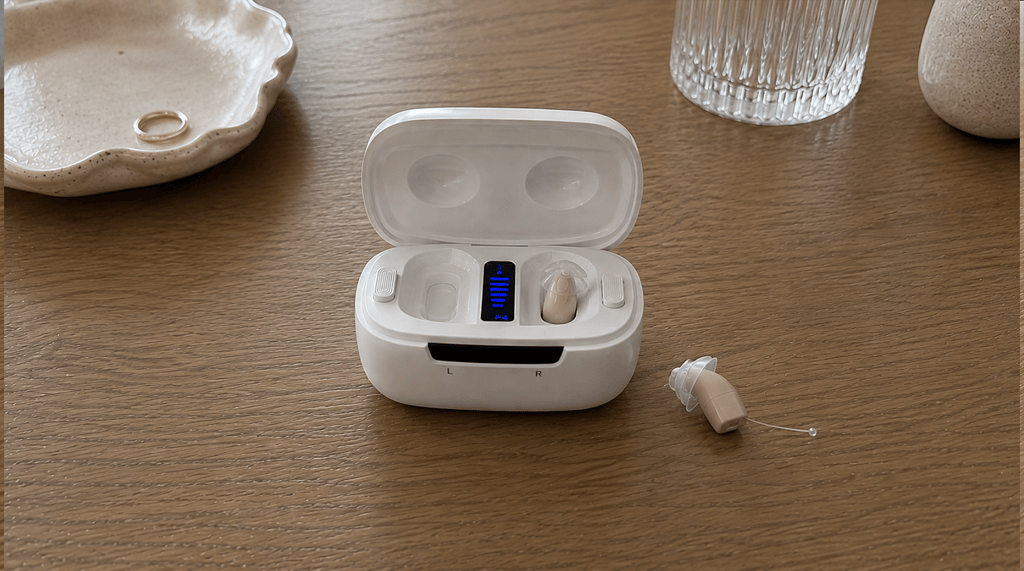
Ceretone Core One Pro is an in-the-ear OTC hearing aid, meaning it goes deep in your ear canal and becomes almost undetectible. This deep in the ear design also means the fit is secure.
Ceretone Core One Pro arrives in a compact plastic case with straightforward instructions. The aids themselves are extremely small and lightweight—among the smallest in this lineup.
Out of the box, they feel less premium than Jabra or ELEHEAR, but they're also significantly more affordable, and the physical quality feels solid rather than flimsy. Pairing and the initial hearing assessment take under 10 minutes.
Battery life is competitive, especially for an in-the-ear device, and the charging case is compact and efficient.
However, some of our testers noted that ceretone felt uncomfortable in their ear canal. Moreover, the sound quality is not as good as our top picks, but it is expected at this price range.
- FDA-registered
- Budget-friendly option
- Discreet design
- Sound quality might disappoint some users
- Some found it uncomfortable
Audien ION Pro 2 Hearing Aids
Best for: unique UV self-cleaning technology
- Battery: Does not specify
- Case capacity: Up to 48 hours
- Noise reduction: Yes
- App compatibility: iOS and Android
- Warranty: 1 year
Audien ION Pro 2 is a solid mid-range OTC hearing aid that covers the basics well without trying to compete with pricier, feature-packed options higher up this list.
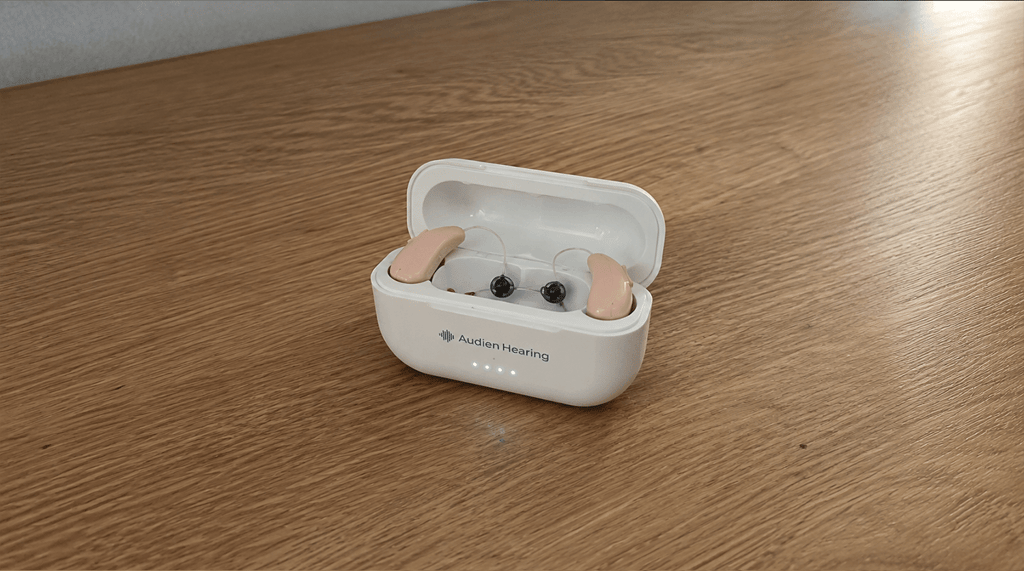
The charging case includes UV cleaning technology, which is particularly useful when you're on the go. Instead of needing to clean the hearing aids separately, you can place them in the case when you're done wearing them and let the UV light handle the cleaning while they charge.
Audien ION Pro 2 offers Bluetooth streaming, app-based sound adjustments, and a 48-hour battery life on a single charge, making it a practical pick for everyday use rather than a standout performer.
We also liked that ION Pro 2 keeps things simple. The device is designed to be easy to use, so you can put it in, adjust the volume, and get on with your day without having to spend much time figuring out complicated controls.
The most important drawback we noticed was related to connection drops. Having a phone nearby is needed to reestablish the connection.
- FDA-registred
- Mid-priced option with a great set of features
- Intuitive, modern app design
- Shorter warranty
- Bluetooth connection can be unreliable
Linner Mercury
Best for: those who don’t want to use an app
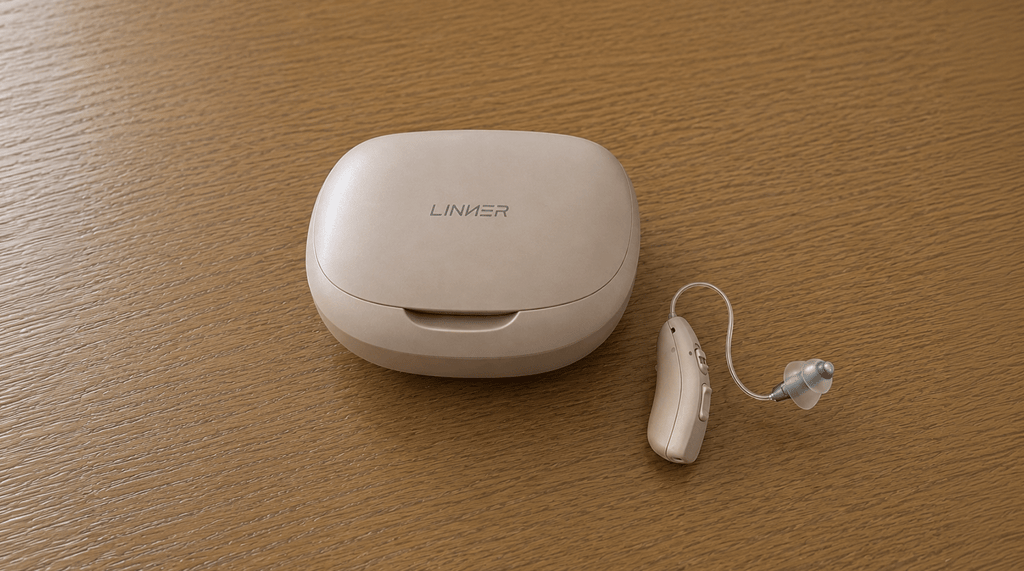
- Battery: Up to 20 hours
- Case capacity: Up to 60 hours
- Noise reduction: Yes
- App compatibility: None
- Warranty: 1 year
Linner Mercury closes out our list as the most stripped-back option, and it makes no attempt to hide that. If you're after a highly customizable, tech-forward hearing aid, this isn't it, but for those who are looking for an app-free experience, Mercury is the most suitable pick.
The 20-hour battery life is respectable, if not class-leading, and the charging case adds a few extra charges when you're away from an outlet. It's a reasonable trade-off for the low price point, which puts Mercury among the more affordable OTC hearing aids we tested.
Audio from Mercury is decent but constrained because it has only a single-microphone. Speech in quiet environments sounds clear and relatively natural. In noisier settings, however, the experience is less sophisticated than the dual-microphone systems in premium models.
- FDA-registred
- Easy to operate
- Budget pick
- Shorter warranty
- No self-fitting customization
What are OTC hearing aids?
Over-the-counter hearing aids are FDA-approved devices designed for individuals with mild to moderate hearing loss.
OTC models do not require a hearing test performed by an audiologist and professional fitting adjustments—but taking it to your provider first is still important. They will help you determine whether an OTC hearing aid is right for you, as in some cases it might not be effective enough.
The FDA definition of mild to moderate hearing loss
OTC hearing aids are intended only for perceived mild to moderate hearing loss, not for the treatment of severe or profound hearing loss. Here are some of the experiences that are associated with mild to moderate hearing loss:
- You find it difficult to hear speech in noisy environments
- You have trouble following speech in group settings
- Hearing on the phone may be difficult
- You feel tired after listening
- You may be turning up the volume of the TV or radio, even though others complain it is too noisy
Users with hearing loss exceeding these thresholds should consult a hearing care professional for prescription device fitting.
OTC hearing aids are not intended for users under 18. For adults, there’s no age restriction, making them suitable for age-related hearing loss in seniors.
OTC vs. prescription hearing aids
Over-the-counter and prescription hearing aids serve different hearing loss severities and user needs.
| Attribute | OTC hearing aids | Prescription hearing aids |
| Hearing loss severity | Mild to moderate | Mild to severe/profound |
| Professional fitting | No, app-guided self-fitting, or no fitting at all | Yes; audiologist-fitted |
| Hearing test | Usually within the app | Conducted by an audiologist in clinic |
| Medical evaluation | None required | Required; verifies candidacy and rules out underlying conditions |
| Customization | Limited to moderate; preset profiles and manual adjustments | Extensive; fine-tuned to the individual ear and hearing profile |
| Cost | $200–$2,000 per pair | $4,000–$6,000 per pair |
| Insurance coverage | Rarely covered; most OTC devices are out-of-pocket. | Possible; coverage varies by plan and provider. |
| Follow-up care | User-managed via app | Professional adjustments and support included |
| Return policy | Manufacturer-specific; typically 30–90 days risk-free | Often includes an extended trial period with professional support |
How to choose the right OTC hearing aid
We would advice to consider several things before you make your purchase.
Hearing loss level
Before purchasing, determine whether your hearing loss is mild (26–40 dB HL) or moderate (41–55 dB HL). You may achieve this using a self-administered app-based test or by obtaining a professional audiogram from an audiologist.
OTC devices are optimized specifically for this mild-to-moderate range; if your hearing loss is severe (above 55 dB HL), you'll need prescription devices capable of delivering greater amplification.
Design style
The form factor affects daily usability. Behind-the-ear (BTE) models are larger, more visible, but they offer clear advantages: longer battery life, more advanced noise reduction capabilities, and easier insertion.
Mini-RIC and in-the-ear (ITE) models prioritize discretion—they're far less noticeable when worn—but they sacrifice battery endurance and typically offer more limited feature sets.
Bluetooth
Bluetooth connectivity allows your hearing aids to stream audio directly from smartphones, tablets, and televisions. This feature is essential if you want to watch TV through your hearing aids or listen to music and podcasts wirelessly.
However, if your primary use case is amplifying ambient sound for conversation—and you rarely engage with entertainment or phone calls—Bluetooth becomes less critical. All five reviewed devices, except Linner Mercury, offer full Bluetooth audio streaming.
Are OTC hearing aids effective?
Research and real-world user experiences demonstrate that OTC hearing aids can effectively amplify sound for individuals with mild to moderate hearing loss.
However, it's essential to set realistic expectations about OTC hearing aids. OTC devices amplify sound; they do not restore "normal" hearing. Users with significant hearing loss may continue to struggle in extremely noisy environments or when following rapid speech patterns.
The technology has limits, and no hearing aid—OTC or prescription—can perfectly replicate natural hearing.
Most users require 2–4 weeks to acclimate to hearing aids as the brain adjusts to new auditory input and the devices themselves adjust to your listening patterns. AI-driven systems like ELEHEAR Beyond Pro continue learning and optimizing your sound profile throughout this period, so patience during the initial adjustment phase is also important.
Other hearing aid reviews:
Best online hearing aids
Best hearing aids: FAQ's
Yes, as a category. That means that they are FDA-regulated devices that must meet specific requirements before they can be legally marketed in the U.S. However, this does not mean that every product advertised as an “OTC hearing aid” has been individually FDA-approved.
Yes, they can be helpful for some people. If your hearing loss is minimal, sometimes even an OTC hearing aid can be enough for you to get back to a normal life. However, it is always important to discuss the matter with your doctor, who will determine if that’s the correct solution for you.
Most health insurance plans do not cover OTC hearing aids because they are purchased directly by consumers without a medical prescription. Contact your specific insurance plan to determine whether you have any hearing aid coverage; coverage eligibility varies widely.
Device lifespan depends primarily on build quality and how well you care for your hearing aids. The reviewed devices include 1–3 year warranty periods covering manufacturer defects. Rechargeable battery capacity degrades gradually over time, but devices may last longer than 3 years.
References
-
American Speech-Language-Hearing Association.
-
JAMA Otolaryngology–Head & Neck Surgery.
-
FDA.