
Our list of the best hearing aids helps avoid decision fatigue and find the right fit for your budget
Hearing loss affects millions of adults and can significantly impact communication and quality of life. While prescription devices remain the best choice for many, over-the-counter (OTC) options are making hearing support more accessible.
Whichever type you choose, modern hearing aids do more than just amplify sound. They now feature Bluetooth streaming, rechargeable batteries, AI-powered sound processing, and smartphone apps, making the experience much more comfortable than before.
However, their wide selection can make finding the perfect fit difficult. That’s where this guide comes in. We compare the top OTC hearing aids across different categories to help you choose the right device for your needs, evaluating each option based on sound quality, comfort, features, battery life, ease of use, value, and ideal user.
Quick picks: Best hearing aids
- ELEHEAR Beyond Pro – best overall
- Jabra Enhance Select M3 – best premium hearing aid
- Ceretone Core One Pro – best invisible hearing aid
- Audien ION Pro 2 Hearing Aids – best rechargeable model
- Linner Mercury mini-RIC OTC Hearing Aid – best budget hearing aid
How we tested hearing aids
Every hearing aid on this list underwent a thorough review process to ensure the best possible user experience. We started by evaluating the setup process and initial fitting to see how easily you can get the devices up and running. From there, we focused on physical design, assessing comfort during all-day wear.
To better assess their real-world performance, we tested sound and speech clarity in both quiet rooms and busy environments. During this process, we paid close attention to background noise reduction and feedback suppression to ensure a natural, whistle-free listening experience.
We also reviewed their smart features, evaluating their app experience alongside Bluetooth reliability for both calling and music streaming. Finally, we assessed their everyday usability by tracking battery performance, the convenience of the charging case, and ease of cleaning—allowing us to pick the hearing aids that offer the best overall value.
ELEHEAR Beyond Pro
Best for: Users looking for well-rounded hearing aids
- Type: Self-fitting OTC
- Style: Receiver-In-Canal (RIC)
- Bluetooth: Yes
- Battery life: 20 hours
- App compatibility: ELEHEAR app for iOS and Android
- Price range: Medium range
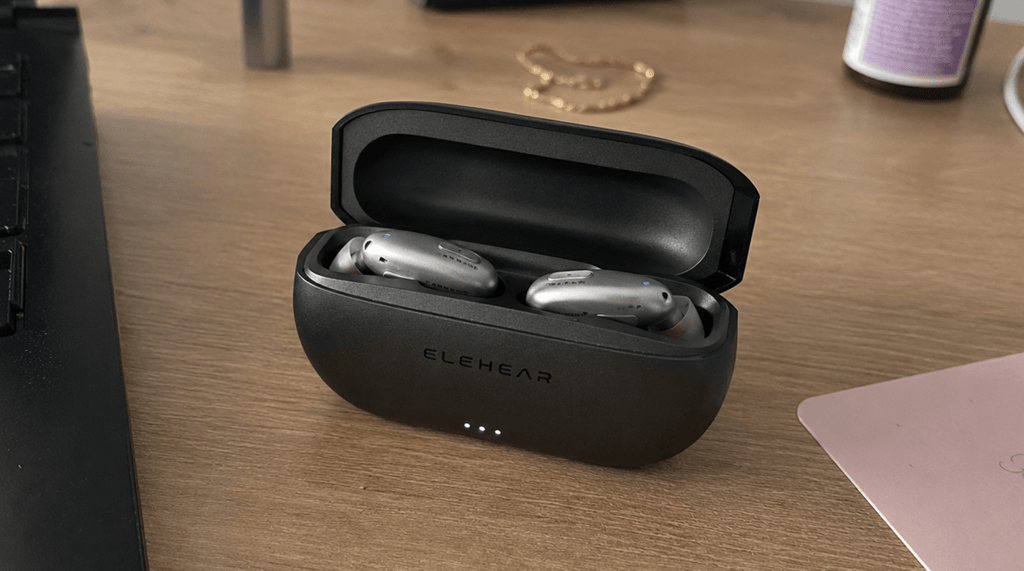
Our top recommendation is ELEHEAR Beyond Pro, which offers a well-rounded package of advanced features at a mid-range price. The most impressive one is its proprietary VOCCLEAR® 2.0 technology, which, with the help of AI algorithms, reduces noise and controls feedback for clearer speech and other sounds.
Thanks to the app, the setup with ELEHEAR Beyond Pro is simple. It prompts you to complete a hearing test, after which ELEHEAR’s audiologists tailor the hearing aids to your specific hearing profile. If needed, you can later easily adjust settings such as volume, listening mode, noise control, and directionality yourself. ELEHEAR also offers lifetime customer support in case you need help doing so.
Bluetooth allows you to stream calls, TV, and music from both Apple and Android devices directly from your earpiece. Not to mention, it has a separate Music Mode that delivers a richer, more immersive listening experience.
This device also includes tinnitus masking with more than 20 soundscapes designed to distract from phantom sounds. AI translation in 20 languages is available too, allowing you to overcome language barriers.
While its design is ergonomic, the Receiver-in-Canal (RIC) style can feel bulkier than some other more streamlined options. However, if you’re not particularly concerned about discretion, it remains a practical option with 20 hours of battery life and a fairly accessible price point.
- In-app hearing test
- Lifetime customer support
- Tinnitus masking
- AI translator
- Slightly less discreet design
Jabra Enhance Select M3
Best for: Premium sound experience
- Type: Self-fitting OTC
- Style: Receiver-In-Canal (RIC)
- Bluetooth: Yes
- Battery life: 24 hours
- App compatibility: Jabra Enhance app for iOS and Android
- Price range: Premium range
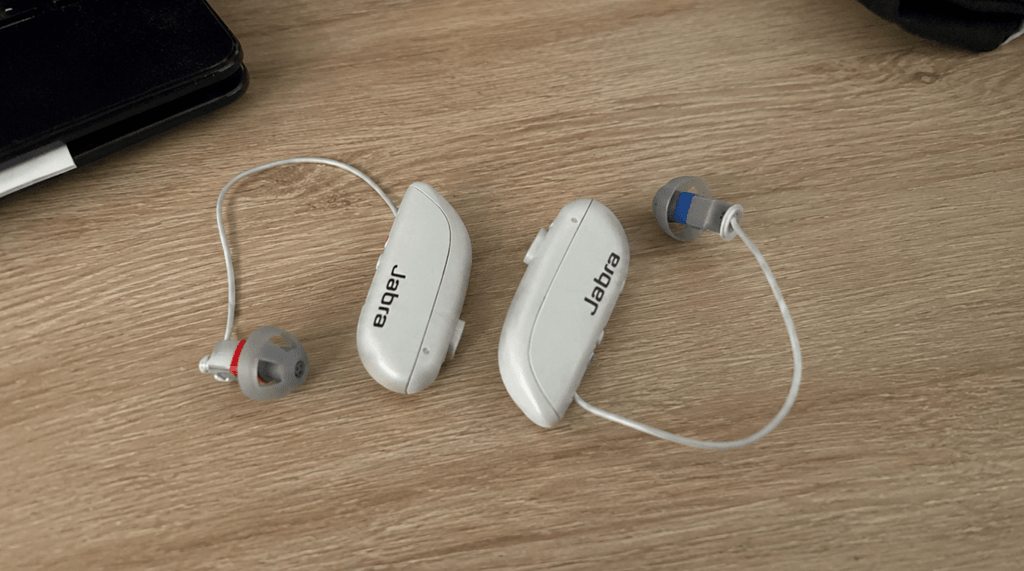
Jabra Enhance Select M3 is a premium option that packs advanced hearing technology in one of the smallest RIE hearing aid designs. Its proprietary SoundScape™ technology was created to improve speech clarity, automatically adjusting noise and volume levels depending on the environment you’re in.
Since it’s a self-fitting hearing aid, the setup is handled through the app. To complete it, you take a hearing test, which the licensed audiology team uses to program settings tailored for you.
The app also allows you to adjust settings yourself if you ever need to change volume or noise filters. You’ll have professional support for three years at no additional cost, so if you ever need guidance, it’s conveniently available without an office visit.
Our tests found its Bluetooth function to be solid, with seamless pairing with both iPhone and Android. This lets you stream music, podcasts, and phone calls directly through your hearing aids. A small yet impactful feature we liked was TapControl, which allows you to answer calls by double-tapping your device.
Plus, it’s Auracast-ready, which means you’ll be able to tune in to public-space broadcasts through your hearing aids when the public infrastructure is in place. Meanwhile, the Bluetooth LE Audio standard minimizes battery drain so the device can run 24 hours on a single charge.
Admittedly, it comes at a premium price point, but if you’re looking for a nearly invisible design packed with advanced sound features, it might be well worth considering.
- Nearly invisible design
- Hearing test
- 3 years of professional remote care
- Premium price point
Ceretone Core One Pro
Best for: Invisible wear
- Type: OTC
- Style: Invisible-in-the-Canal (IIC)
- Bluetooth: No
- Battery life: 20 hours
- App compatibility: No
- Price range: Budget range
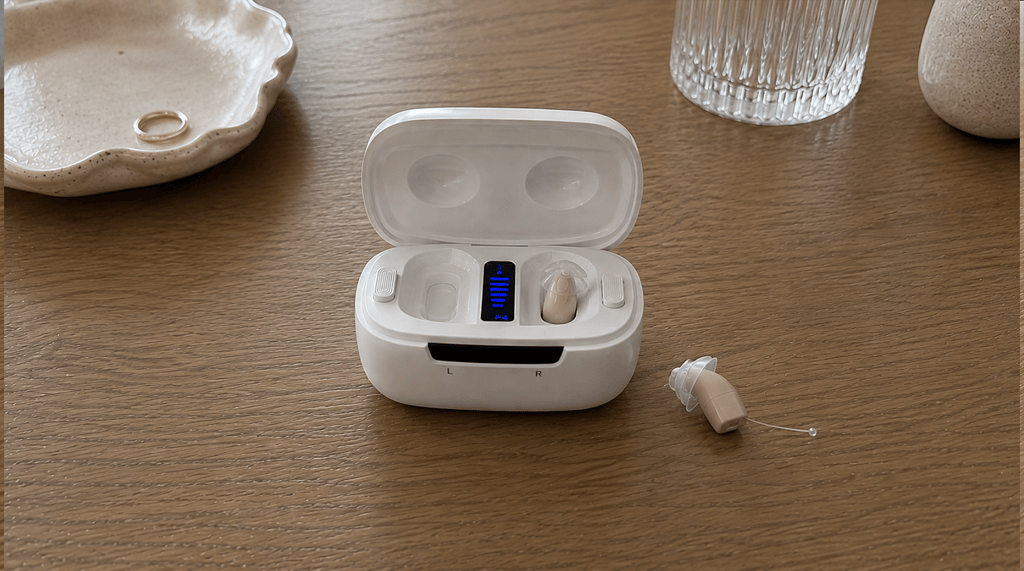
Ceretone Core One Pro instantly stands out on this list for its design. It uses an Invisible-in-Canal (IIC) design, meaning the device rests in your ear canal and remains virtually hidden. To ensure comfort and a good fit, Ceretone provides a variety of eartip sizes.
Its sound technology features voice detection, feedback cancellation, and noise reduction for clearer sound. It also includes wind noise reduction and tinnitus masking, which help improve sound quality outdoors and distract from phantom sounds in silent environments.
However, its main drawback is limited customization. You can only choose from 4 sound programs, which change when you tap your device. The rest of the controls, like volume, are located on the charging case. While this may be convenient for people who aren’t very tech-savvy, some may find the absence of app controls inconvenient.
Still, it boasts 20 hours of battery life and offers comfort with minimal visibility while falling in the budget price range.
- Hidden design
- Tinnitus masking
- Suitable for less tech-savvy users
- Lacks a hearing test and customization
Audien ION Pro 2 Hearing Aids
Best for: Users prioritizing simplicity
- Type: OTC
- Style: Receiver-In-Canal (RIC)
- Bluetooth: Yes
- Battery life: 48 hours
- App compatibility: Audien app for iOS and Android
- Price range: Mid-range
Designed with the help of audiologists and Grammy-winning sound engineers, Audien ION Pro 2 hearing aids promise to deliver sound that feels natural, not artificial. You can choose from six hearing modes created for different environments.
However, beyond choosing your sound profile and adjusting the volume, that is pretty much where its customization ends. While this makes for a quick setup, most people require more robust adjustment options.
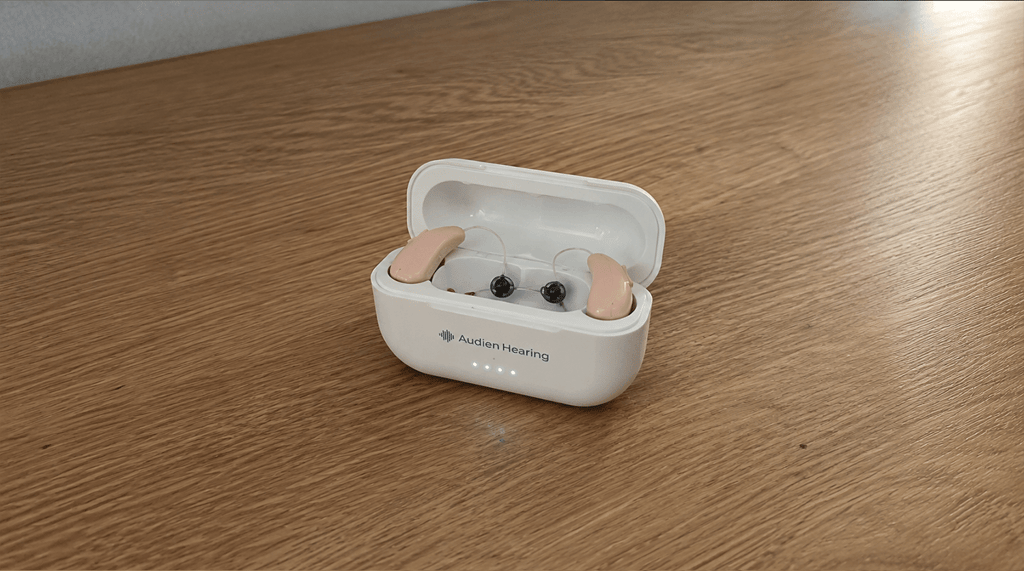
On the brighter side, it supports Bluetooth compatibility for both iOS and Android, which lets you stream calls, music, and TV directly to your earpiece. Plus, it has the longest battery life on this list—lasting up to four days between charges if you wear it 12 hours a day.
Interestingly, it also features a UV charging case, which is marketed to sanitize the hearing aids while they charge. Overall, it’s ergonomic and lightweight, but its biggest drawback remains the lack of personalized tuning and readily available audiology support.
Ultimately, this device is best suited for users seeking a simple solution with minimal customization.
- Natural sound
- UV charging case
- Long battery life
- No in-app hearing test
Linner Mercury mini-RIC OTC Hearing Aids
Best for: Less tech-savvy users
- Type: OTC
- Style: Receiver-In-Canal (RIC)
- Bluetooth: No
- Battery life: 20 hours
- App compatibility: No
- Price range: Budget range
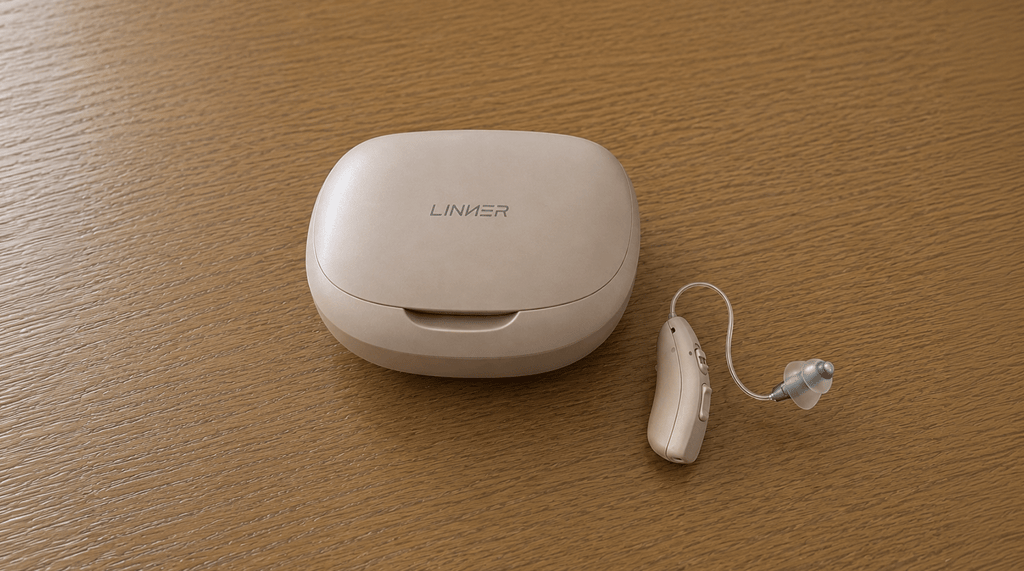
Linner Mercury mini-RIC OTC hearing aid is a competitively priced device for less tech-savvy users. It keeps operation simple by placing tactile buttons directly on the hearing aid.
However, our concern is that it can be difficult to use the controls on a device that is already so small. The physical buttons also mean the device offers limited customization, allowing you to choose from just three sound modes and nine volume levels.
Still, it provides essential amplification by harnessing 16-channel WDRC technology for precise sound processing. We especially liked the noise cancellation feature, which can be a lifesaver in busy environments.
The battery lasts 20 hours on a single charge, and if you’re in a rush, a 10-minute charge provides two hours of run time. Overall, we found this device to be ergonomic, though it is best suited for people who prefer simplicity over advanced customization.
- Budget-friendly
- Simple controls
- Solid sound quality
- Limited customization
What are hearing aids?
Hearing aids are small electronic devices worn in or behind the ear that amplify certain sounds so people with hearing loss can hear more clearly.
They are made out of three main components: a microphone, amplifier, and speaker. The microphone picks up sound, allowing the hearing aid to convert it into electric signals. Then they are sent to the amplifier, which boosts their power and transmits them to the ear via a speaker.
While this can make people hear better, hearing aids can’t “cure" hearing loss, as reversing damaged ear function is a complicated process.
OTC vs prescription hearing aids
Over-the-counter (OTC) hearing aids are available to consumers with mild or moderate hearing loss without the involvement of licensed health care professionals. As a rule, manufacturers must register them with the FDA before selling to ensure safety and effectiveness for consumers.
Since users set them up themselves—sometimes with remote audiology support—rather than attending in-office visits for custom fittings, OTC options are more affordable and accessible. Users benefit most from OTC hearing aids when they need accessible solutions for mild hearing support.
On the contrary, prescription hearing aids require a professional fitting and are meant to support any level of hearing loss. This makes their price much higher, but it covers in-person clinic visits, custom ear molds, precise adjustments, and more. Users benefit most from prescription hearing aids when dealing with complex or severe hearing loss that requires personalized, expert care.
Types of hearing aids
Experts categorize hearing aids into five main types:
- Receiver-in-canal (RIC). These hearing aids have a small case that fits behind the ear and connects to a small speaker inside the ear canal with a nearly invisible wire. They are among the more discreet styles that remain comfortable, sport solid battery life, and are suitable for mild to severe hearing loss.
- Behind-the-ear (BTE). Used to support all levels of hearing loss, it's the most noticeable yet powerful device. The larger case rests behind the ear, delivering sound to the ear canal through a thin tube. While it can feel bulky to some, this type of hearing aid is ergonomic and usually sports the longest battery life of any style because it can hold the largest batteries.
- In-the-ear (ITE). This type fills the entire outer bowl of the ear and is recommended for mild to severe hearing loss. They are often easier to handle due to their larger size and offer solid running time.
- Completely-in-canal (CIC). Recommended for mild to moderate hearing loss, it's a very hard-to-see style since the hearing aids rest inside the ear canal, leaving just a small, clear string you can pull to take them out. While they’re discreet, they can make your ear feel a bit plugged up, and the tiny size requires small batteries that need frequent charging.
- Invisible-in-canal (IIC). These hearing aids are completely hidden from the outside as they rest deeper inside the ear canal. They’re designed for mild to moderate hearing loss and, unfortunately, often cause wax buildup and are prone to frequent charging.
What should you look for when buying hearing aids?
Choosing a device to support hearing isn’t something you should take lightly. Consider these factors before committing to one:
- Degree of hearing loss. Knowing the degree of hearing loss (mild, moderate, severe, or profound) helps to find the exact type of hearing aid you need.
- OTC vs. prescription. OTC devices are available for mild to moderate loss, while custom and more expensive prescription aids are meant for severe or complex hearing loss.
- Rechargeable batteries. They eliminate the hassle of changing tiny disposable batteries. Just charge them overnight, and you’re good to go.
- Bluetooth connectivity. This function allows you to stream calls, music, and TV directly from your hearing aids, leveling up sound quality immensely.
- Directional microphones. They’re designed to focus on the sound coming in front of you, while reducing unnecessary noise from other directions. This allows listening to conversations better, even in busy environments.
- AI sound processing. This functionality can further clarify speech as it analyzes the environment to reduce unnecessary noise.
- Background noise reduction. This entails various other technologies that automatically suppress loud noise.
- Feedback cancellation. This prevents you from hearing high-pitched whistling that sometimes happens when amplified sound escapes from the speaker.
- Smartphone apps. They let you adjust volume and other settings directly from your phone.
- Water resistance. While you shouldn’t submerge hearing aids in water, water-resistant models can survive accidental splashes, rain, sweat, or humidity.
- Warranty. The longer the warranty period, the longer your investment is protected from high repair or replacement costs.
How much do hearing aids cost?
The price of hearing aids varies considerably, from about $100 to more than $2,000.
For people with mild to moderate hearing loss, OTC options offer a more accessible price, while prescription hearing aids suitable for all types of hearing loss typically start at a premium price. However, the latter includes comprehensive professional testing, custom programming, and follow-up care.
That said, even OTC options can carry high price points, as premium models drive the price due to advanced technology like AI processing and include ongoing, personalized care from an audiologist.
Admittedly, paying for hearing aids is challenging for many people since traditional Medicare generally does not cover hearing aids. Private health insurance plans might offer partial coverage, but they usually come with strict limitations. To help manage this expense, many clinics and manufacturers provide flexible financing options.
This situation is unfortunate, as everyone should be able to access the hearing support they need, which has a significant impact on communication and overall quality of life.
Are hearing aids worth it?
Yes, hearing aids are worth it for most people affected by hearing loss. These tiny devices make speech clearer, naturally leading to improved social participation. Because the brain no longer has to strain to understand speech, people also notice a huge drop in listening fatigue. All these improvements can create a much better overall quality of life.
That said, hearing aids might not work perfectly straight away or be the right fit for everyone. Your brain and ears need to get used to processing new sounds again, which can take some time and adjustments. But with some patience, wearing them can be worth it for many.
Other hearing aid reviews
Best Bluetooth hearing aids: Tested picks
Best OTC hearing aids: Our top picks for every budget and hearing need
Best online hearing aids: Our top picks for where and how to buy safely
Best hearing aids: FAQ
On our list, ELEHEAR Beyond Pro is the best hearing aid overall. It’s a well-rounded option packed with modern and unique features that you can still buy at a relatively accessible price, especially compared to prescription options.
Over-the-counter (OTC) hearing aids are accessible, self-adjusting devices designed for mild to moderate hearing loss. In contrast, prescription hearing aids are custom-fitted by specialists in a clinic and can treat any degree of hearing loss.
Older adults are often looking for hearing support solutions that aren't overly complicated. So our recommendation for them is Linner Mercury mini-RIC OTC hearing aid, which keep controls directly on the device for simple operation. Not to mention, it features an ergonomic design, modern sound technology, and comes at a budget-friendly price.
Rechargeable batteries can be a better choice for people who want to avoid changing tiny batteries and disposing of them. That said, disposable battery models may still suit certain lifestyles.
Yes, hearing aids can connect to phones. Just make sure that they include Bluetooth technology that allows them to do this.