
- Simple controls
- Budget-friendly
- Discreet design
- Less personalization
LINNER is an over-the-counter (OTC) hearing aid brand known for its discreet designs and low pricing. By focusing on affordability, LINNER makes OTC hearing aids that shoppers can buy online or in stores without a prescription even more accessible.
To see if the brand makes any trade-offs for affordability, I reviewed its currently available models—Mercury, a receiver-in-canal (RIC) style, and Saturn, a completely-in-canal style.
During the review process, I evaluated design and comfort, controls, ease of setup, battery longevity, and sound performance to help you decide whether the low price provides enough value.
LINNER hearing aids compared
| Feature | LINNER Saturn | LINNER Mercury |
| Style | CIC (completely-in-canal) | RIC (receiver-in-canal) |
| Price | $199.99 (before discount) | $299.99 (before discount) |
| Intended hearing loss | Mild to moderate | Mild to moderate |
| Battery life | 24 hours | 20 hours |
| Listening modes | 3 modes | 3 modes |
| Bluetooth | No | No |
| Controls | Manual | Manual |
| Best for | Budget-conscious users wanting a discreet design with longer battery life | Users needing stronger amplification and design that doesn’t plug their ear canal |
Does LINNER’s low price offer enough value?
LINNER sits at the budget end of the over-the-counter (OTC) hearing aid market, offering a relatively low price point.
LINNER Saturn normally retails for $399.99, though at the time of writing, it's available at a steep 68% discount. Mercury, on the other hand, is usually available for $299.99, with the price fluctuating based on active promotions. Both can be purchased using Health Savings Accounts (HSA) and Flexible Spending Accounts (FSA), helping you save even more on hearing healthcare.
Out of the box, each model comes with everything needed to get started: the hearing aids, a portable charging case, multiple eartip sizes (small, medium, large), a USB-C charging cable, wax guards, and a user manual. LINNER also includes free standard shipping, a 45-day risk-free trial, and a one-year limited warranty.
Unfortunately, the lower price point comes with some compromises. Neither model supports Bluetooth audio streaming or app controls. Sound customization is also limited, lacking deeper adjustments found on premium OTC options. Additionally, user support is restricted to basic customer service rather than having professional audiology guidance.
However, the brand isn't known for smart controls and features anyway. It positions itself as a quality baseline hearing aid at an affordable price, and I think it delivers the value you’d expect for the price.
What are LINNER hearing aids exactly?
LINNER started as an acoustics technology startup in 2016, offering active noise-canceling earbuds at a more affordable price. In 2022, the company shifted toward OTC hearing aids and released its first model the following year. That is why LINNER hearing aids feature a design similar to standard earbuds, prioritizing background noise reduction alongside amplification.
For those unfamiliar with over-the-counter (OTC) hearing aids, they are small electronic devices that make certain sounds louder. Adults with mild to moderate hearing loss can buy OTC hearing aids without an in-office visit. They officially hit the market in 2022 to make hearing support more accessible and affordable.
Although OTC options are easier to obtain, they are more limited in capability than their prescription counterparts. They are specifically designed for mild to moderate hearing loss, whereas prescription devices can be tuned for any level of hearing loss. Prescription hearing aids are significantly more expensive, but they provide more customization and ongoing professional care that OTC models lack.
LINNER’s approach to OTC hearing aids is to offer affordable, rechargeable, and relatively simple devices. While the company doesn’t include advanced smart features and controls, not everyone is looking for them—and that is exactly their target audience.
Closer look at LINNER Saturn
LINNER Saturn is a mini completely-in-canal (CIC) hearing aid that sits in the ear canal for less visibility. Being lightweight and small, they are barely felt when worn, just keep in mind that the fit really depends on the ear tips you choose. They are also conveniently color-coded—red for right, blue for left—so you avoid mixing them up.
Even though small, these hearing aids feature a 16-channel WDRC Onsemi chip and feedback shield technology. Together, these components split audio into 16 different pitches to boost the ones you struggle to hear while keeping loud background noises at a comfortable level. During our review, we concluded that it has performed well with feedback cancelling and in quiet spaces, but noisy environments appear to be more of a weakness.
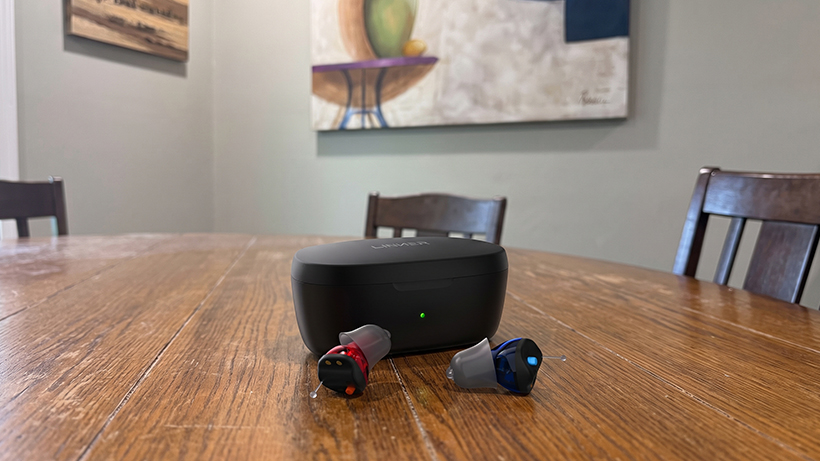
The customization is quite limited, including 9 volume levels and 3 listening modes (commute, indoor, outdoor). Indoor mode enhances speech in quieter environments, commute mode reduces background noise, and outdoor mode delivers natural sound in an open environment. They can be selected by long-pressing the button on the hearing aids. Meanwhile, the volume can be adjusted by short-pressing the same button. The change will be indicated with a beep.
While you can download the LINNER HA App, you won’t be able to control this particular device using it. It’s there so you can access customer support and guides. Bluetooth connectivity is also unavailable, which means you won’t be able to stream audio directly through your hearing aids.
Battery life is a solid 24 hours. It additionally supports fast charging, while the charging case provides three additional charges, bringing the total battery life to up to 96 hours. This means you can go about a week between charges. I also appreciated the charging indicator, which turns off when the hearing aids are fully charged.
Who is LINNER Saturn best for?
I’d recommend considering LINNER Saturn to people who prioritize discretion, simplicity, and a relatively affordable price. Its CIC design makes it particularly appealing if you want your hearing aids to be barely noticeable, while its straightforward controls provide enough customization for entry-level users. However, those who need more powerful or customizable devices may want to consider a more powerful model.
Closer look at LINNER Mercury
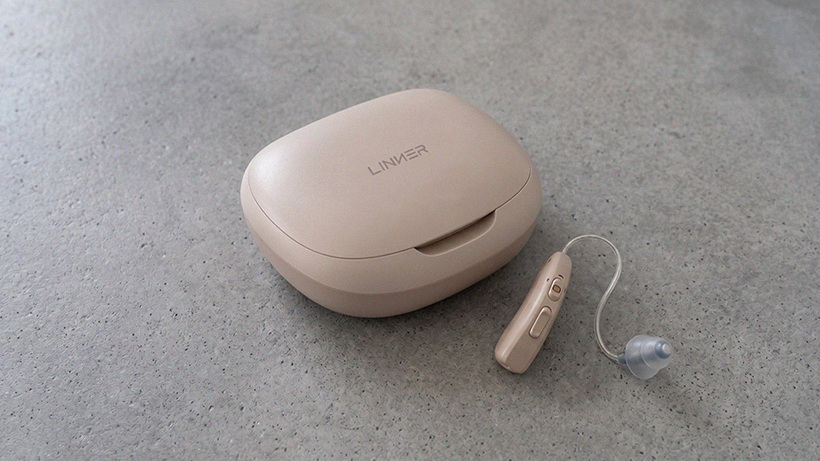
Mercury uses a more visible mini receiver-in-canal (RIC) style, with a body that rests behind the ear and a thin wire connecting it to the speaker. This type of hearing aid may be more comfortable for those who don’t feel comfortable plugging their ear canal.
While it’s less discreet, it stores more power. It offers up to 50dB of amplification compared to Saturn’s 35dB, making Mercury the better choice for people who need more hearing loss support.
Just like Saturn, Mercury features U.S. Onsemi™ chips, feedback technology, and uses 16-channel WDRC technology so speech is clearer in busier environments while minimizing whistling and squealing. Our review, however, showed that while its noise reduction may work well enough for some everyday situations, it shouldn’t be considered a standout feature.
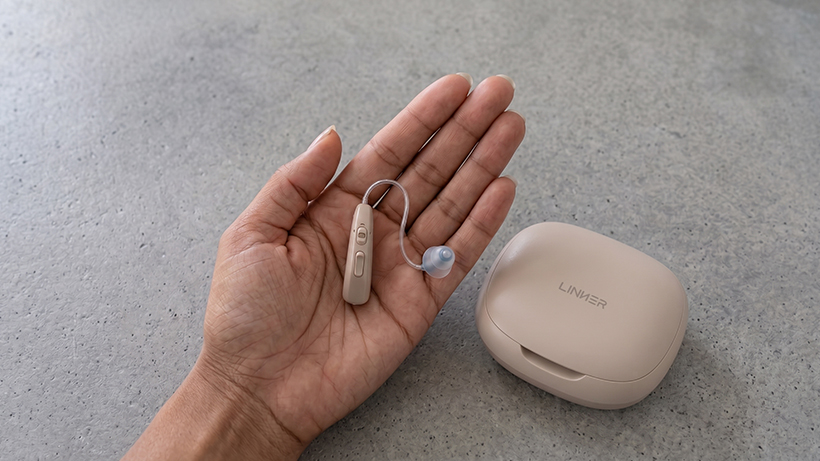
The customization is fairly limited with Mercury, as you only get three listening modes and nine volume levels. They can be adjusted via buttons on the device itself. However, the buttons can be tricky to operate because the hearing aid is so small. The manual controls hint at the fact that the device lacks an app or Bluetooth compatibility. This can be both good and bad news depending on your preferences.
Its battery life is solid, providing up to 20 hours of use on a single charge, while a 10-minute quick charge can provide around two hours of use.
Who is LINNER Mercury best for?
I’d recommend considering LINNER Mercury for people who prefer receiver-in-canal (RIC) design over in-the-canal (ITC) styles and manual, straightforward controls. It’s a good fit if you’d rather keep things simple, but not suitable for those looking for extensive customization or Bluetooth streaming.
LINNER Saturn vs Mercury: Which should you choose?
One isn’t particularly better than the other. The choice depends on what is most important to you. Both are relatively affordable models that feature the same technology, nine volume levels, three basic listening modes, and rely on simple manual controls rather than featuring Bluetooth or app connectivity. Their main differences lie in their design and power. So:
Choose Saturn if discretion matters most, and you don’t need particularly powerful amplification. Thanks to its completely-in-canal (CIC) design, it’s barely visible when worn. Its style and 96-hour battery life make it a good companion for active, on-the-go lifestyles. Admittedly, the device is less powerful than Mercury, but it should be enough for entry-level users and mild hearing loss.
Choose Mercury if you prefer a more traditional receiver-in-canal (RIC) style and need higher amplification. The majority of this device rests behind the ear, which may feel more comfortable for users who dislike having plugged ear canals. It also delivers stronger power for those needing moderate hearing support.
LINNER hearing aids vs. alternatives
LINNER Saturn and Mercury seem to strike a middle ground between highly affordable OTC hearing aids and premium-priced models. Paying less than LINNER products means less customization, while paying more typically provides greater customization, more advanced technology, and professional support. To put this into perspective, here’s how LINNER compares with both budget and premium alternatives:
| Feature | LINNER | Audien | ELEHEAR | Jabra |
| Starting price | $99–$400 | $98–$700 | $370–$631 | $1,195–$1,995 |
| Styles available | CIC, RIC | ITE, RIC | RIC, ITC | RIC |
| Customization | Volume and preset sound profiles | Volume and preset sound profiles | Audiologist tuning, volume, listening mode, noise control, and directionality | Audiologist tuning, volume, and noise filters |
| App | No | Yes | Yes | Yes |
| Bluetooth | No | Yes | Yes | Yes |
| Battery | Around 24 hours | Around 48 hours | Around 20 hours | Around 24 hours |
| Trial & warranty | 45-day trial / 1-year warranty | 45-day trial / 1-year warranty | 45-day trial / 1-year warranty | 100-day trial / 3-year warranty |
| Best suited for | Budget-conscious buyers needing simple controls | Entry-level users | Mid-range budgets looking for advanced features | Users seeking premium customization and features |
Who should consider LINNER hearing aids?
If you are an adult on a budget dealing with mild to moderate hearing loss and looking for simple controls, LINNER hearing aids might be a good fit. They cost less than most OTC models, making them a suitable choice for those on a budget. Since they are ready to wear, first-time users often find them easy to use too. People wanting a discreet device with simple controls might also appreciate their small size and baseline manual adjustments.
However, while these over-the-counter hearing aids may be a good starting point, they aren't for everyone. It is generally best to consult a professional if you have a more complex or severe case of hearing loss.
Other health tech and wellness reviews:
Best Bluetooth hearing aids: Tested picks
Best OTC hearing aids: Our top picks for every budget and hearing need
Best online hearing aids: Our top picks for where and how to buy safely
Final verdict: Are LINNER hearing aids worth it?
LINNER hearing aids offer an affordable, simple-to-use solution with discreet designs for mild to moderate hearing loss. This makes them best suited for someone looking for a straightforward, budget-friendly device, as they do have some sound performance limitations and lack advanced personalization and connectivity.
Mercury is a practical choice if you need stronger amplification and prefer a traditional fit and uncomplicated controls. If an almost invisible design is your top priority, Saturn might be a better option. Ultimately, if you’re seeking advanced sound quality, audio streaming, enhanced customization, or experience severe hearing loss, you would likely be better off looking elsewhere for a more advanced option.
FAQ
Yes, LINNER hearing aids are legitimate, FDA-registered over-the-counter (OTC) hearing aids designed for adults with perceived mild-to-moderate hearing loss. Just note that while OTC hearing aids make hearing support more accessible, they’re more limited than their prescription counterparts.
LINNER hearing aids are FDA-registered, meaning the brand has provided reasonable evidence of their safety and effectiveness to the FDA to sell their products to consumers. While the products aren’t tested or verified by the FDA, they are considered safe to use.
LINNER hearing aids are best suited for adults with mild to moderate hearing loss who are looking for a relatively affordable OTC option that is easy to use.
The main difference between LINNER Saturn and Mercury lies in their design style. The Saturn is a discreet, completely-in-canal (CIC) earbud-style device, while the Mercury is a slightly more visible receiver-in-canal (RIC) model. Additionally, Mercury is the more powerful of the two, designed for users who require stronger amplification.
No, LINNER hearing aids don’t have Bluetooth technology, so if you want to stream audio directly through your hearing aids, this isn’t a suitable option for you.