- Relatively inexpensive
- 16 channels and 4 programs
- Easy physical button controls
- Strict return policy
- Warranty protection costs extra
- Advertised battery life may differ from real-world use
This time I got to test an over-the-counter (OTC) hearing aid from Oricle Hearing. Just one important disclaimer first: I don’t currently have hearing loss, so my experience with Oricle Pro can’t tell you how well it may compensate for mild or moderate hearing difficulties.
However, in my Oricle hearing aids review, I take a closer look at the device itself, including its design, features, controls, sound quality, battery life, and overall usability. If you’re considering an affordable OTC hearing aid, I’d suggest taking time to understand Oricle Pro before deciding whether it’s the right fit for you.
| Product | Oricle Pro |
| Price | $199.99 |
| Type | OTC air-conduction hearing aid |
| Style | In-ear design |
| Advertised battery life | Up to 48 hours |
| Charging time | Around 2 hours |
| Programs | 4 |
| Noise reduction | Yes ✅ |
| Return period | 30 days |
| Verdict | Best for buyers looking for simple, affordable OTC hearing aid |
What are Oricle hearing aids?
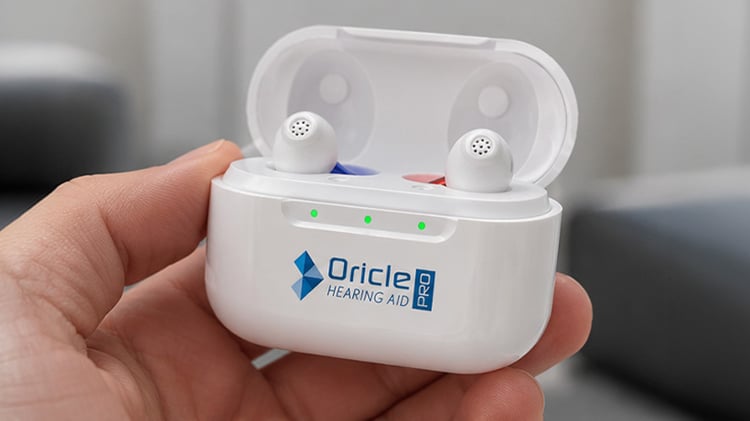
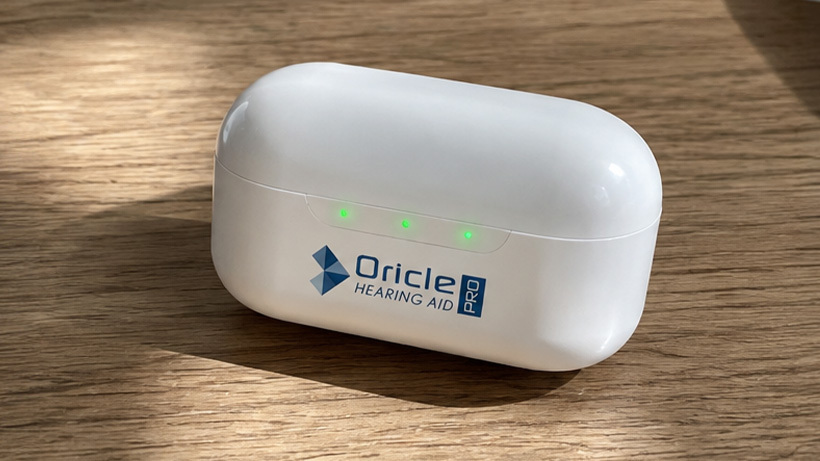
US-based Oricle Hearing currently sells a small lineup of OTC hearing aids, including Oricle 2.0, Oricle Pro, and Oricle TrueFit. In this review, I’m focusing on Oricle Pro, which is the brand’s in-ear model and, in my view, the most interesting option if you want discreet amplification.
Is Oricle Pro a real hearing aid or just a sound amplifier? It is an OTC hearing aid—the FDA lists Oricle Hearing LLC in its device-registration database in the OTC category.
However, there’s an important distinction here: FDA registration is not the same as FDA clearance or approval. The FDA itself warns consumers not to interpret registration as evidence that it has reviewed a device.
So, is Oricle hearing aids a scam or legit?
I wouldn't call Oricle Pro a scam. It’s sold within the FDA’s OTC hearing-aid framework, and during my testing, the device worked as intended. There are also plenty of positive user reviews online, although experiences vary.
Oracle Pro is most relevant for the common mild-to-moderate hearing difficulties where speech, TV, or conversations have gradually become harder to hear. It may be particularly appealing if you want something small, rechargeable, and relatively affordable.
Yet, if your hearing loss is severe, or accompanied by pain, dizziness, or other unusual symptoms, you shouldn’t try to solve the problem with an OTC hearing aid alone. I strongly encourage you to seek guidance from a professional in those situations.
Oricle Pro uses a microphone to capture sound, digital processing to modify it, and a receiver to deliver the processed signal into your ear. Oricle lists 16 hearing channels, four listening programs, rechargeable case, and noise-reduction technology among its main features.
The 16-channel architecture sounds impressive, but I wouldn’t automatically assume that means Oricle Pro is highly personalized. In theory, multi-channel processing may allow different levels of amplification across the frequency range, providing more assistance where you need it and less where you don’t. Oricle describes the channels as customizable, but it’s still based on preset programs and can’t be as individualized as professionally fitted prescription hearing aids.
How much does Oricle Pro cost?
Currently, Oricle Pro is listed at $199.99 on the official brand website. That puts it toward the more affordable end of the OTC hearing-aid market.
I’d describe it as something of a middle ground—more advanced than the cheapest basic devices, but not as feature-rich as many premium OTC alternatives. Where things get a little more messy is the return and warranty policies.
Oricle Hearing gives you 30 days from delivery to request a refund, but there’s a $4.95 processing fee, and shipping costs are deducted from the refund. The device also needs to be undamaged and returned in its original packaging with the included accessories and paperwork. Returns have to be approved by Oricle, so the process isn’t as straightforward as just sending the hearing aid back.
The brand also offers an optional one-year protection plan. It covers manufacturing defects and certain internal component problems during normal use, while loss or water damage are handled with a discounted replacement.
Overall, I think Oricle Pro is reasonably priced, but I’d go into the purchase knowing that the advertised price isn’t necessarily the amount you’ll get back if you decide to return it.
Oricle Pro: My experience as a hearing person
As a person without hearing loss, my experience testing Oricle Pro is obviously quite different from that of someone with mild or moderate hearing difficulties. OTC hearing aids are meant to compensate for hearing loss, so I can’t tell you whether Oricle Pro provides the right amount of amplification in your particular situation.
What I can evaluate is how the device sounds to me, how noticeable environmental sounds become, what my own voice sounds like, and the everyday details that matter when you wear a hearing aid—comfort, ease of use, and battery life. For the question of whether it actually improves hearing, you should put more weight on feedback from people who use hearing aids because they need them.
Sound quality: Background noise and conversations
This was probably the most interesting part of my testing. In quieter environments, I found the sound clean and relatively natural. One-on-one conversation and watching TV (or short videos) were easy enough, although I had to experiment with the volume and different programs to find settings I preferred.
Oricle Pro has 16 channels and four programs, giving you more adjustment options than the brand’s basic Oricle 2.0. The brand also advertises digital noise reduction for busier environments, but, in my experience, background noise was still noticeable. I’d say the noise reduction is helpful but not perfect.
One thing I found more distracting was my own voice. It was an echo-like experience when speaking, so I soon started talking more quietly to make it less noticeable. This may be specific to my ears and the way the device fitted, so don’t assume everyone will have the same issue. Though, it’s worth noting.
Design: Why are earpieces different colors?
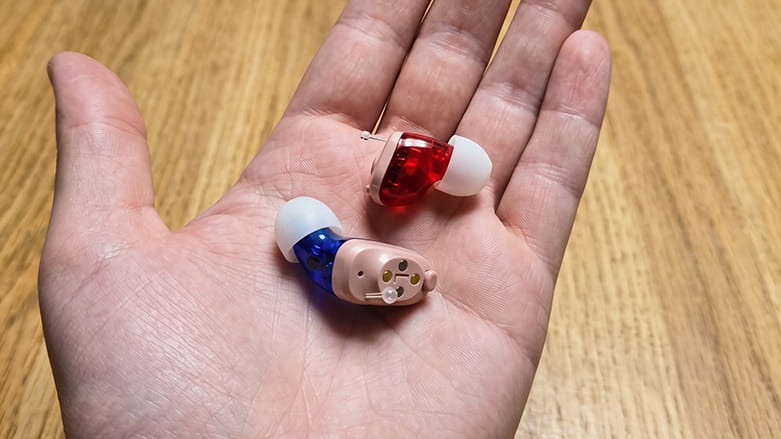
One small design detail that immediately caught my attention is the different colors on the two earpieces. Turns out, the red and blue markings are there to help distinguish which device goes in which ear—a simple feature, but actually useful for daily use.
Oricle Pro is a tiny in-ear hearing aid, so it’s pretty discreet when worn. The colored parts are hidden inside your earl, and it’s definitely difficult to tell when a person is wearing them.
Comfort, though, is more subjective. Ear canals vary considerably, and even with different dome options, the fit that works for one person may not work for another. If you’re sensitive to having something inside your ear, I’d pay particular attention to the fit.
Are the controls complex or beginner-friendly?
Whether physical buttons are easier than an app really depends on the person. I’m comfortable with apps and touchscreens, but I can also see why someone might prefer basic button controls.
Oricle Pro uses a multi-function button on each hearing aid. I found the controls somewhat confusing at first, and switching between functions took me longer than I expected. Once I understood the button combinations, though, they became fairly simple.
Here’s how I used the main controls:
- Turn on. Press and hold the button on the bottom of the hearing aid for around five seconds until it powers on.
- Adjust volume. A quick press increases the volume by one step. The device beeps three times when you reach the top of the range, after which the next press cycles back to the lowest setting. You adjust each hearing aid separately.
- Change programs. Press and hold the button for around two seconds. Oricle Pro has four programs, and the number of beeps indicate which program you’ve selected.
Testing the battery life
Oricle Hearing currently advertises up to 48 hours of battery life for Oricle Pro on its website. In my own test, with the hearing aids continuously turned on, I got around 16 hours on a single charge.
That’s a huge difference, but the mismatch may simply be due to a misunderstanding of how Oricle calculates its advertised battery life. While researching OTC hearing aids, I often came across battery-life figures that included additional power from a charging case rather than continuous use on a single charge. It’s similar to how many wireless earbuds are marketed: the case can provide multiple additional charges, even though the earbuds themselves last only several hours at a time.
I can’t confirm that this is how Oricle calculates its 48-hour figure, though, so I wouldn’t assume that’s what the company means. All I can say is that 16 hours was the result I got in my own testing, and that was still enough for a full day of use. Recharging took around two hours, so I could simply put the hearing aids back on charge overnight.
Oricle hearing aids vs. alternatives
If you’re not completely convinced that Oricle Pro is the right choice for you, comparing it with a few other popular OTC hearing aids can help you see what you get for the money. Here’s how Oricle Pro compares with several alternatives currently available:
| Product | Oricle Pro | ELEHEAR Beyond Pro | Jabra Enhance Select M3 | Ceretone Core One Pro | Audien ION Pro 2 |
| Best for | Budget-conscious buyers | Smart and AI features | Professional support | Discreet, no-app use | App control and extensive features |
| Price | $199.99 | $631 | $1995 | $299 | $551.20 |
| Style | In-ear | Behind-the-ear | Behind-the-ear | In-ear | Behind-the-ear |
| Advertised battery life | 48 hours | 20 hours per charge | 24 hours per charge | 20 hours per charge | 48 hours |
| Programs | 4 | No fixed programs | No fixed programs | 4 | 6 |
| Controls | Physical button | Physical buttons + app | App | Physical button | App |
| Refund period | 30 days | 45 days | 100 days | 100 days | 45 days |
| Warranty | 1 year (for a fee) | 1 year | 3 years | 1 year | 1 year |
| Official website | Visit Oricle Hearing | Visit ELEHEAR | Visit Jabra Enhance | Visit Ceretone | Visit Audien Hearing |
Read other OTC hearing aids reviews
Audiens hearing aids review: Which model is right for you?
Ceretone Core One Pro review: Are these tiny OTC hearing aids worth it?
ELEHEAR Beyond Pro review: The best mid-priced OTC hearing aid?
Jabra hearing aids review: Which Enhance Select model is best?
My final verdict on Oricle hearing aids
Overall, I think Oricle Pro is a decent OTC hearing aid, even though I wouldn’t call it particularly impressive. If you have mild-to-moderate hearing loss, prefer physical controls, and like the idea of a small in-ear design, it’s certainly worth considering.
Features such as noise reduction and 16 channels sound promising. In my testing, they worked fine, but I didn’t find them especially remarkable compared with what’s available from other OTC hearing aids.
For me, Oricle Pro makes the most sense as a basic, budget-friendly option rather than feature-packed device. You may want to compare it with a few alternatives before buying and make sure you’re comfortable with the return terms, yet it still can be a practical choice.
FAQs
Oricle hearing aids are FDA registered, but that doesn’t mean they’re FDA approved or cleared. FDA registration simply means the company and device are listed with the agency. It hasn’t been reviewed for effectiveness.
They may suit some adults with mild-to-moderate hearing loss. Oricle Pro may be worth considering if you want an affordable, discreet hearing aid with simple controls.
Yes, to some extent. Oricle Pro includes noise-reduction processing, but you shouldn’t expect it to eliminate background noise completely, particularly in busy environments.
Prices vary by model. Oricle currently offers three OTC hearing aids, with listed prices generally ranging from around $150 to $290, although promotions can change the final price.